Articles
Rasayana: the Ayurvedic system of rejuvenation, restoration, and longevity
What rasayana is, how it is described in classical Ayurvedic texts, which methods and herbs are used, and what modern science knows about them.
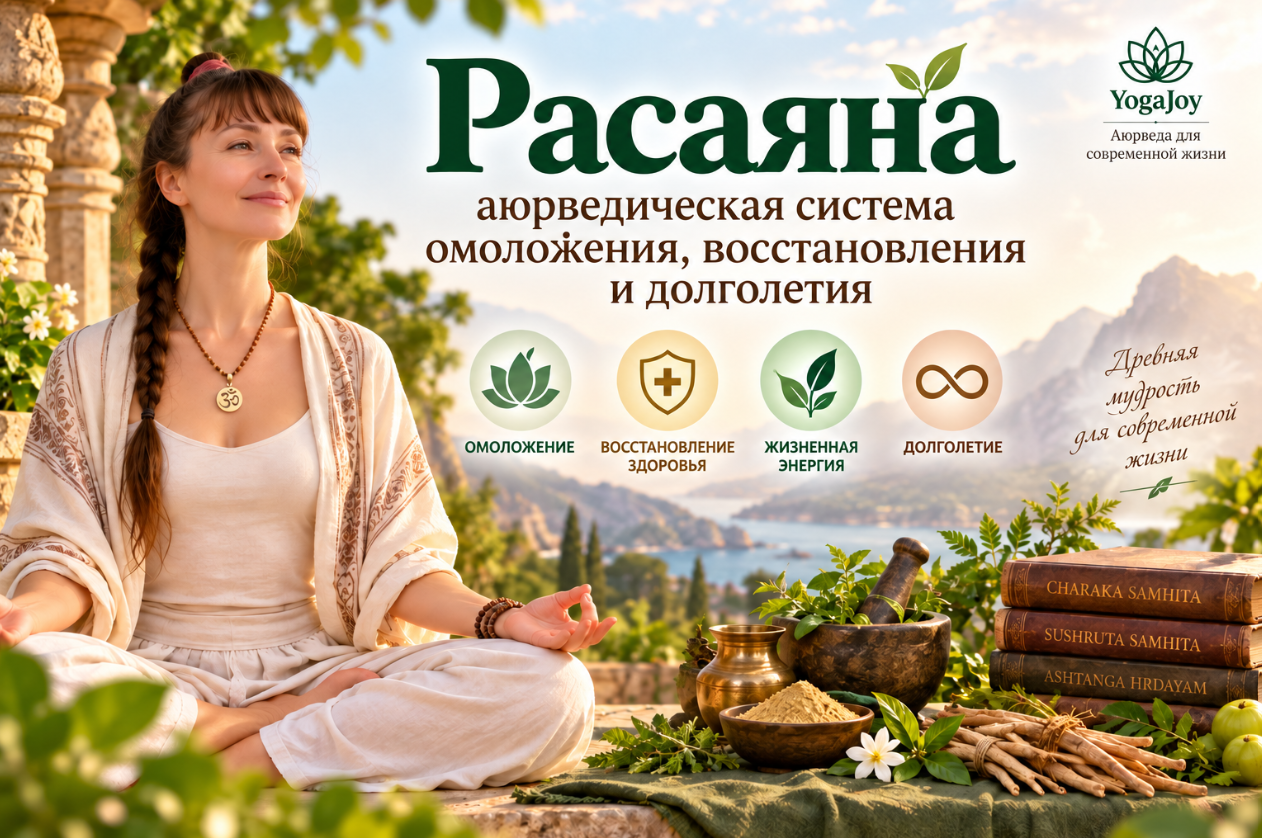
Rasayana: the Ayurvedic system of rejuvenation, restoration, and longevity
Briefly ABOUT THE ESSENTIAL
Rasayana is one of the classical branches of Ayurveda, focused not so much on treating a specific disease as on preserving vital energy, maintaining bodily functions, recovering from exhaustion and illness, and achieving the longest possible full life.
In Sanskrit medical literature, rasāyana is among the eight traditional branches of medicine. Its goals are longevity, preservation of youth, physical strength, memory, intellect, and resilience of the body.
But rasayana is not a single herb or an ancient equivalent of a modern "anti-aging" pill. Classical texts describe a whole system: diet, medicinal plants and complex formulations, daily routine, sleep, behavior, mental state, cleansing procedures, special restorative courses, and even prolonged stays in specially prepared environments.
Some ideas of rasayana sound surprisingly modern today: not waiting for illness but maintaining health in advance; considering diet, exercise, sleep, and mental state simultaneously as a whole; viewing aging as a process affecting the entire body, not just one organ.
This does not mean that modern biomedicine has "proven" rasayana. It has studied only individual plants, preparations, and a small number of complex programs. A 2026 systematic review found only eight clinical studies of rasayana in elderly people, which varied significantly in methods and quality. The results were promising, but the authors explicitly concluded that larger, high-quality studies are needed.
At the same time, some plants of classical rasayana—amalaki, ashwagandha, brahmi, shatavari, boswellia, and others—already have their own clinical research base. It varies in strength but is interesting enough to consider rasayana not as historical exoticism but as a tradition worthy of serious study.
And perhaps the most interesting aspect of rasayana lies precisely here: Indian physicians long before the advent of modern gerontology raised the question not only of how to treat disease but also how to maintain the full functionality of the Body-Mind-Energy system of a person for as long as possible.
Rasayana is much more than "Ayurvedic herbs for aging."
The word rasāyana is usually explained through rasa and ayana. In Ayurvedic physiology, rasa dhatu is the first of the sequentially forming tissues of the body, associated with the nourishment of subsequent tissues; ayana it conveys the idea of movement, a path, a passage.
Hence the traditional logic: if the nourishment and subsequent transformation of tissues occur fully, the body gains the ability to maintain strength and resilience.
However, reducing the meaning of the word to the literal formula "path of rasa" would be too simplistic. In classical medical literature, rasāyana becomes the name of an entire field of knowledge and at the same time can denote the method itself, the regimen of its application, an individual medicinal agent, or a complex formula. The historian of Indian medicine Dagmar Wujastyk describes this multilayered meaning of the term exactly this way.
In Charaka Samhita — one of the main classical Ayurvedic treatises, traditionally associated with the name Charaka, one of the central authorities of ancient Indian internal medicine,— the section on rasayana opens Chikitsa Sthana, the part of the treatise devoted to therapy. Traditionally, rasayana is attributed effects such as: prolonged life, good memory, intellect, health, youth, bodily strength and sensory organs, quality of voice and appearance.
In Sushruta—the legendary physician and surgeon of the ancient Indian medical tradition, whose name is associated with Sushruta Samhita, one of the most important classical Ayurvedic treatises and especially developed surgical school—entire separate chapters are also devoted to remedies and regimens that should counteract disease and age-related weakening.
Later, Vagbhata—the outstanding Ayurvedic physician and systematizer of classical medical knowledge, whose name is associated with the treatises Ashtanga Hridaya and Ashtanga Sangraha, defines and preserves rasayana as an independent branch of the Ayurvedic system.
Therefore, the translation "rejuvenation" conveys only part of the meaning.
It would be more accurate to speak about a system for maintaining the ideal original functionality of the body, vitality, and healthy longevity.
How ancient is rasayana?
Here it is especially important not to replace history with a neat number.
In popular literature, Ayurveda and rasayana are often attributed an age of five thousand years or more. The antiquity of the Indian medical tradition is undeniable, but the surviving texts were formed in layers, edited, and supplemented at different times. Therefore, academic history does not allow us to assign a single exact date of origin to rasayana.
The oldest layer of Indian culture indeed contains ideas about strengthening life, extraordinary power, and overcoming human limitations. Particularly interesting here is the image of Soma in the Vedic tradition—a drink and a plant associated with power, gods, and immortality.
But to say that “in the Rigveda the classical Ayurvedic rasayana is already described” would be historically too simplistic.
Rather, we see a more ancient Indian cultural foundation where ideas of longevity, strength, and bodily transformation existed long before rasayana acquired a systematic medical form.
In early classical Ayurvedic literature, this idea becomes much more concrete. Already Charaka Samhita contains an extensive section on Rasayana Chikitsa, and Sushruta Samhita has its own chapters on restorative and rejuvenating remedies. Modern historians consider both texts multilayered: they cannot be honestly dated to a single specific year or author. In particular, recent research emphasizes that the commonly cited popular literature dating of all surviving Sushruta Samhita to the 6th century BCE does not correspond to the current state of historical science.
By the 4th–5th centuries CE, the word rasāyana appears beyond strictly medical literature. In Pātañjalayogaśāstra according to Philipp Maas’s analysis, it denotes an elixir of longevity prepared from herbs. Interestingly, later commentators interpreted this passage differently: some linked it to Ayurveda, others to alchemy.
This is an important detail: the meaning of rasayana changed along with Indian intellectual culture.
Medical rasayana and alchemical rasayana are not exactly the same.
In older literature, these lines are often mixed.
Classical medical rasayana primarily concerns the human being: their health, age-related weakening, tissue nourishment, memory, strength, and vitality.
Later, the term developed significantly in the Indian alchemical tradition — rasaśāstra. There, mercury, minerals, metals, complex purification and transformation processes of substances gained great importance, and the ultimate goal of some branches became not just health but radical bodily transformation, extraordinary longevity, and spiritual achievements.
Dagmar Vuyastik shows that medical and alchemical rasayana indeed interacted, but they cannot be fully equated.
Later, knowledge of rasayana spread beyond Sanskrit culture. Historian Fabrizio Speciale traced how, starting from the Middle Ages, materials on rasāyana and rasaśāstra were translated into Persian and included in South Asian medical works, where Indian ideas met the Greco-Arab medical tradition. Moreover, there was no exact equivalent for rasayana in Persian medical classification—it had to be assimilated as a distinct Indian discipline.
This is no longer a legend of “secret knowledge.” It is a traceable history of the movement of medical ideas between cultures.
What exactly did classical rasayana promise to a person?
If we remove the later promotional language, the list of goals remains quite ambitious.
Rasayana was meant to help a person maintain health and vitality, resist age-related weakening, support memory and intellect, physical strength and sensory organs, appearance, and the ability to recover.
Some texts go much further and promise practically fantastic results. But to understand the system as a whole, what matters more than the literal maximal promises is the very object of attention.
Rasayana is not concerned with a single disease. It is concerned with the quality of a person’s functioning as a whole, literally entirely as a Body-Mind-Energy system.
This is fundamental.
A typical therapeutic task starts with a problem: the stomach is ill—we treat the stomach; an infection arises—we fight the infection; a joint is damaged—we work with the joint.
The logic of rasayana is different:
what can be done with a person before their bodily resources have significantly diminished?
And what can be done after illness or a difficult period so that recovery does not end simply with the disappearance of acute symptoms?
That is why in the classical tradition rasayana has a pronounced preventive significance. An old article by Professor Subhash Ranade very accurately preserved this aspect: maintaining health, preventing age-related weakening, and recovery after illness were more important to it than the idea of a “cure-all.”
Ojas: why it should not simply be translated as “immunity”
In modern popular Ayurveda ojas — ojas Very often it is automatically translated as "immunity."
This makes it clearer, but much of the original meaning is lost.
Ojas is a traditional Ayurvedic concept of the body's vital resilience, associated with tissue integrity, strength, the ability to withstand adverse influences, and the overall state of a person.
The immune system in modern physiology is a much more specific concept: cells, antibodies, cytokines, organs, signaling mechanisms.
Therefore, the statement "rasayana increases Ojas" refers to the Ayurvedic model.
The statement "a specific remedy changes a certain immunological marker" is already a testable biomedical question.
These languages should not be mixed.
On the contrary, rasayana becomes more interesting when we allow it to remain itself, rather than trying at all costs to replace every Sanskrit word with a modern laboratory abbreviation.
Why we age: today the answer is much more complex than it was twenty years ago.
Articles from twenty years ago about rasayana explained aging through free radicals, advanced glycation end products, telomeres, and the Hayflick limit.
For their time, these were popular scientific models. Now the picture has become significantly more complex.
Modern biology of aging does not reduce the process to free radicals, nor to a single 'aging gene,' nor even solely to telomere shortening.
In an influential update of the concept Hallmarks of Aging In 2023, researchers have already identified Twelve interconnected hallmarks of agingincluding genomic instability, telomere shortening, epigenetic alterations, loss of proteostasis, impaired autophagy, altered nutrient sensing, mitochondrial dysfunction, cellular senescence, stem cell exhaustion, altered intercellular communication, chronic inflammation, and dysbiosis.
This is a completely different picture.
Aging turns out not to be a single broken part, but a gradual disruption of the coordinated work of many systems.
And here arises an interesting — though not conclusive — resonance with Rasayana.
Ayurveda has also never tried to reduce the preservation of youthfulness to a single substance.
It worked simultaneously with food, digestion, tissues, routine, sleep, physical activity, mental state, behavior, and medicinal plants.
This does not yet mean that the ancient theory predicted twelve signs of aging.
But it shows that the question itself was posed broadly.
Rasayana does not start with herbs.
This is perhaps one of the most important points of the entire system.
If we imagine Rasayana simply as a set of jars with Ashwagandha, Amalaki, and Brahmi, we lose a significant part of the classical idea.
In the Ayurvedic tradition, there are different ways to classify Rasayana.
Dravya Rasayana It uses substances: plants, food, and complex formulations.
Adravya Rasayana It is built not around the substance itself, but around the regimen, behavior, and working with the person's state.
There is Sharira Rasayana, oriented towards the body, and Manas Rasayana, connected with the mind.
Kamya Rasayana It is aimed at the desired qualities of health and vitality; within it, the tradition distinguishes, for example, the aspiration to maintain lifespan or cognitive abilities.
Naimittika Rasayana It is used in connection with a specific condition or after illness.
Ajasrika Rasayana It relates to regularly consumed nutritious foods and everyday maintenance of the body.
There are also Vardhamana Rasayana — a special scheme in which the amount of a certain remedy is gradually changed. This part of the tradition is especially important in the history of Pippali Rasayana, to which we will return.
But perhaps the most unexpected variety for the modern reader is another kind.
Achara Rasayana: rejuvenation through lifestyle and behavior
Achara Rasayana is the rasayana of behavior.
This is one of those fragments of Ayurveda that significantly changes the perception of it as just "herbal treatment."
The classical tradition links maintaining health not only to what a person eats or takes, but also to how they live..
The lists of Achara Rasayana include calmness, absence of constant aggression, moderation, patience, cleanliness, a reasonable attitude towards sexuality and alcohol, respectful treatment of others, a balance between rest and work, spiritual discipline, and control over excessive desires.
For an ancient text, the ethical, mental, and physical aspects of health are not separated as rigidly as we tend to do today.
One can argue with certain moral prescriptions of ancient Indian society.
But the core idea remains strong:
it is impossible to seriously talk about restoring the body while simultaneously ignoring how a person sleeps, eats, moves, experiences stress, and manages their mind.
It is precisely here that Rasayana closely aligns with the comprehensive logic on which YogaJoy practices are built: movement, breathing, relaxation, and attention work are viewed not as competing methods but as different ways to influence a person’s state.
We explore this connection in more detail in YogaJoy materials. "Yoga, Breath, and Meditation: Why the Combination Is More Effective" and "Why Relaxation Is One of the Keys to Youthfulness?".
Medhya Rasayana: a special rasayana for the mind.
Rasayana has another interesting branch— Medhya Rasayana.
Medha related to intellect, memory, and the ability to assimilate and retain knowledge. Therefore, classical texts mention plants intended not just to support the body but to work with cognitive functions.
Among them, one is especially well-known: Brahmi — Bacopa monnieri.
Here we have a rare case where ancient use and modern research focus truly coincide quite well.
A meta-analysis of nine randomized studies on Bacopa monnieri included 518 participants and found signals of improvement in some cognitive indicators, especially attention speed. The authors, however, did not declare the matter settled and emphasized the need for larger, well-designed studies.
So, we cannot yet say: "Brahmi has been proven to rejuvenate the brain."
But we can say something much more meaningful:
the plant that Ayurveda has classified for centuries as a remedy for medha—memory and intellect—has indeed become the subject of randomized studies specifically on cognitive functions.
This is already a noteworthy intersection.
Kutipraveshika Rasayana: an ancient restorative retreat.
The most unusual form of rasayana is Kutipraveshika.
Kuti a specially arranged space. Classical descriptions suggest a protected area with several inner chambers, minimizing contact with sun, wind, dust, and external irritants.
A person is prepared in advance, then lives in this space under a strictly established regimen, receives doctor-selected remedies, follows a specific diet, rests, may engage in light exercises, yoga, and meditation, and then gradually returns to the usual external environment.
Sushruta and Vagbhata describe variants of rasayana after preliminary cleansing; in Ashtanga Hridaya there are distinctions, in particular a more intensive Kutipraveshika and a more accessible Vatatapikathat a person can undergo without complete isolation from ordinary life.
The classical promises of Kutipraveshika results are grand—up to the restoration of youth and extraordinary enhancement of abilities.
Such claims cannot be automatically transferred to modern physiology.
But the method’s structure itself deserves attention.
A person is temporarily removed from their usual environment, the number of stimuli is sharply reduced, sleep and diet are regulated, alcohol and other harmful factors are excluded, the regimen is controlled, time is given for recovery, and the process is placed under medical supervision.
Rasayana tries to change not only what a person takes in. It temporarily changes the entire environment in which their body lives.
That is why reducing it to "Ayurvedic dietary supplements" is especially unfair.
Kayakalpa: where medicine ends and the dream of body transformation begins.
Kutipraveshika is closely associated with the concept of Kayakalpa —transformation or renewal of the body.
In the later tradition, many stories arose around Kayakalpa about almost complete restoration of youth.
Here it is necessary to distinguish several layers.
There are real historical restorative regimens.
There are medical formulas.
There are yogic and ascetic practices.
There are also promises of radical body transformation that belong to a different intellectual and religious environment and cannot be considered an established medical outcome.
The history of rasayana constantly walks this boundary.
On one hand — prevention, nutrition, plants, regimen.
On the other — an ancient human dream not just to age more slowly, but to conquer aging itself..
This dream is not unique to India.
But it is the Indian tradition that turned it into an exceptionally branched medical and philosophical system.
Chyawanprash: one formula that has lived through almost two thousand years of written history.
Probably the most famous rasayana preparation today is Chyawanprash..
Its name is connected with the legend of the sage Chyavana, whom the Ashvins — divine healers of the Indian tradition — helped to restore youth and strength.
The legend remains a legend.
But the formula itself has a very solid written history: researcher Maarten Bode notes that cyavanaprāśa is already present in Charaka Samhitathe textual tradition of the early centuries CE. At the same time, the composition, use, and even the cultural significance of the preparation have changed over the centuries.
The central herbal component of the modern formula usually becomes Amalaki — amalaki, Indian gooseberry..
Clinical data on Chyawanprash itself are still significantly weaker than its reputation. A review in Journal of Ethnopharmacology found several studies whose authors directly called for larger, high-quality randomized trials.
This is a good example of the fact that
a long tradition of use has enormous significance. And today it needs good, deep, and high-quality research to be more widely applied for the benefit of humanity.
And the reverse is also true and important:
the absence of large modern RCTs does not turn a centuries-old medical tradition into a nonexistent one.
These are simply two different approaches, two different cultural and mental codes that need to be learned to apply together, not replacing one with the other, but complementing and strengthening in synergy the effects and power of one with the results of the other.
Amalaki: one of the central plants of rasayana
Amalaki — Phyllanthus emblica / Emblica officinalis holds a special place in rasayana.
It is included in classic rejuvenating formulas and is the basis of Chyawanprash. In the Ayurvedic tradition, amalaki is associated with tissue support, digestion, overall resilience of the body, and longevity.
Today it is one of those rasayana plants for which there is already a human research base.
A 2023 systematic review and meta-analysis included nine randomized trials with 535 participants. In the combined analysis, administration of Emblica officinalis was accompanied by changes in LDL cholesterol, triglycerides, VLDL, and hsCRP. But the studies were heterogeneous, and the authors themselves emphasize the need for cautious interpretation of the results.
This is not yet complete scientific proof of the “rejuvenating effect of amalaki.”
But it is no longer just pharmacology in a test tube.
The plant has entered clinical trials in humans, with indicators truly related to metabolic and cardiovascular health.
Ashwagandha: perhaps the most famous rasayana plant today
Ashwagandha — Withania somnifera has become one of the most popular Ayurvedic plants outside India.
In rasayana, it is traditionally associated with strength, recovery, muscle tissue, resistance to stress, and nervous system condition.
Modern interest has focused primarily on stress and anxiety.
A 2022 meta-analysis combined 12 randomized trials with 1002 participants and found reductions in stress and anxiety measures compared to placebo. However, study heterogeneity was high, and the authors rated the confidence in the evidence as low.
The studies provide a promising signal. Now higher-quality research and more extensive data are needed.
Therefore, “natural” in rasayana should not become synonymous with “can be taken without control.”
Pippali: a plant especially important to preserve in the history of rasayana
Pippali — Piper longum, long pepper requires a separate discussion.
And not only because it holds a prominent place in classical rasayana.
In the traditional system, Pippali is associated with several srotas — functional channels of the body. Especially important is Pranavaha Srotas, related to breathing and vital air.
There is also a special Vardhamana Pippali Rasayana — a scheme of gradual changes in the amount of Pippali.
Classical and later Ayurvedic texts used it for chronic respiratory disorders, coughs, and conditions that in modern terminology were attempted to be matched with bronchitis and asthma.
But here an important boundary is drawn.
Modern experimental literature indeed actively studies Piper longum, piperine, and piperlongumine. However, there is still insufficient high-quality human clinical evidence to recommend Vardhamana Pippali as a proven treatment method for asthma or chronic bronchitis; research continues.
There is another curious historical layer.
Long pepper was one of the Indian products that reached the Mediterranean in antiquity. Trade sources and studies of Indo-Roman trade show that the Romans distinguished black, white, and long pepper; long pepper was especially expensive and was used not only in food but also in medicine.
This is precisely the case where the external historical context truly relates to the very same Indian plant, and does not merely demonstrate that "other cultures also had herbs."
At the same time, Pippali has another modern aspect: piperine can influence metabolic enzymes and drug transporters, and therefore potentially alter the pharmacokinetics of simultaneously taken medications. This is another reason not to repeat old dosing schemes from historical articles as advice for self-administration.
Yashtimadhu: when Ayurvedic and European herbal traditions truly coincide
Another especially interesting example is Yashtimadhu, licorice, Glycyrrhiza glabra.
In classical rasayana, it was related, among other things, to Pranavaha and Annavaha Srotas — the respiratory and digestive systems.
And here we find an almost perfect external parallel.
In July 2026, the EMA published an updated European monograph on licorice root. The European phytotherapeutic tradition recognizes its traditional use for cough associated with colds, as well as for certain digestive symptoms, including dyspepsia.
So we are not dealing with an abstract similarity of worldviews.
The same plant was used in Indian and European medical traditions in similar directions — for the respiratory tract and digestion.
This does not automatically prove all Ayurvedic properties of Yashtimadhu.
But such a coincidence of independent medical traditions certainly deserves attention.
Ginger and black pepper: the boundary between food and medicine
Rasayana often breaks the boundary familiar to Westerners:
here is food, and here is medicine.
Ginger — Zingiber officinale and Maricha — Piper nigrum, black pepper can be ordinary food components and at the same time be considered by Ayurveda as agents affecting agni, digestion, and certain srotas.
The same happens with milk, ghee, honey, fruits, spices.
That is why Ajasrika Rasayana — everyday nourishing rasayana — is conceptually interesting.
The body is supported not only by rare "strong medicine."
It is built from what a person does regularly.
This idea is much less spectacular than the legend of the elixir of immortality.
But perhaps it is the most practical.
Brahmi, Shatavari, and Boswellia: ancient plants gradually entering clinical research
Brahmi — Bacopa monnieri There are already meta-analytic data on cognitive functions, although a definitive conclusion on effectiveness has not yet been reached.
Shatavari — Asparagus racemosusShatavari, which Ayurveda particularly associates with the female reproductive system, is also beginning to transition from traditional literature into clinical research. In a randomized double-blind study published in 2025, 80 women with perimenopausal symptoms were assigned to either Shatavari extract or placebo; 73 completed the study. Differences were observed in some symptoms and quality of life scales. Today, in-depth studies are being conducted on all traditional indications for Shatavari. For more details, see the article
Shallaki — Boswellia serrata already has a more noticeable clinical base in the field of osteoarthritis. A meta-analysis of seven randomized studies with 545 participants found reductions in pain and stiffness and improvements in joint function.
"Boswellia may affect osteoarthritis symptoms" — a clinical claim currently under investigation.
Guggulu, Arjuna, Bhumiamalaki — why we will not turn an old article into a pharmacy guide
The list of rasayana plants in classical and later Ayurvedic texts is enormous.
In the well-known series by Professor Ranade, separate consideration was given to Guggulu — Commiphora mukul, Arjuna — Terminalia arjuna, Bhumiamalaki — Phyllanthus amarus/niruri, as well as many other remedies for specific dhatu, srotas, and organs.
It is important to preserve this part of history.
This article has been created for you a rasayana map.
And every serious plant deserves a separate study: classical sources, botanical identification, history of use, active substances, human studies, safety, interactions, and quality of evidence.
Nowadays, when using rasayana plants, a much more serious question arises:
which plant was actually used, how it was identified, what form the preparation took, what risk factors the patient had, and how to ensure quality and pharmacovigilance?
For rasayana, this is fundamental. For realizing the potential of its global distribution and application, it is very valuable and important.
Traditional medicine becomes safe not because it is ancient, but because it is properly identified, manufactured, prescribed, and monitored.
This is much more honest and, ultimately, much stronger for the present and future of Ayurveda itself.
Rasayana and modern science: what can already be said
In 2023, a review of studies on Ayurvedic plants as potential agents affecting aging mechanisms was published. The authors examined oxidative stress, inflammation, mitochondrial processes, and telomeres, but at the same time explicitly noted that the rasayana itself as a comprehensive system is still insufficiently studied in clinical trials..
And in 2026, a systematic review of clinical rasayana programs in elderly people found only eight studies.
Some reported improvements in functional status, cognitive indicators, and quality of life.
But the studies were varied: open-label, randomized, and non-randomized; different formulations were used, and even complex programs combining rasayana with yoga.
The authors of the review itself speak of promising results and simultaneously emphasize the need for well-planned large RCTs.
As of today.
We have an ancient and extremely developed system; some of its individual plants already demonstrate measurable effects in clinical studies; some complex programs yield interesting results; but rasayana as a holistic model is still, unfortunately, studied significantly less than it deserves.
One of the strategic goals of our educational project is, among other things, to draw scientific attention to rasayana and enhance the opportunities and potential for its deep study for further dissemination for the benefit of people.
And here arises an uncomfortable question: why has it been studied so little until now?
The history of use itself is not proof of effectiveness.
Millions of people can repeat the same mistake for centuries.
Therefore, modern experimentation in the broadest sense is indeed necessary.
But there is another extreme: to consider that everything that has not yet undergone a modern large RCT automatically lacks value. This is a critical mistake!
Rasayana poorly fits into the standard research model precisely because it often represents a complex intervention. This is its strength and the key to its success and effectiveness.
Diet changes.
The routine changes.
Plants may be prescribed.
Alcohol and other harmful factors are eliminated.
Sleep is regulated.
The person rests.
Sometimes preliminary procedures are performed.
External stress is reduced.
Movement, breathing, yoga, or meditation are added.
That is why the results of a comprehensive Ayurvedic program cannot be automatically attributed to any single powder.
But this does not mean that there are no results.
The following applies: it is more difficult to study.
And modern science still needs to develop methods that allow studying not only individual molecules against placebo but also well-standardized complex recovery systems.
The fact that a person feels better is also data—but not definitive proof.
In Ayurvedic clinics, you can meet people who report significant changes after a course: weight loss, improved sleep, increased mobility, changes in digestion, reduced fatigue, and return of physical activity.
It makes no sense to dismiss such observations just because they are not randomized studies.
This is clinical observation.
A huge part of medicine began with observations.
But the next question should be:
why did the improvement occur?
Because of a specific plant?
Because of dietary changes?
Because of reduced calorie intake?
Because of giving up alcohol and ultra-processed foods?
Because of sleep?
Because of movement?
Because of stress reduction?
Because of the combination of all these factors?
Without a control group, we won’t know.
Therefore, observation should neither be undervalued nor turned into proof of a specific mechanism.
It should become the beginning of good research.
This is one of the strengths of rasayana: it does not require finding a single cause of aging.
Modern culture loves one molecule.
One test.
One biomarker.
One pill.
Rasayana offers a much less convenient picture.
It talks about nutrition.
About digestion.
About tissues.
About restoration.
About sleep.
About emotions.
About behavior.
About age.
About the environment.
About medicinal plants.
About the state of mind.
Sometimes — about a person's social and spiritual life.
Part of its ancient physiology does not coincide with modern biology.
Some statements remain unproven, often science currently lacks the tools.
Some classical promises seem fantastic to modern people.
But the central idea does not become weaker because of this:
healthy aging cannot be reduced to a single pill, because it is not just one organ that ages — the whole person changes.
This is exactly why rasayana remains interesting after centuries, with its comprehensive holistic approach to the person as a microcosm.
Rasayana — prevention or treatment?
In classical logic — primarily the preservation of health and restoration of resources.
This does not mean that rasayana was never used for illnesses. There are Naimittika Rasayanaspecific remedies for certain conditions and a vast tradition of prescribing plants after diseases.
But the fundamental idea comes a bit earlier.
Not to wait until everything breaks down.
To support function.
To recover after stress.
Not to allow one unfavorable period to gradually become a lifestyle.
To regularly return to a state in which the body has the opportunity to recover.
In this sense, rasayana is by no means a museum medicine.
The questions it asks, the tasks it sets and solves are becoming only more relevant every day.
Is it necessary to undergo rasayana today?
If a person is interested in Ayurveda — rasayana, in our opinion, is one of the most meaningful directions for getting acquainted with it.
But specifically with the system, not just the idea:
"Which herb to buy for rejuvenation?"
True rasayana is individual.
Age matters.
Constitution matters. DETERMINE PRAKRITI AND VIKRITI } DOSHA CALCULATOR
Nutrition matters.
The state of digestion and diseases matter.
Medications a person is already taking matter.
And, as modern literature on Tinospora, Ashwagandha, Piperine, and other herbal remedies shows, it even matters which exact species of the plant was in the jar and how well the raw material was processed..
Therefore, it is wiser to undergo a serious Rasayana course not based on an internet list, but with a qualified Ayurveda specialist, especially if concentrated preparations, complex formulas, minerals are used, chronic diseases are present, or medications are taken simultaneously. A trusted clinic in Kerala
But the elements of Rasayana philosophy go far beyond medicinal prescriptions.
Regularity.
Adequate rest.
Movement.
Calm breathing.
The ability to relax and reduce accumulated tension.
Normal sleep.
Reasonable nutrition.
And the ability to sometimes stop continuously demanding more from the body than it can recover.
You don't need to wait another hundred years for this. You don't need to wait for definitive research results.
Rasayana does not promise to stop time. It poses a more interesting question.
One can endlessly debate whether a person can truly significantly extend their maximum lifespan.
But most of our real life does not pass near the longevity record.
The question is much closer:
in what condition will we live the years we already have?
How much physical independence will there be.
Clarity of mind.
Ability to move.
Interest and inspiration.
Vitality and joy.
Recovery after illnesses and stresses.
It is precisely here that ancient Rasayana turns out to be unexpectedly modern.
It grew up in a world that knew nothing about mitochondria, epigenetics, senescent cells, and the microbiome.
Modern gerontology knows nothing about rasa dhatu or ojas as physiological entities.
These are different systems of describing a person.
And yet they meet in one question:
why does a person gradually lose functional reserve with age — and can part of this reserve be preserved?
Modern science is only beginning to analyze this process at the molecular level.
Ayurveda created a whole practical discipline around it many centuries ago.
Not everything in it will turn out to be true.
Not everything can be verified.
Not every ancient remedy will withstand modern research.
But the existing data on individual plants and the first clinical studies of Rasayana provide enough grounds to treat it seriously and attentively.
Not as a promise of eternal youth.
But as one of the oldest systematic human attempts to learn to age more slowly, recover more fully, and live longer not only by calendar but also by the quality of one’s own life.
What to read next
Ayurveda: how traditional Indian medicine is structured
Amalaki: the main plant of classical Rasayana
Ashwagandha: what Ayurveda says and what modern research shows
Chyawanprash: the ancient Rasayana formula and its modern story
Brahmi: Ayurveda, memory, and brain research
Panchakarma: cleansing in Ayurveda — tradition, practice, and modern perspective
Main research and sources
Dagmar Wujastyk.
Acts of Improvement: On the Use of Tonics and Elixirs in Sanskrit Medical and Alchemical Literature.
History of Science in South Asia, 2017; 5(2):1–36. DOI: 10.18732/hssa.v5i2.26.
One of the key modern historical works on medical and alchemical rasayana, its goals, methods, and the changing meaning of the concept itself.
Philipp André Maas.
Rasāyana in Classical Yoga and Āyurveda.
History of Science in South Asia, 2017; 5(2):66–84. DOI: 10.18732/hssa.v5i2.32.
Explores the early use of the term rasāyana in yogic and Ayurvedic literature and shows how its meaning evolved in subsequent commentaries.
Fabrizio Speziale.
Rasāyana and Rasaśāstra in the Persian Medical Culture of South Asia.
History of Science in South Asia, 2019; 7:1–41. DOI: 10.18732/hssa.v7i0.40.
Shows how materials on Ayurvedic rasayana and Indian alchemy were translated and incorporated into the Persian-language medical culture of South Asia.
Charaka Samhita. Chikitsa Sthana, Chapter 1 — Rasayana Chikitsa.
One of the main primary texts on classical rasayana: goals, preparations, regimens, and traditionally attributed results. The modern research publication of the chapter was prepared by the Charak Samhita Research, Training and Development Centre.
Sushruta Samhita. Chikitsa Sthana, Chapter 27 and subsequent chapters on Rasayana.
An important classical source on rasayana, preliminary purification, and restorative remedies.
Carlos López-Otín, Maria A. Blasco, Linda Partridge, Manuel Serrano, Guido Kroemer.
Hallmarks of Aging: An Expanding Universe.
Cell, 2023;186(2):243–278. PMID: 36599349.
Modern concept of twelve interconnected mechanisms of aging.
Sumit Raina, D. K. Goyal, Punita Pandey.
Ayurvedic Geriatric Care Through Rasayana: A Systematic Review of Clinical Evidence.
Journal of Ayurveda and Integrated Medical Sciences, 2026;11(3):162–165. DOI: 10.21760/jaims.11.3.26.
A systematic review of clinical studies on rasayana in the elderly; eight studies, promising results, and significant methodological limitations.
Kirti Raina and co-authors.
Mechanistic Role and Potential of Ayurvedic Herbs as Anti-Aging Therapies.
2023. PMID: 37254529.
A review of modern proposed mechanisms of rasayana plants; the authors specifically note the lack of clinical studies on rasayana as an integrated system.
Camellia Akhgarjand and co-authors.
Does Ashwagandha Supplementation Have a Beneficial Effect on the Management of Anxiety and Stress?
Phytotherapy Research, 2022. 12 RCTs, 1002 participants. PMID: 36017529.
A meta-analysis found a positive signal for stress and anxiety, but the confidence in the evidence was rated as low.
Chuenjid Kongkeaw and co-authors.
Meta-analysis of Randomized Controlled Trials on Cognitive Effects of Bacopa monnieri Extract.
Journal of Ethnopharmacology, 2014. PMID: 24252493.
Nine studies, 518 participants; promising results for some cognitive indicators, primarily attention speed.
Clinical Effects of Emblica officinalis Fruit Consumption on Cardiovascular Disease Risk Factors: a Systematic Review and Meta-analysis.
2023. PMID: 37296402.
Nine RCTs, 535 participants; changes in several cardiometabolic markers were found, but the studies were significantly heterogeneous.
Ganpeng Yu and co-authors.
Effectiveness of Boswellia and Boswellia Extract for Osteoarthritis Patients: a Systematic Review and Meta-analysis.
BMC Complementary Medicine and Therapies, 2020. PMID: 32680575.
Seven randomized studies, 545 participants; results on pain, stiffness, and joint function.
D. B. Anantha Narayana and co-authors.
Chyawanprash: A Review of Therapeutic Benefits as in Authoritative Texts and Documented Clinical Literature.
Journal of Ethnopharmacology, 2017. PMID: 27496580.
A review of the history and clinical literature on Chyawanprash; emphasizes the small size and short duration of most existing studies.
European Medicines Agency, HMPC. Liquiritiae radix.
European monograph of the root Glycyrrhiza glabra and related species. Interesting as an independent European tradition of using the same plant known in Ayurveda as Yashtimadhu, particularly for respiratory and digestive systems.
AG