Articles
Red Bone Marrow: What It Is, Where It Is Located, and What It Does
What red bone marrow is, where it is located, how it participates in hematopoiesis, and the role regular movement can play.
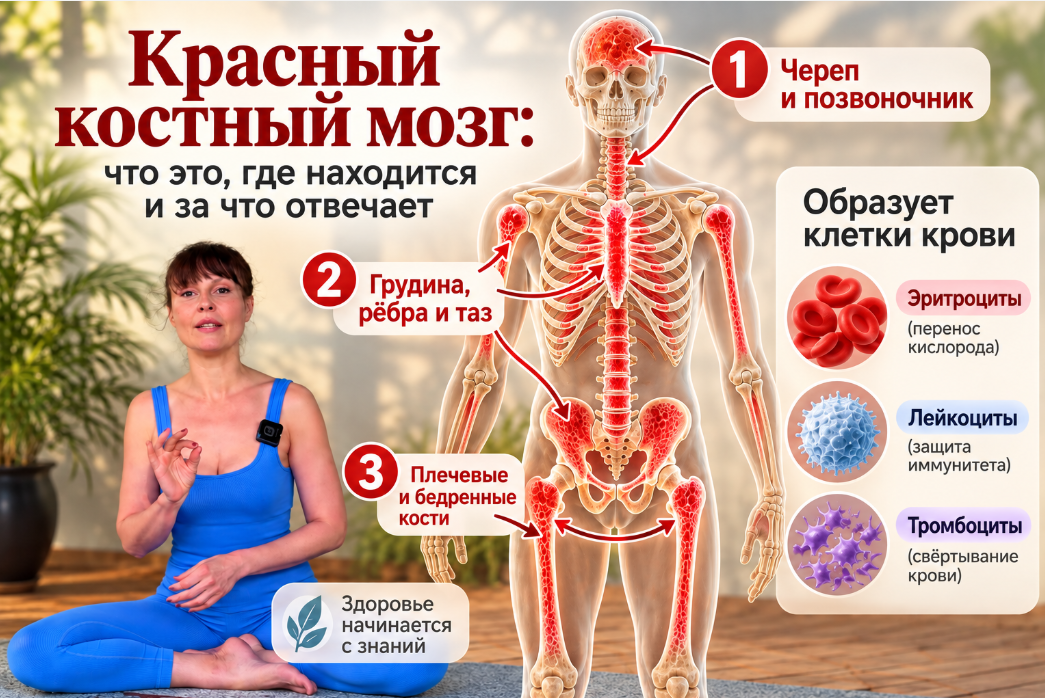
Red bone marrow
When we talk about body organs, we usually imagine something localized and familiar: the heart, liver, or brain.
But there is a system in the body that is arranged differently. This is the red bone marrow — a functionally non-local organ.
It has no single center and is distributed throughout the body. In adults, red bone marrow is mainly located in the pelvic bones, vertebrae, ribs, sternum, skull bones, and partially in the tubular bones of the limbs.
And here is the important part: red bone marrow functions as a unified hematopoietic system.
From a scientific point of view, red bone marrow is the main organ of hematopoiesis, that is, the process of blood cell formation.
It is here that hematopoietic stem cells are found, from which the following are formed:
• erythrocytes — cells that carry oxygen
• leukocytes — immune system cells
• thrombocytes — cells responsible for blood clotting
Millions of new blood cells are formed every second in the body, and this process is continuous. It ensures the renewal and survival of the entire organism.
It is important to understand that red bone marrow is not just a “mass of cells.”
It is a complex microenvironment, or niche, where the following interact:
• stem cells
• vascular network
• nerve endings
• signaling molecules and hormones
What is especially interesting: this environment is very sensitive to the state of the entire organism.
The functioning of the bone marrow can be influenced by:
• oxygen levels
• blood circulation
• stress hormones, such as cortisol
• activity of the autonomic nervous system
And here, let’s see how this can manifest in life.
Today, many people have a fast pace of life, chronic sleep deprivation, eating on the go, tension that doesn’t let go even at night, an aggressive external environment, and high levels of stress hormones.
Under the influence of these factors, the body often reflexively tightens: the neck tenses, breathing is restricted, chest mobility decreases, and peripheral blood vessels may spasm. All this triggers a cascade of neurophysiological reactions and can create less favorable conditions for the normal functioning of recovery, regulation, and hematopoiesis systems.
Conversely, when breathing is restored, spinal and chest mobility improves, the parasympathetic nervous system is activated, blood flow improves, and hormonal regulation normalizes, the body creates more favorable conditions for the natural processes of hematopoiesis.
Thus, red bone marrow can be considered not just as tissue, but as a distributed, highly sensitive renewal system throughout the body, biochemically and physiologically closely connected to the state of the entire organism.
It is a space of life within us that responds sensitively to how we breathe, move, think, and feel.
Red bone marrow does not need special “activation” — it is constantly working anyway.
Our task is to create conditions in which the natural processes of hematopoiesis proceed fully. Through simple yet deeply conscious actions: breathing, movement, nutrition, reducing chronic inflammation and tension.
And here is the key: it is critically important to perform these actions together, as a whole.
Because only a competent combination of techniques, practices, and methods can multiply their effect and provide a qualitatively new result, which is not always achievable when performing these elements separately.
This is the synergy effect — one of the phenomena underlying our method.
A whole set of special practices to support red bone marrow can be found on our website YOGAJOY.SPACE in the “Special Practices” section.