Articles
Tongue muscles — muscles of youth: how to develop strength and maintain function at any age
How to strengthen the tongue muscles and why train them? Scientific research, anatomy, connection with swallowing, breathing, and the face. YogaJoy exercises.
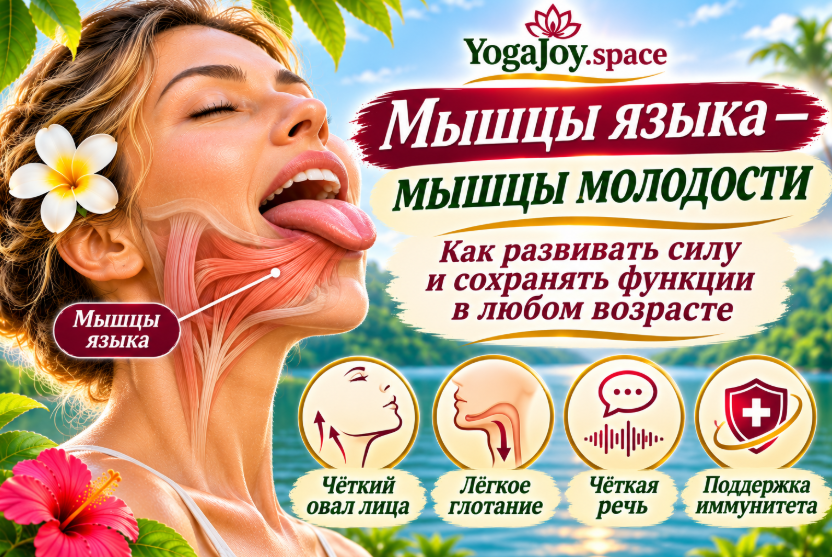
Did you know that one of the most amazing muscle systems in our body is almost never left inactive?
We train the abs, strengthen the back, take care of the facial muscles. We learn to hold the head correctly, relax the neck, and broaden the shoulders.
Meanwhile, inside the oral cavity, there is an entire muscular system that controls speech, swallowing, tongue position, certain breathing mechanisms, as well as the position and condition of our face.
And the most interesting part is that it can become stronger in response to training.
Moreover, studies confirm this ability in people of all ages.
We are talking about the muscles of the tongue and the sublingual area.
Their function is connected to the lower jaw, the hyoid bone, neck muscles, and the respiratory tract.
Therefore, in our series "Muscles of Youth" We pay special attention to the tongue.
After all, the youthfulness of the body is not only about the strength of large muscles and good posture. It is also about the ability to maintain movement precision, muscular coordination, and the body's functional capabilities.
Briefly about the essentials
The tongue is a complex muscular organ consisting of intrinsic and extrinsic muscles.
They allow it to change shape, move in different directions, and generate force. Thanks to this, we can speak, chew food, and swallow. Through the muscles of the floor of the oral cavity and the hyoid bone, the tongue is functionally connected to the lower jaw, larynx, and neck.
Why this topic is especially interesting for our purposes:
-
The tongue muscles can be trained throughout adult life.
-
Regular resistance training can increase their strength and functional power reserve.
-
The tongue participates in swallowing, speech formation, and maintaining the patency of the upper airways.
-
The position of the head, neck, and lower jaw is related to the function of the tongue and sublingual muscles.
-
Yoga offers practices that combine tongue movements, breathing, sound, and focused attention.
Modern research helps us understand how to develop the capabilities of this amazing muscular system.
At YogaJoySpace, we complement tongue work with posture, breathing, gentle movements, attention training, and relaxation.
Why is it important to maintain tongue strength throughout life?
How and why does tongue training affect our breathing, snoring prevention, and the lower third of the face?
Read more details further in this article.
Anatomy of the tongue: why is it capable of such precise movements?
Try running the tip of your tongue along the inner surface of your upper teeth.
Now touch the palate.
Move your tongue to the right, then to the left.
And now make it wide and relaxed.
Just a few seconds—and so many completely different movements!
The secret lies in the unique structure of the tongue.
It is a so-called muscular hydrostat: an organ capable of changing shape and position through the interaction of muscle fibers, while practically maintaining its own volume.
A similar principle of movement organization is found, for example, in an elephant's trunk.
In the human tongue, fibers run longitudinally, transversely, and vertically intertwined.
Thanks to this, the tongue can become narrower or wider, lengthen, flatten, bend, and create pressure in different directions.
In anatomy, two main groups of tongue muscles are distinguished.
Intrinsic muscles — control of shape
These include the superior and inferior longitudinal, transverse, and vertical muscles.
They allow the tongue to change its own shape.
It is thanks to their work that we are able to perform very precise movements with the tip and dorsum of the tongue.
This is especially important for the pronunciation of sounds.
When we speak, the tongue quickly changes position, touching the palate and teeth, shaping the space for air to pass through.
External muscles — controlling the position
They connect the tongue to the surrounding structures.
Genioglossus muscle It originates from the inner surface of the lower jaw. It is involved in protruding the tongue forward and controlling the position of its base.
Hyoglossus — hyoglossus connects the hyoid bone to the tongue and helps lower it.
Styloglossus — styloglossus runs from the styloid process of the temporal bone and participates in moving the tongue backward and upward.
Palatoglossus — palatoglossus connects the soft palate to the tongue and helps regulate the space between the oral cavity and the pharynx.
Most of the tongue muscles are controlled by the hypoglossal nerve — the twelfth pair of cranial nerves.
The palatoglossus muscle receives motor innervation through the vagus nerve.
Before us is an amazingly delicate system of neuromuscular control.
The tongue is capable of generating force, performing extremely precise movements, and instantly changing shape all at once.
And it is precisely these qualities that make its training so interesting.
The hyoid bone and muscles under the chin: the connection between the tongue, neck, and face
Now let's mentally move a little below the tongue.
Under the lower jaw lies a small hyoid bone — os hyoideum.
It is horseshoe-shaped and located in the front part of the neck.
Its remarkable anatomical feature is that it does not form a typical joint connection with other bones.
The hyoid bone is held in place by a system of muscles and ligaments.
Muscles of the tongue, floor of the mouth, pharynx, and larynx attach to it.
Imagine a small movable center linked to several complex functions and connected to other neck structures.
Together they create a complex system of movement and stabilization.
Why are these muscles so important for swallowing?
Every time we swallow, an amazingly precise sequence of actions occurs.
The tongue shapes and moves the food bolus.
The muscles of the floor of the mouth participate in moving the hyoid bone.
The larynx moves upward and forward.
At the same time, airway protection mechanisms are activated.
Swallowing seems like a completely simple action to us.
But from a physiological perspective, it is one of the most complex coordinated movements of the body.
And the quality of this system's function matters throughout life.
That is why the muscles of the tongue and hyoid area deserve attention long before age-related functional limitations appear.
Why strengthen the tongue muscles at any adult age?
We are used to training muscles that we can clearly see and feel.
Legs — to walk confidently.
Back — to maintain stability.
Abdominal muscles — to support movement and trunk control.
But the tongue muscles also have strength and can adapt to load.
And here an interesting physiological concept appears — muscle reserve.
What is the functional reserve of the tongue?
Imagine that a muscle can generate a certain maximum effort.
But for an ordinary everyday task, it requires only part of that strength.
The difference between the maximum capacity and the load needed to perform the task forms the strength reserve.
The same happens with the tongue.
During normal swallowing, it creates pressure on the palate.
But the maximum effort the tongue can exert is usually higher than the pressure during habitual swallowing.
This means that the tongue has a reserve of muscular capacity.
Maintaining such a reserve can be important when the body's functional needs change.
And now the most interesting part: scientific studies show that this reserve can be increased with special exercises.
What the studies showed: tongue muscles can be trained even in young and middle age.
A 2022 study: 102 healthy adults.
In a randomized study, Hui-Lin Xiao and colleagues involved 102 healthy people aged 20 to 59 years.
The average age of participants was 37.2 years.
This is especially interesting for our YogaJoySpace audience.
Fifty people performed special tongue resistance training.
Fifty-two participants formed the control group.
The program lasted eight weeks.
Five days a week, participants in the training group performed exercises using a special device: pressing an air-filled balloon against the hard palate with their tongue.
Researchers measured the maximum pressure of the front and back parts of the tongue, pressure during swallowing, and strength reserve.
The results showed:
-
Maximum tongue pressure strength increased.
-
The strength reserve of the back part of the tongue improved compared to the control group.
-
Four weeks after completing the program, no significant decrease in the achieved strength levels was found.
At the same time, most pressure indicators during normal swallowing did not change significantly.
And this is a very interesting physiological feature.
The tongue became capable of exerting greater effort, although the habitual swallowing task did not require such an increase in load.
It turns out that training can develop the reserve of muscular capacity.
Hsiao et al., 2022. International Journal of Environmental Research and Public Health.
A 2021 study: 91 healthy adults.
In another randomized study, Lin and colleagues involved 91 healthy adults.
Forty-four people performed special tongue training five days a week for eight weeks.
Forty-seven participants continued their usual daily activities.
Scientists separately measured the strength of the front and back parts of the tongue.
After the program, both indicators increased in the training group.
Moreover, the changes appeared unevenly.
A positive result for the back part of the tongue was noticeable after two weeks, and for the front part by the eighth week.
This once again shows that different areas of the tongue can respond differently to training loads.
This means that the tongue muscles represent a complex system where strength, direction of movement, and features of muscular control are important.
Lin et al., 2021. Auris Nasus Larynx.
A 2022 meta-analysis: results of 12 scientific studies.
To assess the results more broadly, Lin and colleagues combined data from 12 randomized studies involving 388 people.
The work was published in a journal. Scientific Reports.
Researchers compared the results of tongue training with control conditions.
The average difference between groups after training was:
-
5.34 kPa for maximum pressure of the front part of the tongue;
-
8.12 kPa for the back part of the tongue.
Kilopascal is a unit of pressure measurement used in such studies to assess tongue strength.
The analysis included both healthy adults of various ages and participants with certain medical conditions.
In healthy individuals, positive changes in the strength of the front part of the tongue were observed across different age groups.
This confirms the main idea for us.
The ability of tongue muscles to respond to training is not limited to old age.
At the same time, the study results varied in the magnitude of the effect.
Therefore, the specific program, intensity, and duration of sessions should be tailored to the set goal.
Lin et al., 2022. Scientific Reports.
But what happens with tongue control in the brain? A new study from 2026
Here is another fascinating aspect of this topic.
Muscle training is not only about changing their strength.
Every movement is connected to the nervous system's work.
The brain forms a motor command, the muscles execute it, and sensory information helps adjust the movement.
In June 2026, in Scientific Reports a study by Dongxiang Mi and colleagues was published, dedicated to the effects of oropharyngeal exercises on the neural mechanisms controlling the tongue.
It involved 22 healthy adults aged 20–31 years.
The researchers compared individual sessions with tongue exercises, breathing exercises, and control conditions.
To assess the motor system's response, they used transcranial magnetic stimulation—a method that allows studying the excitability of nerve pathways controlling muscles.
After one forty-minute tongue training session, an increase in corticomotor excitability indicators related to its muscles was found.
At the same time, there was no significant immediate increase in tongue strength or improvement in other measured functions.
What does this mean?
The nervous system can change its response to a specific motor task quite quickly.
This is an interesting possible mechanism of early adaptation to training.
But such short-term changes do not yet prove stable neuroplastic restructuring or long-term functional improvement.
For us, this study is especially valuable because it expands the understanding of tongue training.
We work not only with muscle strength.
We create tasks for the movement control system.
We learn precision.
We develop attention to our own sensations.
And gradually make movement more conscious.
Mi et al., 2026. Scientific Reports.
Why is it important to maintain tongue strength throughout life?
In 2013, researchers Todd and colleagues studied tongue strength in 126 healthy people.
Participants were divided into three age groups:
20–40 years, 41–60 years, and 61 years and older.
The scientists measured maximum tongue pressure and the pressure generated during swallowing.
It turned out that in the older age group, maximum tongue strength was lower than in younger participants.
But the pressure required for normal swallowing remained relatively comparable.
This means that habitual function can be maintained even with reduced maximum strength capabilities.
However, the available functional reserve becomes smaller.
This is exactly where we see the important idea of our "Muscles of Youth" series.
Developing the body's functional capabilities is interesting when we are active, healthy, and able to learn new things.
This applies to the muscles of the legs, back, respiratory system—and to the tongue.
At the same time, not every healthy person needs intensive specialized tongue training.
Modern research confirms its trainability. The specific need for strength training depends on the individual's condition and goals.
For everyday yogic practice, we can start by developing sensitivity, precision, and coordination of movements.
Tongue muscles, breathing, and sleep: why does tongue position matter?
One of the most interesting external tongue muscles is the geniohyoid muscle, genioglossus.
It originates from the inner surface of the lower jaw and is involved in controlling the position of the tongue, including its base.
Behind the root of the tongue lies the oropharyngeal space, through which air passes.
Therefore, the position and activity of the tongue muscles are related to the patency of the upper airways.
Muscle activity changes during sleep.
In some people, decreased activity of the upper airway muscles contributes to their narrowing.
That is why the tongue and oropharyngeal muscles are studied today in research on sleep breathing disorders.
In a systematic review and meta-analysis by Saba and colleagues, published in The Laryngoscope 2024, programs of orofacial myofunctional therapy for obstructive sleep apnea were studied.
The results showed the promise of such exercises for certain condition indicators in adult participants.
But clinical myofunctional therapy includes special complexes that differ from regular yoga exercises.
For our practice, the principle itself is especially important: the tongue participates not only in speech and swallowing but also in the complex functioning of the upper airways.
Therefore, working with it naturally complements the study of breathing.
At YogaJoySpace, a large part of our system is dedicated to this, especially classes on pranayama and breathing mechanics.
More about the role of the diaphragm, posture, and nervous regulation can be found in the article series "The Diaphragm — the Muscle of Youth: How Breathing Affects Posture, the Nervous System, and Inner Stability".
Tongue, posture, and the lower third of the face: where does the connection begin?
Now let's return to a topic that is especially interesting in our Face Yoga system.
How is tongue position connected to the lower jaw, chin, and neck muscles?
The answer begins with anatomy.
The geniohyoid muscle originates from the lower jaw.
The suprahyoid muscles connect the lower jaw and the hyoid bone.
Below are the neck muscles involved in the position of the hyoid bone and larynx.
And more superficially runs the platysma, a broad subcutaneous muscle associated with the tissues of the lower third of the face.
Thus, several muscle layers interact in the chin area.
Tongue — muscles of the floor of the mouth — hyoid bone — neck muscles — lower jaw — superficial facial tissues.
Each structure performs its own function.
But together they participate in the functional organization of the lower part of the head and neck.
Why is posture especially important here?
Imagine your usual position at the computer.
The head gradually moves forward.
The thoracic spine rounds.
The position of the lower jaw relative to the cervical spine changes.
The neck muscles adapt to the new spatial task.
Along with this, the position of the hyoid bone and surrounding soft tissues may change.
Try a small experiment.
Sit down, slightly pushing your head forward.
Pay attention to the sensations under your chin.
Now feel the support of your pelvis, gently stretch the crown of your head upwards, and allow your head to rest above the spine.
What has changed?
Perhaps it has become easier to move your lower jaw.
Or the sense of space under your tongue has changed.
Our body constantly adapts to the position we take.
And that is why at YogaJoySpace we begin work with the face not only focusing on the facial muscles but also on posture.
Is it possible to lift the facial oval with tongue exercises?
Here it is especially interesting to distinguish between muscle functions and the appearance of tissues.
Training the tongue with resistance can indeed increase its strength.
But the shape of the lower third of the face depends on many factors: the structure of the lower jaw, skin condition, distribution of fatty tissue, connective tissue structures, facial muscles, and head position.
Therefore, in our approach, we pay attention to what we can directly develop: motor coordination, posture, freedom of the lower jaw, breathing, and muscle control.
And we consider this as part of a comprehensive facial practice.
Read more about the anatomical and functional connections in the article "Face Yoga: What It Is and Why Facial Youth Begins with the Body".
Tongue muscles and facial lymphatic drainage: what happens in the sublingual area?
Under the lower jaw lies a complex system of muscles, salivary glands, blood vessels, and lymphatic vessels.
This is where important lymphatic drainage pathways from the lower part of the face and specific areas of the oral cavity are located.
Lymph from the tongue flows along several pathways to the regional lymph nodes of the head and neck.
Then it enters the deep cervical lymphatic system and returns to the venous bloodstream.
Lymph movement is influenced by the contractions of the lymphatic vessels themselves, pressure changes, and the movement of surrounding tissues.
Therefore, in yoga, we are interested in combining breathing, gentle movements, stimulation of lymph flow, and overall muscle relaxation.
Our task is to develop and maintain the natural mobility and functional coordination of tissues, taking into account the complex physiology of the body.
This is the important feature of the comprehensive YogaJoySpace approach.
The tongue and the nervous system: why is movement precision as interesting as strength?
Remember how we learn to perform a new asana.
At first, the position feels unfamiliar.
It is difficult to feel individual muscles.
The movement requires concentration.
But gradually the nervous system controls the body more precisely.
The same happens when we master unfamiliar tongue movements.
For example, trying to slowly run the tip of the tongue along the inner surface of the palate or create slight pressure at a specific point.
Such a task requires a motor command, sensory feedback, and coordination.
There is a constant exchange of information in the nervous system between structures responsible for movement and sensory pathways.
The brain receives signals about the tongue’s position, contact with the palate, the amount of effort, and other sensations.
This allows for movement correction.
Thus, tongue exercises can be another interesting part of sensorimotor practice.
Here we come to the concept proprioception — the nervous system’s ability to perceive the position and movement of body parts.
At YogaJoySpace, a separate article is dedicated to this. Proprioception: What It Is in Simple Terms and Why It Is Needed in Yoga.
It is precisely this combination of movement, sensation, and attention that forms the basis of our Living Yoga.
The tongue in yoga: Simhasana, mudras, and working with attention
Now let's move from modern neurophysiology to the tradition of yoga.
Here the tongue occupies a special place.
Its position is used in asanas, mudras, breathing techniques, and concentration practices.
Simhasana — the lion pose
Simhasana is described in the classical treatise "Hatha Yoga Pradipika" Svātmārāma.
In the first chapter, in the section dedicated to the lion pose, it talks about the position of the body, hands, open mouth, and focused gaze.
In the commentaries and modern variations of Simhasana, the tongue is stretched forward.
What is especially interesting about this movement?
The tongue changes position.
The muscles of the oral cavity are activated.
The face takes on an unusual expression.
And then we return to relaxation.
Try, after calmly stretching your tongue, to feel how it naturally returns to a comfortable position.
You may notice the difference between active movement and a state of rest.
It is precisely this ability to consciously create effort and then release it that is one of the important tasks of our practice.
Nabho Mudra and the position of the tongue at the palate
In some yoga traditions, practices involve gentle contact of the tongue with the palate.
One of these is known as Nabho Mudra.
Depending on the school, its execution and symbolic meaning may vary.
For our daily practice, a simple principle is interesting: to gently feel the contact of the tongue with the palate while simultaneously maintaining freedom of the lower jaw and breathing.
This develops attention to an area that usually remains outside of conscious perception.
In Hatha Yoga, there is also a more complex practice called Khechari Mudra.
It has special traditional significance and relates to advanced techniques.
But to get acquainted with the muscles of the tongue, simple, natural movements are enough.
Vishuddha Chakra: tongue, voice, and the energy of self-expression
In traditional yoga philosophy, the throat area is associated with Vishuddha—the fifth chakra..
In the common seven-chakra system, it is associated with sound, speech, inner clarity, and self-expression.
During our in-person yoga retreats in the YogaJoySpace system, we guide participants through a unique author’s program called "7 Gifts to Yourself" to activate and harmonize all seven energy centers.
The word Vishuddha is connected with the concept of purification.
In yogic symbolism, this area corresponds to the element of space — akasha.
And here an amazing connection with physiology arises.
The throat is the area where the structures of breathing, swallowing, and voice formation interact.
The tongue participates in articulation.
The vocal folds create sound.
The respiratory muscles provide airflow.
And the nervous system integrates all this into the complex process of speech.
In traditional yoga, working with sound also becomes a tool for concentration of attention.
Why is the practice of sound so interesting?
Try gently pronouncing several prolonged sounds:
"A-a-a."
"O-o-o."
"M-m-m."
Notice how the position of the tongue, the shape of the oral cavity, the movement of the lips, and the sensations in the facial area change.
Each sound requires its own muscle organization.
When pronouncing "M-m-m," the air mainly passes through the nasal cavity, and one can feel vibrations in the lips and facial area.
That is why sound breathing techniques hold a special place in yoga.
One of them is Bhramari Pranayama, or "bee buzzing."
It combines a calm exhale, a soft sound, and focused attention.
At YogaJoySpace, there is a separate short Bhramari practice, which perfectly complements our topic.
To explore more deeply the influence of voice and internal dialogue on your state, see the article "The Power of Words: How Voice, Vibrations, and Meaning Affect Our State.".
YogaJoy Practice: "The Gentle Power of the Tongue and Freedom of the Lower Jaw."
Duration — about 7–8 minutes.
This sequence combines familiarization with tongue muscles, coordination, gentle activation, breathing, and relaxation.
It is intended for people without swallowing disorders and represents a mindful movement practice, not a substitute for specialized resistance strength training.
1. Establish support and natural vertical alignment — 1 minute
Sit comfortably.
Feel the support of your pelvis.
Allow your spine to naturally lengthen upwards.
Relax your shoulders.
The head rests freely above the spine.
Take several calm inhales and exhales.
Pay attention to the position of the lower jaw.
Let the teeth not be clenched, and keep the lips soft.
2. Get acquainted with the tongue position — 1 minute
Close your eyes.
Feel where your tongue is right now.
Which part touches the palate?
Does it move easily?
Now gently touch the hard palate just behind the upper teeth with the tip of your tongue.
Maintain a light contact for a few seconds.
Then relax.
Repeat five times.
Observe the sensations in the tongue and lower jaw area.
3. Develop the ability to create effort — 1.5 minutes
Gently press the front part of the tongue against the hard palate.
Create a small comfortable upward pressure.
Hold it for about three seconds.
Then fully relax the tongue for five to six seconds.
Repeat five times.
Feel the difference between contraction and relaxation.
This exercise introduces us to the ability to consciously regulate tongue effort.
4. Train movement accuracy — 1 minute
Run the tip of your tongue along the inner surface of the upper teeth from right to left.
Then return back.
Move slowly.
Without strong pressure.
After a few repetitions, run your tongue along the hard palate from the front to the back, staying within a comfortable zone.
Pay attention to the accuracy and smoothness of the movement.
5. Adding gentle Simhasana — 1 minute
Take a calm breath in through your nose.
Exhale, open your mouth, and gently stretch your tongue forward.
Keep your head in a natural position.
Then return your tongue back and relax your face.
Repeat two to three times.
Feel how the state of your muscles changes after the movement.
6. Connecting breath and sound — 1 minute
Take a calm breath in.
You can try to feel this.
Allow the sound to flow freely.
Feel a light vibration around your lips and face.
Repeat four to five times with normal breathing between repetitions.
7. Finishing with relaxation — 1 minute
Close your eyes.
Let your tongue find a comfortable position.
Relax your lips, lower jaw, and neck muscles.
Take several natural breathing cycles.
Feel the position of your head.
The freedom of your shoulders.
The softness of your face.
Now notice: how differently do you feel your tongue and lower jaw after these simple movements?
Our goal is to develop sensitivity, precision, and freedom in muscle control.
This is the special value of gentle practice.
Perform exercises without pain, strong pressure on the teeth, tension in the frenulum, or tilting the head back. If you experience tongue pain, swallowing difficulties, choking, or temporomandibular joint dysfunction, individual exercise selection by a specialist is necessary.
How to continue your practice on YogaJoySpace?
In our system, we combine work with muscles, breathing, posture, sensory perception, and inner state.
The tongue becomes another interesting link in this work.
Author's program "Face Yoga"
This is a natural continuation of our topic.
In the program, we work with posture, breathing, neck and scalp muscles, lower jaw, facial expressions, diaphragm, pelvic floor, feet, and fascial structures.
We consider the face as part of the whole body, and muscle work as an interaction of strength, mobility, and the ability to relax.
Diaphragm and breathing
The tongue is connected to breathing processes, and the main breathing muscle — the diaphragm — also participates in postural control.
Together with the work of the intercostal muscles and the rib cage, this creates the foundation of breathing mechanics.
Small pectoral muscles, shoulder blades, and posture
The position of the head depends on the organization of the entire shoulder girdle.
The pectoralis minor muscles They participate in the movements of the shoulder blades, and the thoracic spine affects the position of the neck.
Therefore, working with the upper body becomes an important complement to exercises for the sublingual area.
Yoga 156 — gentle practice for beginners
This is an evening YogaJoySpace session combining movement, breathing, and relaxation.
It will help shift attention from small tongue exercises to coordinated work of the whole body.
Tongue muscles in the “Muscles of Youth” system
Now let's try to combine everything we've talked about in our series.
The feet provide support and help maintain balance.
Pelvic muscles participate in body stability.
The diaphragm facilitates breathing and aids in postural control.
The intercostal muscles contribute to the mobility of the rib cage.
The pectoralis minor muscles connect the ribs to the shoulder blades.
The neck muscles support the position of the head and control its movements.
The platysma links the superficial tissues of the upper chest, neck, and lower third of the face.
And the muscles of the tongue and hyoid region provide the precise movements necessary for speech, swallowing, and other vital functions.
There are no insignificant muscles in this system.
Each one performs its own task.
And the quality of movement arises from their coordinated work.
That is why we view youth as the body's ability to maintain strength, mobility, coordination, and the capacity to develop.
Youth is not only about how our body looks. It is also about what it is capable of.
We learn to create effort.
To feel movement.
To manage our own state.
To relax in a timely manner.
And to explore new possibilities of the body with interest.
Even in areas where nothing special was noticed before.
Perhaps this is one of the most valuable principles of YogaJoySpace: caring for youth begins with a conscious attitude toward your entire body.
Frequently Asked Questions About Tongue Muscles
Why train the tongue muscles if there are no swallowing problems?
The tongue muscles are involved in speech, chewing food, swallowing, and controlling the position of the tongue.
Scientific studies show that special resistance exercises can increase tongue strength in healthy adults.
However, not everyone needs strength training.
In everyday yogic practice, it is useful to develop awareness, precision of movements, and the ability to control muscular effort.
Is it possible to strengthen the tongue muscles after 35–40 years of age?
Yes.
A 2022 study involved 102 healthy adults aged 20–59 years, with an average age of 37.2 years.
After eight weeks of resistance training, the training group showed increased tongue strength.
These data confirm the tongue muscles' ability to adapt to load in middle adulthood.
How are the tongue muscles connected to the facial oval and double chin?
The tongue muscles are anatomically connected to the lower jaw and hyoid region.
They participate in the function of deep structures located under the chin.
But the appearance of the lower third of the face also depends on the skin, fatty tissue, bone structure, connective tissues, and head position.
There is currently insufficient convincing research confirming the elimination of a double chin through tongue exercises.
What exercises help develop tongue strength and coordination?
Scientific studies use special resistance exercises to develop strength, including pressing the tongue against the palate with measuring devices.
For familiarization with movements, gentle touching of the palate, slight upward pressure with the tongue, side-to-side movements, and a calm adapted Simhasana are suitable.
Special strength programs and short yogic exercises have different goals.
At YogaJoySpace, we include tongue work in a comprehensive practice of posture, breathing, movement, and relaxation.
Scientific sources
-
Hsiao H.-L. et al. (2022). Effects of Tongue-Strengthening Exercise on Tongue Strength Reserve and Detraining Effects among Healthy Adults: A Randomized Controlled Trial. International Journal of Environmental Research and Public Health, 19(11), 6878.
102 healthy adults aged 20–59 years, eight-week tongue resistance training.
https://doi.org/10.3390/ijerph19116878 -
Lin C.-J. et al. (2021). Effect of tongue-to-palate resistance training on tongue strength in healthy adults. Auris Nasus Larynx.
Randomized study of 91 healthy adults, changes in strength of the anterior and posterior parts of the tongue.
https://pubmed.ncbi.nlm.nih.gov/32727703/ -
Lin C.-J. et al. (2022). Effects of tongue strengthening exercises on tongue muscle strength: a systematic review and meta-analysis of randomized controlled trials. Scientific Reports, 12, 10438.
Meta-analysis of 12 studies involving 388 participants.
https://doi.org/10.1038/s41598-022-14335-2 -
Mi D., Castrillon E., Kothari M., Arima T., Svensson P. (2026). Effects of oropharyngeal exercises on orofacial function and corticomotor excitability in healthy individuals. Scientific Reports, 16, 26208.
Study of short-term changes in corticomotor excitability after tongue exercises.
https://doi.org/10.1038/s41598-026-55428-6 -
Todd J. T., Lintzenich C. R., Butler S. G. (2013). Isometric and swallowing tongue strength in healthy adults. The Laryngoscope, 123(10), 2469–2473.
A study of maximum tongue strength and swallowing pressure in 126 healthy individuals across different age groups.
https://doi.org/10.1002/lary.23852 -
Robbins J. et al. (2005). The effects of lingual exercise on swallowing in older adults. Journal of the American Geriatrics Society, 53(9), 1483–1489.
An early study on the trainability of the tongue and swallowing indicators.
https://pubmed.ncbi.nlm.nih.gov/16137276/ -
Saba E. S. et al. (2024). Orofacial Myofunctional Therapy for Obstructive Sleep Apnea: A Systematic Review and Meta-Analysis. The Laryngoscope, 134(1), 480–495.
Data on specialized orofacial exercises for obstructive sleep apnea.
https://pubmed.ncbi.nlm.nih.gov/37606313/ -
Malone J. C., Brizuela M. (2026). Anatomy, Head and Neck, Swallowing. StatPearls.
Anatomy of the tongue muscles, sublingual area, and neuromuscular mechanisms of swallowing.
https://www.ncbi.nlm.nih.gov/books/NBK554405/ -
Alam M. et al. (2018). Association of Facial Exercise With the Appearance of Aging. JAMA Dermatology, 154(3), 365–367.
A small study of facial exercises and certain aesthetic indicators.
https://doi.org/10.1001/jamadermatol.2017.5142 -
American Association of Orthodontists (2025). What Is Mewing, and Does It Work?
A review of claims about the influence of tongue position on jaw shape.
https://aaoinfo.org/whats-trending/is-mewing-bad-for-you/ -
Svātmārāma. Haṭha Yoga Pradīpikā, Chapter I, section on Simhasana.
The classic description of the lion pose in the Hatha Yoga tradition.
https://www.in.yoga/ru/hatha-yoga-pradipika/ - AG