Articles
Why is relaxation one of the keys to youth?
Why the ability to relax is important for recovery, energy, and feeling youthful, and how to learn to release tension in body and mind.
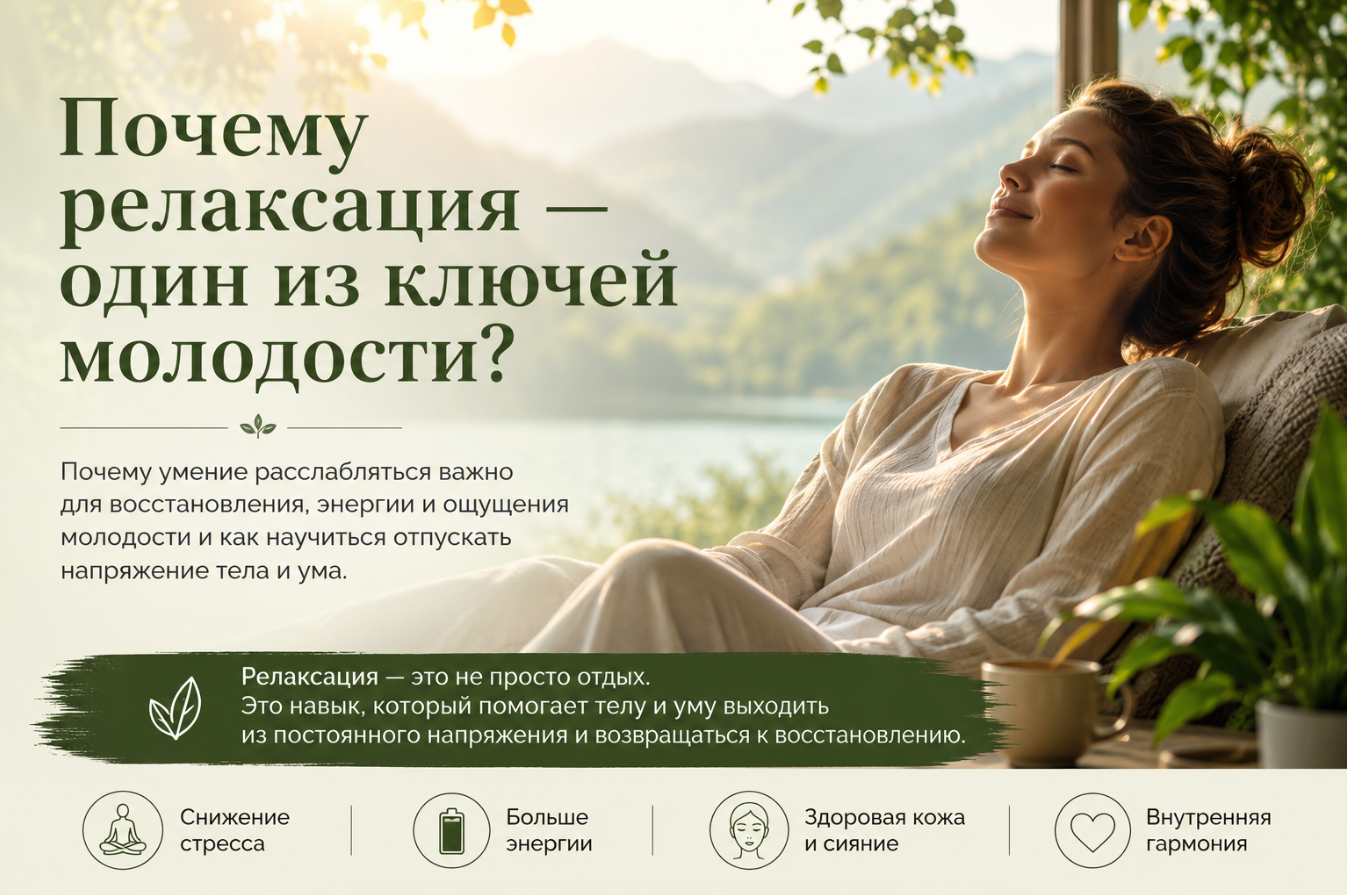
Relaxation is not just rest. It is an important skill that helps the body and mind exit constant tension and return to recovery.
When we learn to notice and release excess tension, breathing, muscle tone, emotional reactivity, and overall self-perception change.
That is why the ability to relax is important not only for well-being but also for preserving energy, mobility, and the feeling of youth.
We often think that youth is only about appearance, skin, figure, energy, or age on a passport.
But there is another important factor that is rarely taken seriously: the ability to relax.
Not just lying on the couch.
Not just falling asleep from fatigue.
Not just distracting yourself with your phone.
But truly releasing tension in body and mind.
Relaxation is not weakness or idleness. It is a state in which the body gets a chance to recover. When we live in constant tension, the body constantly spends energy on holding, controlling, reacting, worrying, and struggling. In such a mode, it is hard to renew, deeply rest, feel lightness and joy.
Our body does not exist separately from the mind.
If the mind is always occupied with anxiety, plans, regrets, inner conflicts, and endless processing of information, the body also does not truly rest. It continues to hold tension: in muscles, fascia, breathing, face, abdomen, shoulders, diaphragm.
Therefore, deep physical rest begins not only with muscle relaxation.
It begins with the mind gradually exiting the state of constant internal race.
Why is it so hard for us to relax?
Modern people live in a huge flow of information, in a rather aggressive informational environment.
Messages, news, tasks, screens, conversations, plans, expectations, comparisons, anxiety about the future — all this forces the nervous system to constantly be "on," in a "fight or flight" state.
We may seem to sit calmly, but inside we continue to react.
What will happen tomorrow?
What did I not manage to do?
Where did I make a mistake?
What did they think about me?
What else needs to be done?
Why am I struggling again?
The mind rarely experiences true peace.
It either returns to the past, rushes into the future, or evaluates what’s happening around as a potential threat. And the body follows it.
Breathing becomes more shallow.
The shoulders rise instinctively protecting the neck.
The jaw clenches.
The abdomen tightens.
The face becomes tense.
Inside, there is a feeling that you always need to be ready to defend, protect, or attack.
Over time, this state begins to feel familiar and even normal.
A person gets used to living in tension and may even mistake it for tone, focus, or activity. But chronic tension is not strength. Often it’s just chronic fatigue that the body has stopped noticing.
The skill of bringing attention back from the past and future to what is happening right now can be trained separately.
Relaxation returns the body to a recovery mode.
When we relax deeply, the body receives a different signal.
Not 'defend yourself.'
Not 'maintain control.'
Not 'react urgently.'
But 'you can exhale.'
In this state, breathing becomes calmer, muscles gradually release excess tension, the mind stops clinging to every thought, and the nervous system gets a chance to shift from constant fight-or-flight readiness to recovery mode.
That is why relaxation is so important for health, energy, and the feeling of youthfulness.
After all, youth is not just the absence of wrinkles. It is the body’s ability to recover, move, breathe, feel joy, be flexible, alive, receptive, and not internally tense.
When a person knows how to relax, they feel better.
Recover better.
Breathe easier.
Respond more gently to stress.
Notice more quickly where tension has accumulated in the body.
And gradually regain more energy.
Why is it necessary to train relaxation?
Many think: 'What’s there to learn? Lie down and relax.'
But in practice, it’s not that simple.
You can lie down and keep thinking.
You can close your eyes and argue with someone inside.
You can lie still but hold tension in your jaw, abdomen, pelvic floor, eyes, or shoulders.
You can sleep many hours but wake up exhausted because the nervous system never left the anxiety mode.
One useful skill here is to learn to notice arising thoughtswithout automatically following each one.
Therefore, relaxation is a skill.
He needs to learn it just like movement, breathing, concentration, or meditation.
First, we learn to notice tension.
Then — to release it.
And then we consciously return to it again and again, each time easier and easier.
Gradually, relaxation becomes not a random event, but a part of the lifestyle.
Relaxation as a practice of self-love
Taking time to relax is not a whim or a luxury.
It is a way to take care of yourself.
Not only when you have no strength left.
Not only on vacation.
Not only after illness.
But regularly, consciously, in advance.
A pause for yourself is not lost time.
It is time that restores your strength and replenishes your life energy.
Sometimes 15–20 minutes a day is enough to stop, exhale, feel your body, close your eyes, observe your breath, do a gentle practice meditation for relaxation or simply be without your phone and external noise.
Relaxation is not an escape from life.
It is a return to yourself.
To the body.
To the breath.
To inner silence.
To a state where energy to live, move, create, feel, and choose reappears.
That is why relaxation can be one of the true keys to youthfulness.