Articles
Yoga, breathing, and meditation: why the combination is more effective
How to combine yoga, breathing practices, and meditation, why to unite movement, breathing, and attention, and how to build a holistic practice.
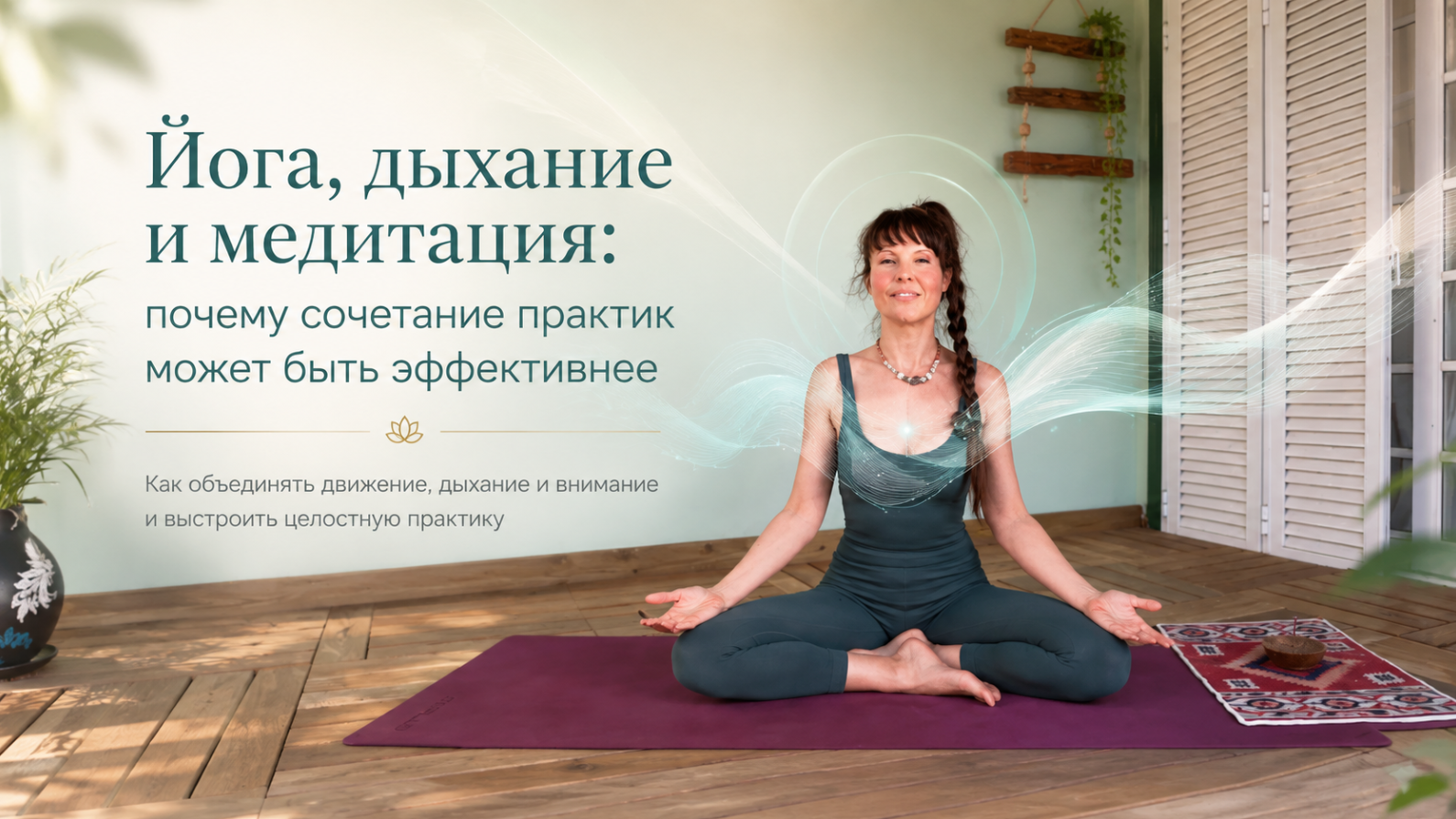
In brief
Yoga, breathing practices, and meditation affect different aspects of one state.
Movement returns attention to the body and develops mobility and strength.
Breathing helps notice and regulate levels of arousal and tension.
Meditation trains attention and the ability to observe thoughts, emotions, and sensations without automatic reaction.
Therefore, their thoughtful combination can provide a more holistic practice than constantly working with only one tool.
Yoga, breathing practices, and meditation can be used separately.
But what’s especially interesting is how they complement each other..
A person is not just a body, breathing, and mind separately.
Our state is formed simultaneously from movement, muscle tension, breathing, attention, thoughts, and emotional reactions.
Therefore, practice can work on several levels at once.
What does movement give?
During the physical part of yoga, we return attention to the body.
We notice:
how the joints move;
where there is tension;
where there is a lack of strength or stability;
how the position of the spine changes;
how the body reacts to the load.
This is a direct and clear way to feel yourself again not only as a “thinking head” but as a whole body.
What does breathing add?
Breathing is especially interesting because it happens automatically but can also be consciously changed.
When we are anxious, rushing, or stressed, breathing often changes along with our state.
Conversely, conscious work with breathing can be used as a tool to regulate the state.
Research on yogic breathing practices shows changes in subjective stress indicators and some physiological markers.
Therefore, breathing becomes a kind of bridge between movement and inner state.
What does meditation add?
You can perform exercises well and still mentally argue, plan tomorrow, or evaluate yourself throughout the session.
Meditation adds another skill — working with attention.
We learn to notice:
where the attention has gone;
what thoughts have appeared;
what emotions have arisen;
what is happening in the body right now.
In randomized studies, mindfulness training showed improvements in some measures of attention control.
Where does the "synergy" arise here?
The word "synergy" is often used too loosely.
For us, a simpler idea is more important:
different practices can work with different parts of one state and therefore complement each other.
For example:
movement helped release some physical stiffness;
breathing helped change the pace and internal arousal;
meditation helped notice where the attention wanders again.
This is no longer three random exercises.
It is a sequence in which one stage prepares a person for the next.
This is exactly how we use the combination of practices at YogaJoy.
Why is it not necessary to do everything at once?
Complexity does not mean that the more techniques, the better.
Sometimes a person only needs gentle physical practice today.
Sometimes — a few minutes of breathing.
Sometimes — meditation.
The important thing is not to gather the maximum number of methods, but to choose a combination that matches the current state and goal..
This is the practical meaning of a holistic approach.
How to apply this?
A simple example of a sequence:
1. Movement — to bring attention back to the body and remove unnecessary stiffness.
2. Breathing — to calm the internal rhythm a little and make the state more stable.
3. Meditation or Shavasana — to give the nervous system time to adjust and notice the result of the practice.
On another day, the sequence may be different.
The main thing is to understand why you use each element..
Then the practice stops being a set of exercises and becomes a system where movement, breathing, and attention work together.