Articles
Creatine: benefits for muscles, how to take it, dosages, and safety
What is creatine for? Benefits for muscles, monohydrate and other forms, natural and synthetic creatine, dosages, safety, and research.
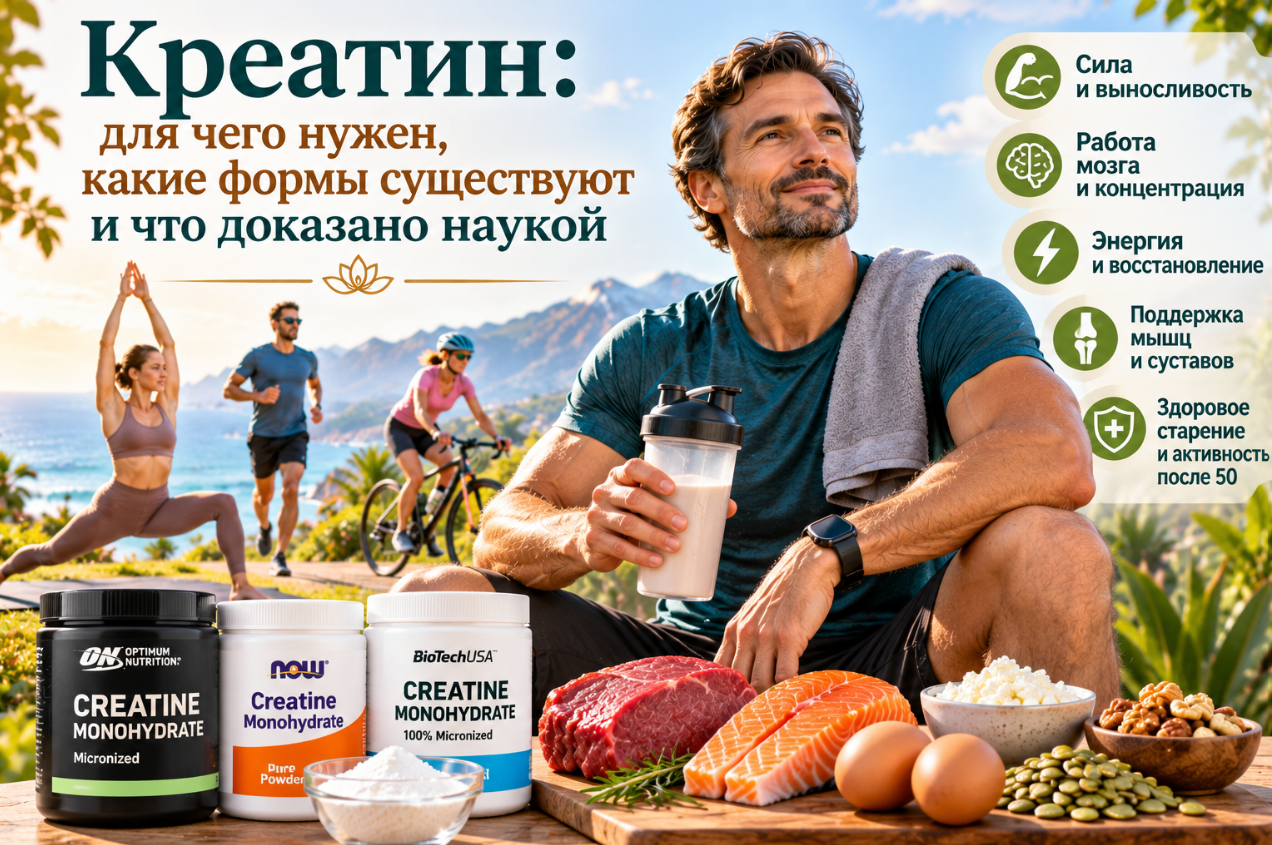
Creatine: benefits for muscles and brain, how to take it, and who needs it
Creatine has long gone beyond professional sports. Today it is studied for maintaining muscle strength after age 50, preserving physical activity in older adults, as well as its possible effects on memory and brain function.
But how broad are its benefits? Does it really help women after menopause? Is it safe for the kidneys, should it be taken continuously, and which form should you choose?
Let's analyze the results of scientific studies, separating proven effects from promising directions and common misconceptions.
Creatine in one minute: the essentials
-
Muscle strength is the most well-established effect. Creatine helps perform short, intense efforts and enhances the results of regular strength training.
-
It is especially interesting after age 50–60. Combined with training, creatine can further improve strength important for daily activities.
-
There are specific scientific results for women after menopause. Studies show a small additional increase in lean mass and muscle strength when combined with exercise.
-
Creatine is also important for the brain. It participates in the energy metabolism of nerve cells. Some studies find positive effects on memory, but consistent cognitive improvements from regular intake have not yet been established.
-
There is significantly less evidence for bones, skin, and hormonal health. Creatine should not be considered a means of preventing osteoporosis or rejuvenation.
-
The most studied form is monohydrate. It is used in most clinical trials.
-
Studies often use 3–5 g per day. Loading with large amounts is not necessary.
-
For healthy kidneys, studied regimens are generally well tolerated. For kidney diseases, individual assessment is required.
Key points: Creatine is beneficial not only for professional athletes. Its most convincing use is supporting muscle strength and training results, including in mature age. Possible effects on the brain continue to be actively researched.
What is truly proven about creatine's benefits?
Muscle strength and physical performance
Creatine is involved in the rapid restoration of energy needed for muscle contractions.
Its effect is especially noticeable during short, intense efforts: strength exercises, sprints, and repeated high-power movements.
By increasing phosphocreatine stores, muscles can more effectively restore energy between efforts.
As a result, a person can sometimes perform more repetitions, increase workload, and gain additional training benefits.
In a 2024 meta-analysis, participants under 50 who took creatine during strength training increased lean mass by an average of 1.14 kg more than control groups.
However, lean mass also includes water, so this measure cannot be fully equated with muscle tissue gain.
After 55–60 years: why does creatine become especially interesting?
With age, muscle mass and strength gradually decrease in many people. This is a natural but not entirely inevitable process.
Regular strength exercises help maintain the body's functional abilities.
Creatine can further enhance the effect of such training.
In the European Union, it is officially permitted to claim that daily intake of 3 g of creatine helps improve resistance training results in adults over 55 under certain conditions.
A 2026 systematic review also found an additional, though small, increase in muscle strength when combining creatine with training in older adults.
The practical benefits are not limited to athletic performance: maintaining strength helps preserve independence and physical activity in older age.
Sources: EU Regulation 2017/672, systematic review 2026.
Creatine for women: what have studies shown?
Creatine works in the bodies of both women and men through the same energy metabolism mechanisms.
But for women, there is a special area of interest — preserving muscle strength and mass after menopause.
During this period, hormonal changes may be accompanied by more pronounced age-related changes in muscles and bone tissue.
Creatine after menopause
In a 2026 meta-analysis, researchers combined seven randomized trials involving 608 postmenopausal women.
The results showed that adding creatine to strength training was accompanied by:
-
An additional increase in lean body mass averaging 0.37 kg.
-
An increase in maximum leg press strength averaging 7.5 kg compared to control groups.
The effect was most noticeable in trials where women performed strength exercises and received at least 5 g of creatine daily.
In studies without training and with lower doses, significant benefits were often not observed.
At the same time, improvements in bone mineral density were generally not found.
Practical conclusion: For postmenopausal women, creatine is primarily of interest as a supplement to strength training to maintain muscle strength. It should not be expected to independently treat osteoporosis.
Meta-analysis of studies in postmenopausal women, 2026.
What about before menopause?
In women of reproductive age, creatine is also studied in relation to physical exercise.
For women who regularly engage in strength training, it may help improve certain strength and athletic performance indicators.
The effects of creatine on menopausal symptoms, sleep, and emotional state continue to be studied. These areas should not yet be equated with the well-established benefits for muscle strength.
Can creatine improve memory and brain function?
The brain, like muscles, requires a constant supply of energy.
The creatine and phosphocreatine system participates in maintaining the energy metabolism of nerve cells.
This explains scientists' interest in the possible effects of creatine supplements on memory, attention, and mental performance.
What has been discovered?
Some studies have noted improvements in certain cognitive measures.
Experiments conducted under conditions of sleep deprivation and other increased brain stress are especially interesting.
However, results vary depending on dosage, duration of intake, and participant characteristics.
In 2024, the European EFSA agency reviewed scientific works on this topic and concluded that a causal relationship between regular creatine supplementation and improved cognitive functions has not yet been established.
Research continues, however, since the energy role of creatine in nervous tissue is well known.
Practical conclusion: Creatine is essential for the brain's energy metabolism, but it cannot yet be recommended to healthy individuals solely for memory enhancement or dementia prevention.
EFSA — scientific assessment of creatine and cognitive functions, 2024.
What other effects of creatine are being studied?
Mood and depression
Scientists are studying creatine as a possible adjunct treatment for depressive disorders.
The interest is related to the role of energy metabolism in nervous system function.
In a systematic review and meta-analysis published in 2025, small positive changes in depression symptoms were found.
However, the average effect did not reach the widely accepted threshold for clinically significant improvement, and the quality of evidence was rated very low.
Therefore, creatine is not yet an established treatment for depression and does not replace psychotherapy or prescribed medications.
Meta-analysis of creatine and depression studies.
Bone tissue
Creatine is studied in connection with age-related changes in bones.
So far, studies in postmenopausal women have not shown a significant increase in bone mineral density.
Therefore, for osteoporosis prevention, physical activity, adequate nutrition, and medical prevention when indicated remain the most important factors.
Skin and rejuvenation
Sometimes creatine is credited with the ability to slow skin aging or restore cells.
However, there is no convincing clinical evidence of such effects with regular oral creatine intake.
It is important here not to confuse biochemical hypotheses with proven benefits for humans.
Which creatine to choose?
Various forms are available on the market: monohydrate, hydrochloride, citrate, malate, and buffered compounds.
Monohydrate
This is the most studied form of creatine.
Monohydrate was used in most studies on muscle strength, physical performance, and safety.
It effectively increases creatine stores in muscles.
Micronized monohydrate has smaller particles, which may make it easier to mix the powder with liquids.
Hydrochloride — HCl
It dissolves better in water, but good solubility does not mean a more pronounced effect.
No convincing advantages over monohydrate for increasing muscle strength have been shown so far.
Other forms
Citrate, malate, and buffered creatine differ in chemical composition and physical characteristics.
However, the main clinical evidence base remains with monohydrate.
Practical choice: For most purposes, it makes sense to consider a quality monohydrate with clear dosing and purity control.
NIH — sports dietary supplements.
How much creatine to take and is loading necessary?
In scientific studies, monohydrate is often used at 3–5 g daily.
With regular intake, creatine stores in muscles gradually increase.
Some research protocols include accelerated loading — about 20 g per day for 5–7 days, divided into several doses.
However, loading is not mandatory. With daily smaller doses, muscle saturation occurs gradually.
What has been established in Spain?
In 2024, the Spanish Agency for Food Safety AESAN evaluated the safety of creatine in dietary supplements.
For healthy adults, the agency recognized an acceptable daily intake of up to 3 g of creatine itself, which corresponds approximately to 3.41 g of monohydrate.
This is a regulatory safety assessment for dietary supplements. It does not mean that all higher doses used in studies are necessarily dangerous.
When choosing an individual dose, it is necessary to consider the goal, health status, and product characteristics.
Scientific conclusion of AESAN, 2024.
Morning, evening, or after training?
There is no convincing evidence of a significant advantage of any particular time of day.
Regularity is more important.
In studies aimed at maintaining elevated creatine stores in muscles, the supplement was usually taken on both training and rest days.
Is creatine safe for the kidneys?
Creatine is often confused with creatinine — a substance used as a laboratory marker of kidney function.
Creatinine is formed during the natural breakdown of creatine and phosphocreatine.
When taking additional creatine, blood creatinine levels sometimes increase, but this does not necessarily indicate kidney damage.
A 2026 meta-analysis found no statistically significant deterioration in kidney function markers with the studied dosing regimens among research participants.
For healthy adults, creatine in studied amounts is generally well tolerated.
However, in cases of chronic kidney disease, impaired kidney function, or the need to take potentially nephrotoxic medications, individual medical evaluation is required.
When undergoing tests, you should inform your doctor about creatine use.
Meta-analysis of kidney safety studies, 2026.
Common claims about creatine: what is true?
Creatine causes hair loss
This question arose after some studies on hormonal indicators.
However, a randomized 2025 study lasting 12 weeks found no significant differences between creatine and placebo in the hair growth parameters studied.
Today, the claim that creatine causes baldness is not supported by convincing clinical evidence.
Creatine causes water retention
Yes. Additional water accumulation inside muscle cells is a known effect of creatine.
Therefore, body weight may increase slightly during the first weeks.
This does not mean an increase in fat tissue.
Creatine increases testosterone
Creatine is not a hormone or anabolic steroid.
Its proven effect on muscle strength is primarily related to energy metabolism, not to increasing testosterone.
Creatine is only needed by men
No. Its mechanism of action is the same in women and men, and postmenopausal studies show additional benefits for muscle strength when combined with training.
Creatine improves memory for everyone
Not established. There are promising studies, but currently no basis to recommend regular creatine intake for memory improvement in healthy people.
What happens to creatine in the body?
Creatine is a natural substance synthesized by the body itself.
Additional amounts come from meat and fish.
Most creatine is concentrated in skeletal muscles.
There, part of it is converted into phosphocreatine, which helps quickly restore adenosine triphosphate — ATP.
ATP serves as the immediate energy source for muscle contractions.
During intense exercise, available ATP stores are rapidly depleted, and the phosphocreatine system helps sustain repeated efforts.
This mechanism explains the best-studied effects of creatine.
Natural or synthetic?
In dietary supplements, creatine is usually produced by industrial synthesis.
Its molecule is chemically identical to natural creatine present in the human body.
For assessing supplement quality, product purity and manufacturing control are more important than the molecule's origin.
What should you really do?
Creatine is among the most studied supplements for muscle strength and physical performance.
Its benefits are especially interesting for people who regularly perform strength exercises, as well as for mature men and women aiming to maintain physical activity.
After menopause, creatine combined with training can provide a small additional increase in strength and lean body mass in women.
Research continues on memory, mood, and other body functions, but these areas do not yet have as strong an evidence base.
When choosing a supplement, the most justified option is high-quality creatine monohydrate.
The main advantage of creatine is not the promise of universal rejuvenation, but the well-studied ability to maintain muscle strength and make training results more effective throughout adult life.
This article is for informational and educational purposes and does not replace medical consultation. In cases of kidney disease, pregnancy, breastfeeding, and ongoing medication use, supplement intake should be coordinated with a healthcare professional.
Main scientific sources
-
NIH Office of Dietary Supplements — Exercise and Athletic Performance
-
Meta-analysis of creatine and strength training in adults, 2024
-
Creatine and muscle strength in the elderly: meta-analysis, 2026
Editorial version: November 5, 2026.