Articles
Indian Classical Music: History, Ragas, and Instruments
History of Indian Classical Music: Vedas, ragas, musical instruments, unusual rhythms, spiritual traditions, and scientific research.
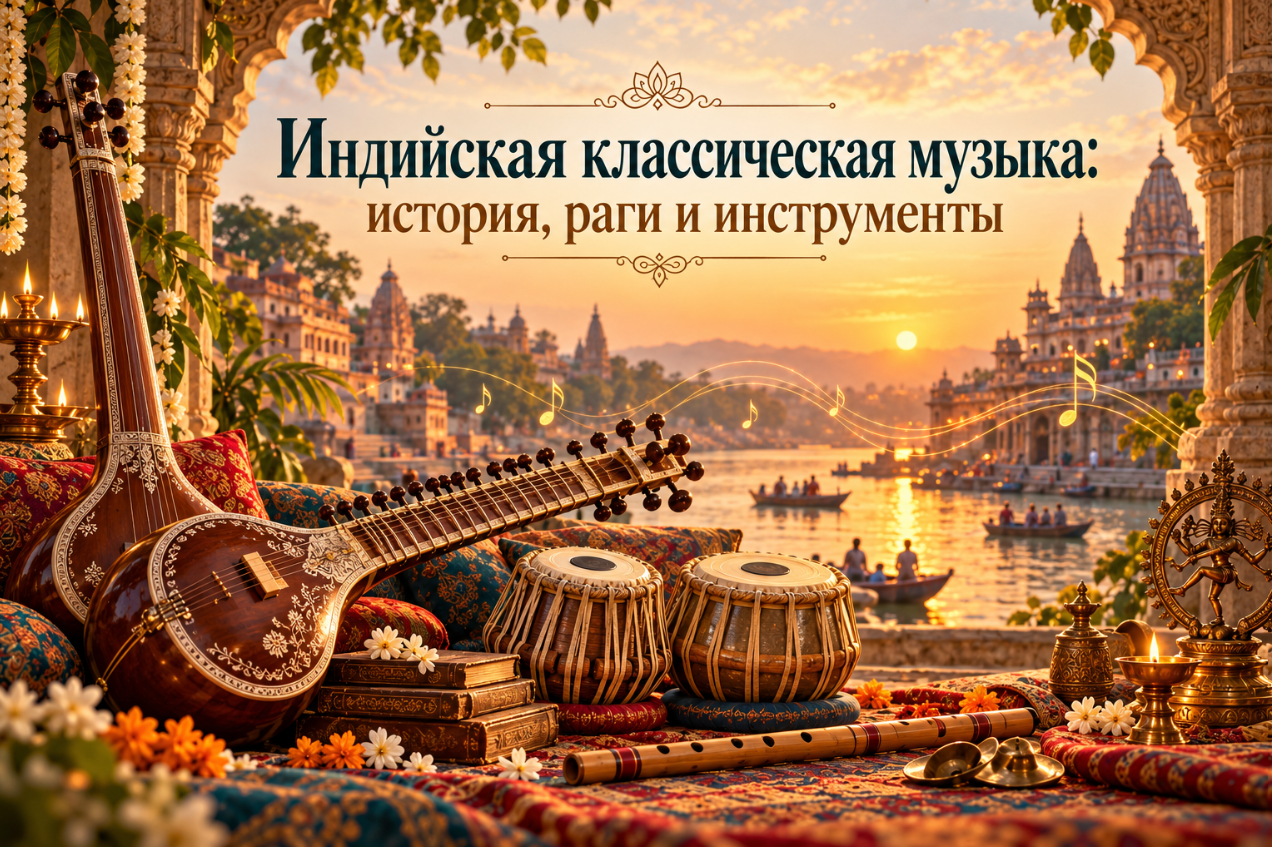
Imagine a musical piece that begins with a single sustained sound. Gradually a melody emerges, barely noticeable changes in intonation appear, and after twenty or thirty minutes the drums enter. Now the music speeds up, turning into a complex conversation between melody and rhythm.
And all this is one piece, which the musician largely creates live during the performance.
This is how a ragacan sound, one of the main forms of Indian classical music.
The uniqueness of this art lies not only in the sound of the sitar or unusual rhythms. India developed its own musical system, in which the finest changes in pitch, improvisation, and the connection of music with the time of day, nature, and human emotions are of great importance.
Its history spans millennia. It combines ancient ritual chants, musical theory, the art of court musicians, spiritual traditions, and modern concert culture.
The origins of Indian music: from Vedic hymns to musical theory
One of the oldest preserved layers of Indian sound culture is Vedic chants.
The Vedas are collections of sacred texts of Ancient India, created and transmitted over a long period. Their oldest layers date back to the 2nd millennium BCE.
Especially important for the history of music is the “Samaveda” — one of the four Vedas, containing hymns intended for special melodic performance during religious rituals.
Many of its texts date back to the more ancient Rigveda, but they develop their own system of musical recitation.
The transmission was primarily oral. Students memorized not only the words but also pitch accents, sound durations, intonational movements, and special methods of repetition.
This system allowed complex forms of singing to be preserved over many generations. Today the tradition of Vedic chanting is recognized by UNESCO as an intangible cultural heritage of humanity..
Centuries of development lie between ancient ritual chants and the modern concert raga. Indian musical culture gradually developed its own concepts of sound, melody, rhythm, and artistic experience.
"Natyashastra": the art that creates experience
One of the most important ancient Indian treatises is "Natyashastra",traditionally attributed to Bharata — the legendary sage and theorist of performing arts.
The exact dating of the work remains debated: its various parts were formed approximately in the last centuries BCE and the first centuries CE.
"Natyashastra" is dedicated to theater, dance, music, acting, and other forms of artistic performance.
A special place in the treatise is occupied by the concept rasa. The Sanskrit word rasa means "taste," "essence," or "juice." In Indian aesthetics, it denotes the artistic experience that arises in a person when perceiving art.
Bharata's traditional system identifies eight primary rasas: love, laughter, compassion, anger, heroism, fear, disgust, and wonder. Later, a ninth rasa — shanta,associated with peace and tranquility — became widespread.
The formulation of the question itself is interesting. Art is considered not only as a sequence of images, words, or sounds. What matters is the state that arises in a person upon encountering a work.
This idea later became one of the important components of Indian musical aesthetics.
Matanga and the theory of raga
Another outstanding monument is "Brihaddeshi",a musical treatise by the Indian theorist Matanga, usually dated to the early medieval period, approximately the 7th–9th centuries.
It is one of the earliest surviving sources that thoroughly explain the concept of raga..
The name is linked to the Sanskrit root ranj, meaning "to color." Music seems to color a person's perception with a certain emotional shade.
Matanga examines relationships between sounds, methods of melody construction, and features of musical forms. The treatise is included among the publications of the Indira Gandhi National Centre for the Arts..
In the 13th century, the Indian scholar Sharngadeva created "Sangita-ratnakara" — "Ocean of Music," one of the most influential medieval treatises.
Its chapters are devoted to musical sound, ragas, composition, rhythm, instruments, and dance.
Thus, by the medieval period, Indian music already had a developed theoretical system that continued to evolve alongside performance traditions.
Northern and Southern India: two directions of classical music
Over time, two main classical musical traditions formed in India.
Hindustani is the classical music of Northern India, developed in close interaction with the cultures of various South Asian regions.
Carnatic music is the classical tradition of Southern India, especially widespread in the modern states of Tamil Nadu, Karnataka, Andhra Pradesh, and Kerala.
Both systems use ragas — melodic patterns — and talas, that is, rhythmic cycles. However, they differ in repertoire, performance forms, approaches to improvisation, and the composition of instruments.
Northern music was noticeably influenced by interaction with Persian culture and the musical traditions of the Islamic world.
In the court environment, new vocal genres developed, instrumental art was refined, and methods of musical performance changed.
One of the most important North Indian genres is khayal,a classical vocal performance of ragas that allows wide melodic improvisation. Its name is related to the Persian word for "thought" or "imagination."
Another genre is dhrupad,an ancient form of North Indian classical singing known for its strict organization and long, gradual unfolding of the raga.
In South India, vocal compositions called kriti gained special significance — works with poetic texts and a stable musical foundation around which improvisation can develop.
Therefore, Indian classical music does not represent a single style. It is several large interconnected traditions with many schools of performance.
The seven sounds of Indian music
At the core of Indian musical training lie seven basic musical steps — svara..
Their abbreviated names are: Sa, Re, Ga, Ma, Pa, Dha, Ni.
The full Sanskrit names are shadja, rishabha, gandhara, madhyama, panchama, dhaivata, and nishada.
They resemble the European "do, re, mi, fa, sol, la, ti," but are organized according to their own principles.
For example, Sa — the main reference tone — is not tied to a single absolute pitch. The performer chooses a suitable pitch, and the other notes are considered relative to it.
In North Indian classical music, there are also lowered variants of Re, Ga, Dha, and Ni, and a raised variant of Ma. Together with the main steps, they form twelve basic pitch positions.
However, the expressive possibilities of Indian music are not exhausted by these twelve notes.
Twenty-two shrutis
In ancient Indian musical theory, there is the concept of shruti, a subtle difference in pitch perceived by the ear.
Classical texts consider twenty-two shrutis within an octave.
Sometimes this is explained as if India had twenty-two notes instead of the usual twelve. But such a comparison is inaccurate.
Shruti should not be imagined as twenty-two equal steps dividing the octave evenly.
It is a complex historical concept whose meaning has changed in musical theory. The relationship between ancient descriptions of shruti and modern performance practice remains a subject of musicological research.
At the same time, the culture of subtle intonational distinctions indeed occupies a huge place in Indian classical music.
Why one musical notation is not enough
An Indian musician can not only move from one note to another but also smoothly change the pitch.
This technique is called meend meend — sliding between pitch steps.
Another important term is gamaka.It denotes various ways of expressively altering the sound: pitch oscillations, melodic bends, rapid intonational movements.
These techniques are not always mere embellishments. In some ragas, they help define the character of the melody.
Two performers can play the same sequence of sounds, but if each uses different intonational movements, the musical impression will be completely different.
Hence the special importance of oral transmission and learning directly from the master.
Indian Music and the West: What Happened During the Colonial Period
In the 19th century, when India was under British colonial rule, European musical culture began to have a more noticeable influence on the country's musical life.
Western instruments, European musical notation, and new forms of musical education spread.
However, traditional Indian music continued to develop within its own schools of performance.
One vivid example of cultural interaction was the harmonium, a European keyboard instrument in which sound is produced by air flowing through metal reeds.
In India, its portable version—the harmonium—became widespread; it is played sitting down, with air supplied by hand-operated bellows.
Initially, the use of the harmonium was controversial. Its keyboard with fixed pitches did not allow for reproducing all the intonational nuances of the human voice, which are so important for traditional raga performance.
Nevertheless, Indian musicians gradually adapted the instrument to their practice. Today, the harmonium is widely used to accompany singing and spiritual chants.
This example is described in detail in the material of the Russian National Museum of Music “Indian Harmonium.”.
How the Modern System of Musical Education Emerged
At the turn of the 19th and 20th centuries, a movement to preserve and systematize the classical musical heritage intensified in India.
One of its leading figures was Vishnu Narayan Bhatkhande (1860–1936), a musicologist, researcher, and educator.
He traveled across India, studied musical manuscripts, met performers from various schools, recorded traditional compositions, and compared them.
Bhatkhande proposed an influential system for classifying North Indian ragas and developed a method for their musical notation.
Another outstanding figure was Vishnu Digambar Paluskar (1872–1931), a singer and teacher.
In 1901, he founded the Gandharva Mahavidyalaya music school in Lahore, now located in Pakistan.
Paluskar created educational materials, developed his own notation system, and sought to make classical musical education more accessible to the general public.
Previously, education often took place within families of hereditary musicians or directly with a teacher who transmitted knowledge mostly orally to the student. New schools, textbooks, and collections of musical notation significantly expanded the circle of learners.
At the same time, reforms changed the status of traditional performing communities and the methods of transmitting musical heritage. This was a complex historical process, not a simple return to the previous state.
Indian musical culture sought new ways to preserve its tradition in a changed society.
More about these transformations is told in the book by historian Janaki Bakhle. «Two Men and Music: Nationalism and the Making of an Indian Classical Tradition».
Raga: A Musical Composition That Is Born During Performance
Raga is one of the central concepts of Indian classical music.
It cannot be reduced to a musical scale or a pre-written melody.
Raga represents a system of sound relationships and characteristic melodic movements within which the musician creates their own performance.
Each raga has a specific set of notes, melodic movement features, characteristic phrases, and sounds that have special significance.
Several special terms are used in the North Indian tradition.
Aroha — the characteristic ascending melodic movement.
Avaroha — its characteristic descending melodic movement.
Pakad — a short recognizable melodic phrase or group of phrases characteristic of a particular raga.
Two ragas may use a similar set of notes but differ in the rules of their connection, accents, and the character of their development.
This allows musicians to create unique compositions within a single musical system.
Ragas and Time of Day
In the North Indian tradition, many ragas are associated with specific times of day or seasons.
For example, Bhairav is traditionally linked to morning ragas, Yaman to evening ragas, and Basant is connected with spring.
Raga Families Malhar is associated with the rainy season.
These associations relate to musical customs and aesthetic concepts. They do not mean that listening to a particular raga will inevitably evoke the same mood in every person.
There is also a wonderful tradition of ragamalas — pictorial cycles depicting ragas through human figures, landscapes, and symbolic scenes.
Artists conveyed anticipation of meetings, love, separation, evening calm, spring blossoming, or the approach of rain. In this way, the musical image transitioned into poetry and painting.
Examples can be viewed in the archive of the exhibition "Ragamala: Picturing Sound" at the Metropolitan Museum..
How Raga Performance Develops
In North Indian classical music, there are several characteristic stages in the unfolding of a raga.
Alap — the free development of melody
Alap — the introductory part in which the musician acquaints the listener with the character of the raga.
There is no established rhythmic cycle here yet.
The performer gradually introduces individual notes, demonstrates characteristic melodic movements, expands the range, and complicates the musical texture.
Alap can be short or last for tens of minutes.
Interestingly, the absence of percussion does not mean the absence of internal organization. Musical time is created by the length of phrases, pauses, returns, and changes in melodic tension.
Jor, jhala, and gat
In some instrumental traditions, after the alap follows jor — a section where a distinct regular pulse appears, but percussion does not necessarily enter yet.
Jhala — a faster and more intense section where rhythmic movement plays a significant role.
Gat — an instrumental composition with a specific melodic foundation, developing within a rhythmic cycle.
The exact sequence and character of these sections depend on the performance tradition.
Most importantly, the raga can progress from an almost motionless sound to complex musical improvisation without losing its character.
Tala: rhythms that can contain dozens of beats
The rhythmic system of Indian music is no less amazing.
Its main concept is tala, a repeating rhythmic cycle with a specific internal organization.
In the North Indian tradition, the counting unit is called matra.
Tala can include seven, ten, sixteen, or another number of beats.
One of the most well-known cycles is tintal, containing sixteen beats grouped into four sets of four.
Jhaptal contains ten beats grouped in the pattern 2 + 3 + 2 + 3.
Rupak is a seven-beat cycle with an internal grouping of 3 + 2 + 2.
At the same time, the number of beats does not mean the number of individual drum hits. Several sounds can occur within each beat, and the performer can create complex rhythmic patterns.
Why the first beat is so important
In North Indian music, the first beat of the cycle is called sam. It is the main point of return.
A musician can develop a long rhythmic or melodic improvisation so that its ending precisely coincides with the start of the next cycle.
Performers mark the internal structure of the tala with hand claps and other hand movements.
Some key points are marked without a clap — these are called khali, meaning "empty."
The system of spoken syllables — bols— also has special significance. Each bol represents a specific way of striking the drum or a combination of strikes. Therefore, a rhythmic composition can be not only played but also spoken aloud.
A rhythmic cycle of 29 beats
Especially long cycles are found in Carnatic music of South India.
There, seven main types of talas are traditionally distinguished, each of which can combine with five variants of length for a certain rhythmic part. Together they form a system of thirty-five talas.
One example is Sankirna-Jati Dhruva-Tala, containing twenty-nine counting beats. Its structure: 9 + 2 + 9 + 9.
Imagine a musical sequence that must pass through all these beats before the next cycle begins.
For a skilled performer, such a structure is not an obstacle but a space for rhythmic creativity.
In a long cycle, one can develop unexpected combinations, change the density of sound, and create a tense anticipation of returning to the beginning.
But the impact of rhythm is determined not only by its length. Tempo, the character of accents, the virtuosity of musicians, and the listener's ability to perceive the entire structure also matter.
Musical instruments of India
The diversity of Indian musical culture is especially noticeable in its instruments.
Even in the ancient "Natya Shastra," musical instruments were divided into four groups based on the method of sound production: stringed, wind, membranophone drums, and instruments where the body itself produces sound, such as metal cymbals and bells.
This classification shows that ancient Indian musical theory was interested not only in the purpose of instruments but also in the very nature of sound generation.
Sitar
Sitar is one of the most famous plucked string instruments of North India.
It has a long neck, strings, and a resonator. Many modern sitars have additional strings that resonate with the main ones.
A special fret design allows the performer to pull the string and smoothly change its pitch. Thanks to this, the sitar can create characteristic sliding movements, which are so important for performing ragas.
Sarod and vina
Sarod — another North Indian plucked string instrument. Its smooth fingerboard allows for long melodic slides.
Vina — an ancient name for a whole family of Indian string instruments. Different types of vina are used in North and South Indian classical music. Especially well-known is the saraswati vina, which holds an important place in the Carnatic tradition.
In Indian iconography, the vina is often associated with the goddess Saraswati — the patroness of knowledge, arts, and learning.
Tanpura — the instrument of continuous sound
Tanpura holds a very special place. It is a string instrument that usually does not play the main melody.
Its strings sound sequentially and regularly, creating a stable acoustic foundation.
Against this background, the performer builds the melody and senses the finest intonational relationships between the sounds.
The tanpura forms a characteristic sound environment, well recognized in Indian classical music.
Sarangi and bansuri
Sarangi — a bowed string instrument whose sound can convey smooth intonational movements reminiscent of the human voice.
It is traditionally associated with accompanying vocal performances, but there is also independent concert playing on the sarangi.
Bansuri — a transverse bamboo flute widely used in Indian musical culture.
Here, the character of the melody directly depends on the performer’s breath, the direction of the airflow, and the specifics of sound production.
Tabla and pakhawaj
Tabla — a pair of drums played with fingers and palms.
The drums differ in size, pitch, and sound production techniques. Their combination allows for creating rich rhythmic sequences.
Pakhawaj — a large double-headed drum especially associated with the ancient vocal tradition of dhrupad.
It has a powerful, deep sound and is used for performing complex rhythmic cycles.
Mridangam and ghatam
In South Indian music, the central percussion instrument is the mridangam — a double-headed drum played with the hands.
Its sound can be deep, ringing, muted, or sharp depending on the playing technique.
Another unusual instrument is the ghatam, a clay pot used as a percussion instrument.
The musician plays with fingers, palms, and various parts of the hand, extracting many timbres from the surface of the vessel.
Indian music shows that complex musical art can develop not only on instruments with many strings or keys but also on objects of extremely simple external form.
More about the history and construction of instruments can be read in the material from the Metropolitan Museum “Musical Instruments of the Indian Subcontinent”.
Spiritual chants of India
Classical concert ragas make up only one part of Indian musical culture.
Religious chants hold a special place, where sound becomes a part of the spiritual life of an individual and the community.
Bhajan
Bhajan — a religious song dedicated to a deity or spiritual experience.
Its lyrics can express love, devotion, gratitude, and the desire for spiritual union.
Bhajans are distinguished by a great variety of melodies and performance styles. They can be heard in temples, home religious gatherings, or public performances.
Kirtan
Kirtan — a form of spiritual singing, often involving group participation.
The leader sings a phrase, and the others respond or repeat it. Here, listening is combined with singing, and individual experience merges with the collective.
Some kirtans are performed calmly and drawn out, while others gradually become more rhythmic and energetic.
Sankirtana Manipura
Represents a special tradition, Sankirtana Manipura — a collective religious performance from the northeastern region of India.
It combines singing, drums, and dance, accompanying religious events and important moments in the life of the community.
In 2013, this tradition was included in the UNESCO Intangible Cultural Heritage list..
Qawwali
Qawwali — a form of Sufi spiritual singing that developed on the Indian subcontinent.
Sufism unites various mystical branches of the Islamic tradition, where love for God and spiritual experience are of great importance.
Qawwali combines poetic text, vocal improvisation, repetitive phrases, and rhythmic accompaniment. The performance can reach immense emotional intensity.
Thus, spiritual music of India is far from always quiet and measured. It can be contemplative, solemn, joyful, or extremely energetic.
Sound and concentration in the yogic tradition
A special perspective on sound is also presented in yogic texts.
In In the “Hatha Yoga Pradipika,”The treatise by the Indian author Swatmarama, usually dated to the 15th century, describes nada-anusandhana — the practice of concentration on sound.
In the fourth chapter of the treatise, there is discussion of internal sound experiences that the practitioner may perceive during deep concentration.
These sounds are compared to drums, bells, conch shells, flutes, the vina, and the buzzing of bees.
Gradually, attention is directed toward subtler sounds.
This practice differs from listening to ordinary music recordings. However, it shows how important sound could become as an object of concentration in the Indian spiritual tradition.
"Hatha Yoga Pradipika," Chapter Four — Nada and Concentration.
What modern research says about the perception of Indian music
Today, music psychology studies how people perceive different musical structures and what emotional reactions arise during listening.
2015 Study: Ragas and Emotions
In 2015, a journal Frontiers in Psychology published a study on the emotional perception of North Indian classical music.
The analysis included evaluations from 122 participants from Indiawho listened to excerpts of twelve ragas.
Each raga was presented in two forms: alap — a free melodic development without a fixed rhythmic cycle — and gat, accompanied by a regular rhythm.
Researchers found that emotional perception depended not only on the sound organization features of the raga but also on the manner of its performance.
Some excerpts perceived as calm in the alap form were more often rated as joyful in the more rhythmic version.
The authors linked the characteristics of emotional coloring to the pitch relationships between sounds, and tempo and rhythm regularity to the level of emotional arousal.
2015 Study: Emotional responses to Hindustani raga music.
2022 Study: Anxiety and physiological reactions
Another randomized study involved 140 healthy young people aged 18 to 30 years.
Participants were divided into four groups. Three groups listened to instrumental recordings of ragas Miyan Ki Todi, Malkauns, and Puria. The fourth served as a control group and rested with brief inclusions of nature sounds.
Researchers assessed anxiety, heart rate, heart rate variability, and some biochemical stress markers.
In the Puria raga group, there was a statistically significant decrease in current anxiety when comparing pre- and post-listening measures. However, differences between groups in the magnitude of anxiety change were not statistically significant..
Some physiological changes were also observed under control conditions. The results show that the effects of specific musical recordings can be studied experimentally. However, they do not yet provide grounds to consider certain ragas as proven treatments for diseases.
2022 Study: Effect of Indian Music as an Auditory Stimulus.
How to learn to listen to Indian classical music
For a first acquaintance, it is better to choose a full performance of one raga.
A good example is Raga Yaman Kalyan performed by Krishna Mohan Bhatt, a master sitar player. He is accompanied by the well-known tabla player Anindo Chatterjee.
The concert recording was made on May 30, 2003, at the Freer Gallery of the Smithsonian Institution in Washington.
Listen to Raga Yaman Kalyan — Krishna Mohan Bhatt, YouTube.
In this concert, you can follow the gradual development of one raga.
The first nineteen minutes feature the alap — a free melodic exposition without percussion. From the nineteenth minute, a regular rhythmic pulse appears. Around the thirty-second minute, the tabla enters, and the music turns into a complex dialogue between melody and rhythm.
Try first listening to the beginning, then move to a later fragment. The difference in sound is very significant.
Upon repeated listening, it is interesting to follow not only the main instrument but also the constant sonic foundation, characteristic melodic phrases, and moments when the rhythmic cycle returns to its beginning.
Attentive listening can also become an independent concentration exercise. You can read more about this in the YogaJoy article. "How to Train Concentration: 7 Practical Exercises".
For readers just beginning to explore Indian music, we have prepared a separate article "Indian Music: What is a Raga and How to Listen to It". It helps to hear the main features of a raga on a specific concert recording.
When music stops being just background
Indian classical music reveals the richness of relationships between sound, time, and human attention.
A single melodic phrase can gradually change, acquire new meaning, and return after several minutes. A long rhythmic cycle creates anticipation that resolves only when it returns to its beginning. Even a single note can become an independent musical event.
The history of this culture shows how diverse the paths of musical art development can be. Vedic chants were followed by musical treatises, complex raga systems, court schools, spiritual traditions, new instruments, and modern teaching methods.
And all this heritage continues to live in the performances of contemporary musicians.
Music ceases to be background the moment its development becomes significant to us. We remember the phrase that sounded, distinguish its changes, and begin to expect continuation. Then listening turns into an independent experience in which sound and human attention continuously interact with each other.