Articles
How to incorporate relaxation into everyday life: simple daily practices
Seven simple ways to relax at home: breathing, Shavasana, evening yoga, meditation, gentle movement, and short daily breaks.
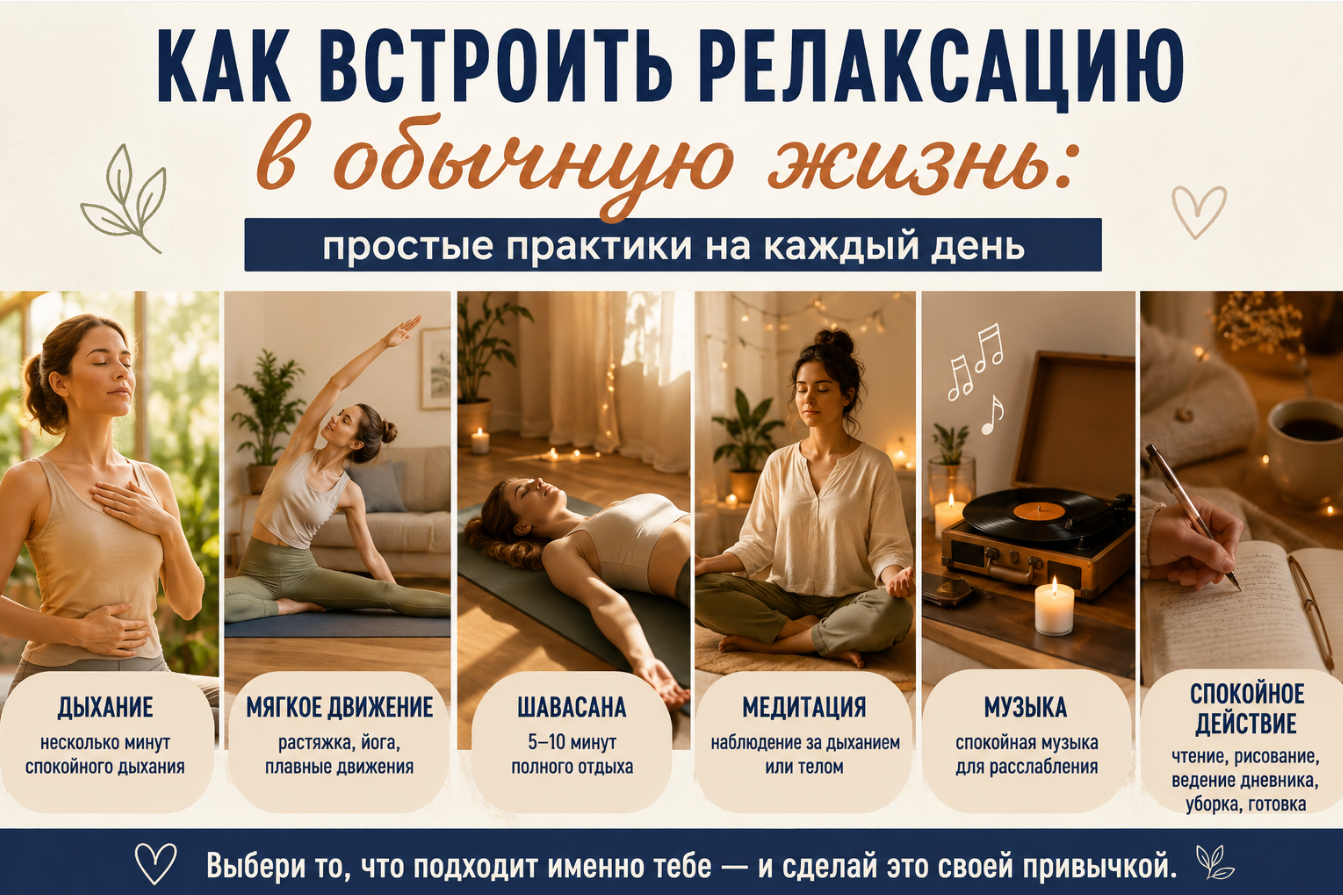
How to incorporate relaxation into everyday life: simple daily practices
Briefly: what is important to understand
-
You don't need a free hour to relax.
-
Even 10–20 minutes without your phone and tasks can become a full pause.
-
You can relax through breathing, gentle movement, Shavasana, meditation, music, or calm repetitive actions.
-
Shavasana is not just lying down, but a distinct relaxation practice.
-
The main thing is not the form, but the change in state after the practice.
-
A small regular pause every day is better than rare rest only when you have no strength left.
Don't wait for time to appear
One of the most common phrases:
"I don't have time."
No time to rest.
No time to practice.
No time for silence.
But free time rarely appears on its own.
One task ends — another begins.
Therefore, it's better not to wait for relaxation, but to deliberately integrate it into your day.
10–20 minutes is enough to start.
No perfect moment is needed.
No special room is needed.
No special mood is needed.
What matters is truly stepping out of the usual flow of tasks and information during these minutes.
Phones and social networks can distract.
But distraction and relaxation are not always the same.
Practice 1. Pause without your phone
Put your phone aside for a few minutes.
Sit comfortably.
Look out the window.
Listen to the sounds.
Feel your body.
You don't need to achieve anything.
Don't respond.
Don't plan.
Don't check.
Don't scroll.
Just spend a few minutes being exactly where you already are.
For a modern person, such a simple pause can sometimes be surprisingly difficult.
That's why it can also be trained.
Practice 2. Calm breathing
You don't need to try to breathe as deeply as possible.
Breathing should not be turned into an exercise focused on results.
Spend a few minutes observing your natural inhale and exhale.
Feel the movement of your belly and ribs.
If comfortable, allow your breath to gradually become calmer.
You can make the exhale a little softer and longer.
The task is simple:
to shift your attention from the endless flow of thoughts to what is happening right now.
To do this, you can choose breathing practices for relaxation and calming.
Practice 3. Calm repetitive action
Not everyone finds it easy to relax in complete stillness.
Sometimes calm repetitive activities work better:
-
walking;
-
knitting;
-
drawing;
-
playing a musical instrument;
-
caring for plants;
-
reading;
-
watching water or fire;
-
softly chanting sounds.
The main simple criterion is:
after this activity, the mind should become calmer, not more agitated.
What relaxes one person may not work at all for another.
Therefore, personal experience is important here.
Practice 4. Gentle Evening Yoga
After a busy day, the body often needs not a new load, but a chance to release accumulated tension.
Evening practice can include gentle movements for the back, neck, pelvis, and chest, calm breathing, and longer relaxation at the end.
There is no need to strive for complexity.
Evening yoga is not a test of flexibility.
Its purpose can be quite different:
to gradually transition the body from activity to rest.
You canshchchoose the rightyoga practice based on level, time, and goal.
Practice 5. Legs on the Wall
When you have little energy, you can lie on your back and place your legs on the wall or another comfortable support.
This is a gentle restorative option, similar to Viparita Karani (Viparita Karani).
Do not strive to achieve the "perfect" form.
Get comfortable.
Relax your face.
Your shoulders.
Your abdomen.
Breathe calmly.
Stay in this position for a few minutes if it feels comfortable and does not cause any discomfort.
Practice 6. Shavasana
Shavasana (Śavāsana) looks almost too simple on the outside:
lie on your back and do nothing.
But ordinary lying down and Shavasana are not quite the same.
In in a study on recovery after physical exertion pulse and blood pressure returned to baseline faster during a standard Shavasana practice than during ordinary resting lying down or sitting.
The point here is not that lying on your back has some magical effect.
Shavasana is a relaxation technique.
In it, we consciously stop holding the body.
We release the face.
Jaw.
Your shoulders.
Your abdomen.
The arms.
The legs.
We don’t try to control every breath.
We don’t continue mentally replaying today’s conversations.
We don’t solve tomorrow’s tasks.
The body lies still.
Breathing happens.
And attention gradually stops clinging to every tension.
That’s why Shavasana also needs to be learned.
Practice 7. Meditation for Relaxation
If it’s difficult to stop the flow of thoughts on your own, you can use guided meditation.
The voice guides attention through the body, breath, and sensations — so the person doesn’t have to decide all the time what to do next.
On YogaJoy you can find meditations for deep relaxation.
It’s not necessary to start with a long practice.
Sometimes 10–15 minutes is enough to feel the difference between the state before and the.
Once a week — a deeper pause
Besides short daily practices, it’s sometimes useful to set aside more time.
This can be:
-
massage;
-
swimming pool;
-
yoga nidra;
-
a calm walk by the water;
-
sound practice;
-
meditation;
-
gentle yoga;
-
favorite music.
You can also use music for relaxation and meditation.
It’s not necessary to choose the “most correct” practice.
Choose the one after which you truly feel:
less tension, more breathing, and quietness inside.
Conduct a small experiment
Choose one practice this week.
Not five.
Not ten.
One.
And do it several times.
After each time, ask yourself:
What has changed in the body?
Is it easier to breathe?
Has your face relaxed?
Have your shoulders softened?
Is it quieter inside?
Has your energy changed?
Do you want to repeat it?
This is how the most valuable knowledge appears — not a theory about relaxation, but an understanding:
of what exactly helps you relax.
When such an action is repeated regularly, relaxation gradually stops being an emergency aid after exhaustion.
It becomes part of everyday life.