Articles
Cortisol, oxytocin, and our reactions: how our state changes the body — and what we can change ourselves
How stress and repetitive thoughts affect the state of the body and how breathing, yoga, meditation, and attention help change habitual reactions.
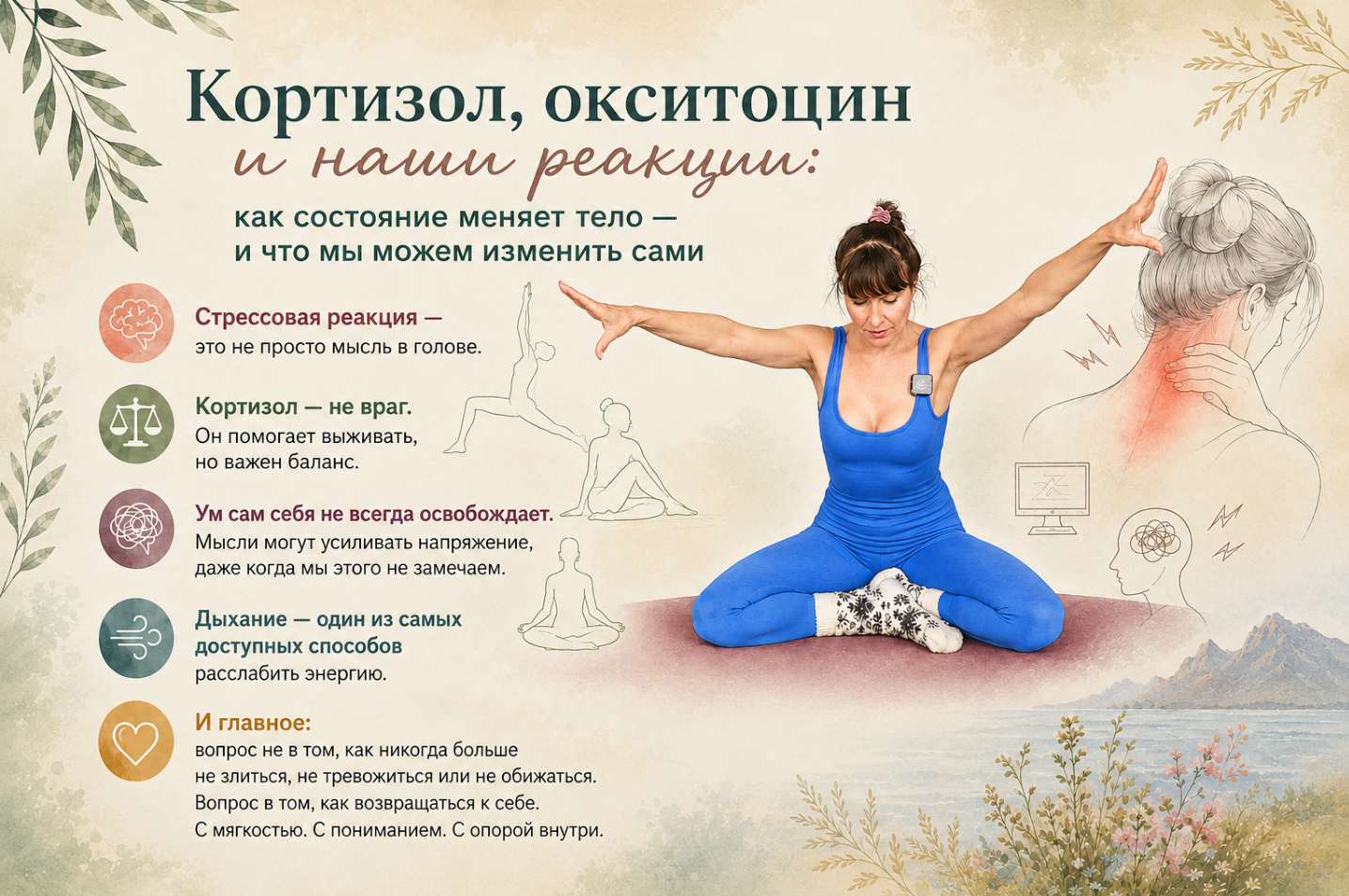
Briefly: what is important to understand
The stress response is not just a thought in the head. It quickly becomes a state of the whole body: breathing, muscle tension, heart rate, attention, and the functioning of systems that help us mobilize all change.
Cortisol is not the enemy. It is essential for the body. The problem is not that we can activate a stress response, but that sometimes we continue to maintain this arousal even after the situation itself has ended.
The first impulse often arises automatically. But even this automatism is not a final given. With the practice of mindfulness, a person can notice the moment their reaction begins earlier and earlier—sometimes even before it fully takes over their thoughts, body, and behavior.
The mind does not always free itself. When a thought has already gone in circles, trying to think about how to stop thinking can only continue this process.
Then you can change not the thought itself, but the state from which it arises: through breathing, movement, body sensations, meditation, and relaxation.
Breathing is one of the most accessible ways to enter this cycle from the other side. Slow controlled breathing is studied as a tool for changing physiological arousal and subjective stress.
And most importantly: the question is not how to never get angry, anxious, or offended again. The question is how much of our life, attention, and energy we are willing to give to each unpleasant situation—and whether we can choose a different scenario.
Now, in more detail
Imagine a completely ordinary situation.
Someone cut you off on the road.
Someone said an unpleasant phrase.
A person acted completely differently than you expected.
You were misunderstood.
Something fell through.
You felt injustice.
The reaction arises quickly.
The jaw tightens.
The shoulders tense up.
Breathing changes.
Attention instantly sticks to the irritant.
The body mobilizes.
This does not mean that there is something wrong with us.
This is how the adaptation system works.
But then the most interesting part begins.
The event is already over. But we continue it ourselves.
The car that cut us off has long gone.
The conversation is over.
The person who made us angry is already going about their business.
And inside, a second conversation begins.
"Why did he say that?"
"I should have responded differently."
"Why did I even let that go?"
And then the mind starts gathering the perfect response, which for some reason comes only after the conversation..
We return to the situation again.
Then once more.
We tell it to another person.
After a few hours, we discover a new detail that especially hurt us.
A paradox emerges:
the event lasted five minutes, but inside ourselves we can continue it for five hours, five days, sometimes much longer.
That is, part of our own life we continue to give to what has already ended.
Attention.
Mood.
Time.
Energy.
What in everyday life we often call "energy.".
And this is not just a philosophical observation. Studies of rumination — the repeated mental return to a stressful event — link it to longer physiological recovery after a stressor and features of the cortisol response.
Cortisol is not a bad hormone.
Today the word "cortisol" has become so popular that sometimes it creates the impression: the less of it, the better.
But that's not the case.
Cortisol is necessary for the body.
It participates in adapting to stress, mobilizing resources, and normal regulation of the body.
We need the ability to activate.
We need energy to take action.
The problem is not that the system can activate..
The problem begins when it becomes difficult for it to finish the reaction and return back.
The real conflict has ended, but the internal conflict continues.
The body lies in bed in the evening, but the mind is still engaged in the morning conversation.
The danger is gone, but we mentally replay it again.
Therefore, it is more useful to ask not:
"How can I make sure my cortisol never rises?"
But:
"How can I learn to return to balance (including hormonal) faster after stress or any load?"
The initial reaction is also not a final given.
There is an important subtlety here.
We often say:
the first reaction arises automatically, and freedom of choice begins only after it.
For starters, this is a workable model.
First, a person learns at least to notice:
"I am already angry."
"I feel hurt right now."
"I want to immediately prove that I am right."
And not allow this state to automatically determine everything that happens next.
But there is a deeper level of practice.
Over time, one can learn to notice not only the anger or fear that has already arisen, but the very moment when the habitual reaction begins to form..
Not:
"I am already angry."
But:
"I can feel irritation rising inside me right now."
A small space gradually appears between the event and the habitual response.
And then the choice arises earlier.
This is no longer a five-minute technique.
Such an ability truly requires deep and regular mindfulness practice.
But the very possibility is very important:
even the first habitual reaction does not necessarily remain unchanged for life.
First, we notice the consequences of the reaction.
Then the reaction itself.
Then the moment of its birth.
And earlier and earlier, space for choice appears.
But the mind does not always free itself.
Here one of the central ideas of this article emerges.
It is possible to understand very clearly:
"The situation is over."
You can tell yourself ten times:
"Calm down."
"Don't think about it."
"It's not worth my nerves."
But the thought still comes back.
There is a very precise practical formula:
the mind does not always free itself.
Sometimes the attempt to think even more about how to stop thinkingjust becomes a continuation of the same internal process.
Because the reaction is no longer only in the head.
The body is aroused.
Breathing has changed.
Muscles have tensed.
Attention has narrowed.
What in yogic practice we often call "energy excitation"is described by modern physiology with a related concept — physiological arousal. arousal.
The state of the entire system changes.
And a vicious circle arises:
an aroused mind sustains the body's arousal, and the aroused body fuels the mind again.
Therefore, sometimes it is useless to spend another half hour explaining to yourself why "you shouldn't be nervous."
You can approach it from another angle.
Through breathing and the body.
Why breathing can change the state
Breathing occupies a very special place.
On the one hand, it automatically changes along with our state.
We got scared — breathing changed.
We got angry — it changed.
We relaxed — it changed again.
But at the same time, breathing is one of those functions we can consciously influence right now.
A systematic review of slow breathing studies shows changes in autonomic nervous system activity and heart rate variability; among psychological effects noted in studies were relaxation and reductions in arousal, anxiety, and anger.
A meta-analysis of randomized breathing practice studies also found a decrease in subjective stress.
And in a separate randomized study of structured breathing practices, five minutes of breathing daily for a month improved mood and reduced physiological arousal; the variant emphasizing the exhale was especially interesting.
This does not mean:
"Breathed properly — and the thought disappeared."
The meaning is more interesting.
We stop trying to calm the mind with the mind alone.
We first change the breath.
Through the breath — the state of the body.
Through the body — the level of arousal.
And from a different state, the mind finds it easier to let go of the thought.
That is, we change not only the content of the thought.
We change the state from which this thought arises.
A short breathing practice when the mind is already "wound up".
If you find yourself repeatedly returning to an unpleasant situation, try stopping thinking about it for a few minutes.
Feel your feet.
Relax your jaw.
Lower your shoulders.
Take several slow, comfortably deep inhales and exhales without holding your breath..
Don't try to inhale the maximum possible amount of air.
We don't need intensity.
We need to gradually change the rhythm.
Inhale.
Calm exhale.
Inhale again.
Exhale again.
Now shift your attention directly to the breath.
How does the air enter?
How does the chest move?
How does the belly move?
How does the exhale begin?
How does it end?
You can allow the exhale to become a little softer and longer — without effort.
If dizziness or discomfort appears, simply return to your normal breathing.
And here the task is fundamentally different:
not to force the mind to calm down, but to change the state from which the mind continues to think.
Sometimes this is exactly how space reappears between a person and their thought.
And a good state shouldn't be just fleeting.
There is another side.
We can spend several hours with unpleasant experiences.
But a pleasant state sometimes passes in a few seconds.
A good conversation.
A beautiful sunset.
A hug.
A feeling of gratitude.
The moment when you suddenly realize:
"I really feel good right now."
Here you can do the opposite.
Don't rush.
Take a calm, deep breath.
If it's comfortable, you can leave a short natural pause after it—without effort.
But the main thing here is not the breath hold itself..
The main thing is to hold your attention inside the pleasant experience..
Feel it with your body.
Don't analyze.
Don't immediately move on to the next task.
Give the state a few extra seconds of space.
This is not a "magical hormone-fixing technique."
It's a simple attention training:
we don't have to hold onto unpleasant things for hours, and good things don't have to automatically pass by in two seconds.
What really solves the situation?
After the excitement has calmed down a bit, you can return to the problem.
But with a different question:
"What exactly needs to be done now?"
If the situation can be changed—take action.
Need to talk? Talk.
Need to set a boundary? Set it.
Need to fix a mistake? Fix it.
Need to leave? Leave.
Need to make a decision? Make it.
Energy here is needed for action.
But if the situation is already over and the only remaining action is to continue arguing inside your own head for several more hours, another question arises:
"Why do I keep paying for this with my attention?"
Does it fix what happened?
Does it change the other person?
Does it restore my strength?
Does it help my body?
Or is it just a familiar pattern that triggers the same way every time?
Here it can be put very simply:
if there is an action that truly changes the situation, energy is needed for action.
If there is no such action now, hours of internal replaying still do not become a solution.
You can be firm and not destroy yourself from within.
Working with your reactions is not a call to become a convenient person.
You don't have to agree with everything.
You don't have to tolerate bad treatment.
You don't have to let others violate your boundaries.
You can say "no."
You can end the conversation.
You can demand respect.
You can walk away.
But there is a huge difference between necessary action and hours of internal turmoil after the action.
You can be firm without giving the conflict the rest of your day.
And here comes another important thing — acceptance of imperfection.
We are not machines.
Other people are not machines either.
Everyone has their own experience, character, fears, habits, weaknesses, and blind spots.
And we ourselves are imperfect.
Perhaps this is exactly what makes people interesting — we are different.
Acceptance does not mean approving everything.
Acceptance means seeing reality as it is right now, and only after that consciously deciding what to do next.
Oxytocin: why closeness and safety are also physiology
There is another side to our internal environment.
Not just stress.
Closeness.
Trust.
Support.
Touch.
A person next to whom you don’t have to constantly defend yourself.
The oxytocin system is involved in these processes.
Oxytocin is often called the "love hormone," although its real function is much more complex and context-dependent.
But the connection between social support and stress physiology is very real.
In a study on social support, oxytocin, and cortisol response to psychosocial stress, social support was linked to a lower cortisol response, and the combination of support with experimental oxytocin administration was accompanied by greater calmness and less anxiety.
And for everyday life, the important idea here is not:
"How can I increase oxytocin?"
But rather:
closeness, trust, and a sense of safety are not just pretty abstractions. The body also participates in these states.
Joy, interest, and gratitude are not just "positive thinking."
Positive states also do not exist separately from the body.
Research on positive affect shows connections with certain psychobiological processes related to stress, cardiovascular, and inflammatory physiology.
But a person is much more complex than the formula:
"smiled → released the right hormone → rejuvenated."
We won’t say it like that.
The interesting thing is something else:
the states in which we spend a significant part of our lives create the background on which the body operates and from which we act.
From one state, we make certain decisions.
From another — different ones.
In one, it is easier to move, communicate, sleep, and recover.
In another, a huge amount of resources go into internal struggle.
That is why the practice of gratitude it is interesting not as an obligation to "think positively."
It is a training of attention:
to be able to see not only threats and shortcomings but also what already supports our life.
And what does youth have to do with this?
It is important here not to turn science into a beautiful promise.
One quarrel does not "age" a person.
One good day does not "rejuvenate."
But chronic psychological stress is indeed studied in connection with a whole complex of processes related to biological aging: inflammation, mitochondrial function, cellular aging, DNA damage, and telomere biology.
It is not about a single emotion.
It is about a prolonged backgroundon which the body lives for months and years.
And here the quality of our daily reactions acquires a very practical meaning.
Not because we can command ourselves to live a hundred years.
But because we can gradually change the environment of our own life:
how we sleep;
how we move;
how we breathe;
how we recover;
how much time we carry unresolved conflicts within us;
what relationships we maintain;
whether we can notice good states;
whether we can get out of agitation.
The quality of individual days gradually adds up to the quality of life.
And this is exactly where philosophy meets physiology.
If the mind won’t let go — change the channel
Sometimes it is impossible to persuade a thought to leave.
And here we return again to our formula:
the mind does not always free itself.
If there is no other tool, we try to work with a thought by using another thought.
But there are other tools.
Your breathing.
Movement.
The body.
Meditation.
Relaxation.
Music.
Sometimes it's enough to just stand up.
Take a walk.
Feel your feet.
Gently massage your temples or scalp.
Stop replaying the situation in your mind and shift your attention to real sensations.
And if you're at home and can give yourself 10–20 minutes, the possibilities become much greater.
How yoga can help here
Yoga gives attention a very specific task.
Feel the foot.
The position of the pelvis.
The spine.
Balance.
Movement.
Inhale.
Exhale.
The boundary of effort.
The attention that just minutes ago endlessly fueled the inner conflict returns to the body.
That is why the combination
movement + breath + attention + subsequent relaxation
turns out to be much more practical for many people than the demand:
"Just stop thinking about it."
At YogaJoy, you can choose a suitable yoga practice according to your level and condition.
And after the practice, Shavasana is especially important, Shavasana,.
the final practice in a lying position, where after movement we consciously allow the body to transition from effort to deep relaxation.
More about this in the article "Why Relaxation Is One of the Keys to Youthfulness?".
What you can do right on YogaJoy
If an unpleasant situation has already ended but the mind keeps replaying it, it's not necessary to try to solve everything solely with thoughts.
1. Breathing Practices
YogaJoy has a dedicated section "For Relaxation and Calmness".
It includes, for example:
"Adrenal Breathing"
and
"Bee Breath (Bhramari)".
This is a great option when you don't want to spend another half hour discussing the situation with yourself, but rather want to shift your focus to your breath and body sensations.
2. Special "Anti-Stress" Page
On the website, in the "Goals" section,there is an "Anti-Stress" goal, where practices and articles on this topic are collected.
3. Meditations
If you want to go deeper into a state of calm, YogaJoy offers:
4. Music
Sometimes you don’t want to analyze your thoughts or practice a technique.
You can play relaxing music, close your eyes and simply give your attention to another object.
5. If the emotion is strong
If you need not just to distract yourself but to figure out what to do with the emotion itself, there is a separate article about this:
"How to manage emotions without suppressing them?".
The main idea here is to not suppress the experience, but also not allow it to automatically determine your next actions.
A simple algorithm for next time
1. Notice.
"I just got triggered."
2. Name it.
"I am angry."
"I feel hurt."
"I am scared."
"I want to prove something."
3. See your body.
Jaw.
Your shoulders.
Your abdomen.
Your breathing.
Feet.
4. Don’t keep automatically feeding the thought with attention.
If your mind goes in circles, switch to your breath, movement, or body sensations.
5. Ask yourself:
"What action truly changes this situation?"
6. Act — or let go.
If action is necessary, take it.
If the situation is over, decide if you really want to give it the rest of your day.
7. Gradually notice everything earlier.
First the consequences of the reaction.
Then the reaction itself.
Then the moment when it just begins to form.
You won’t succeed every time.
We are not machines.
And the goal is not to become perfect.
The goal is to gradually stop living entirely inside an automatic algorithm.
In conclusion
We cannot make it so the world never irritates us.
We cannot force other people to always behave the way we want.
We cannot cancel mistakes, losses, conflicts, and unpleasant conversations.
But we can gradually change one very important thing:
how much of our own life we are willing to give to each of these situations.
The first impulse sometimes arises faster than we can become aware of it.
But the next hour does not have to belong to it.
The next evening does not have to belong to it.
And with practice, even the impulse itself can become more noticeable at the very moment of its birth.
You can see the reaction.
Feel it.
Change your breathing.
Return to the body.
Do what is truly necessary.
And stop fueling what no longer requires our actions.
This is not mystical control over hormones. This is real work with attention, breathing, the body, the nervous system, behavior, and habitual reactions.
No one can change this algorithm for us.
But the good news is that our habitual reaction is not a sentence.
It can be noticed. Explored. And gradually changed for our benefit.
Sources and research
Zoccola P.M., Dickerson S.S.
Extending the recovery window: Effects of trait rumination on subsequent evening cortisol following a laboratory performance stressor
Psychoneuroendocrinology, 2015.
Raugh I.M., Berglund A.M., Strauss G.P.
Implementation of Mindfulness-Based Emotion Regulation Strategies: A Systematic Review and Meta-analysis
Affective Science.
Heinrichs M., Baumgartner T., Kirschbaum C., Ehlert U.
Social support and oxytocin interact to suppress cortisol and subjective responses to psychosocial stress
Biological Psychiatry, 2003.
Steptoe A., Dockray S., Wardle J.
Positive affect and psychobiological processes relevant to health
Journal of Personality, 2009.
Polsky L.R., Rentscher K.E., Carroll J.E.
Stress-induced biological aging: A review and guide for research priorities
Brain, Behavior, and Immunity, 2022.
Zaccaro A. et al.
How Breath-Control Can Change Your Life: A Systematic Review on Psycho-Physiological Correlates of Slow Breathing
Frontiers in Human Neuroscience, 2018.
Fincham G.W. et al.
Effect of breathwork on stress and mental health: A meta-analysis of randomised-controlled trials
Scientific Reports, 2023.
Balban M.Y. et al.
Brief structured respiration practices enhance mood and reduce physiological arousal
Cell Reports Medicine, 2023.