Articles
Balances in Yoga: Benefits for the Body, Attention, and Brain
Why do balances in yoga require such concentration? We explore how vision, the vestibular system, proprioception, and attention participate in maintaining balance and what neuroscience says about it.
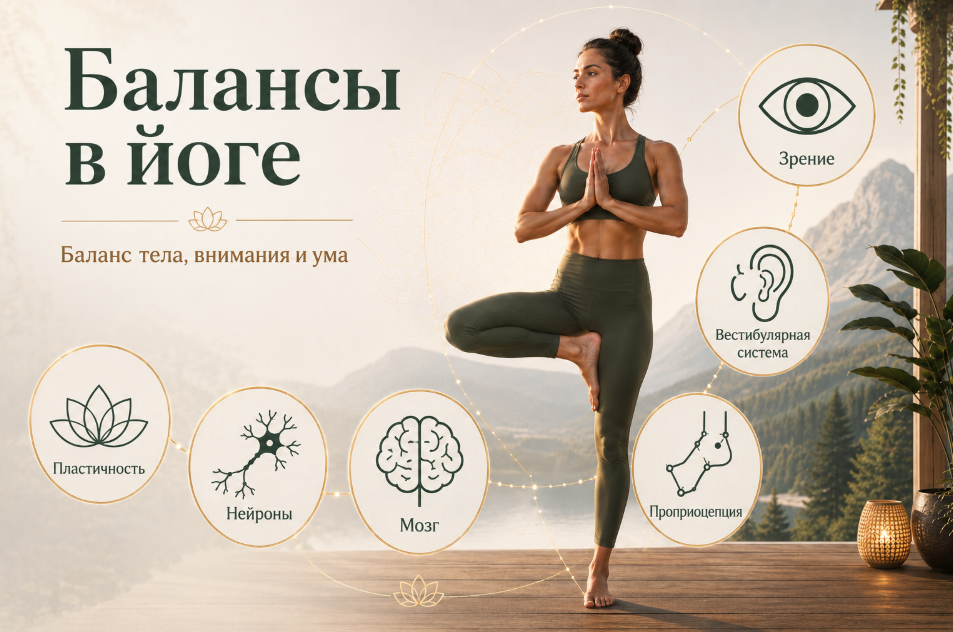
Why Balances in Yoga Are So Beneficial for the Brain: Attention, Coordination, and Presence
Try standing on one leg right now.
And now simultaneously start seriously reading messages on your phone, replying to them, or mentally solving some complex problem.
It gets more interesting, doesn't it?
A stable pose suddenly stops being so simple.
The foot begins to seek a more precise support. The ankle makes barely noticeable corrective movements. The torso slightly tilts. The gaze loses a stable point. Attention flits between the screen and the body.
And here one of the most interesting features of balancing asanas is revealed.
Balance is not just the physical ability not to fall.
It is a complex, subtle, continuous sensorimotor task involving the body, sensory organs, nervous system, attention, and our internal sense of space all at once.
That is why balances in yoga are an excellent trainer not only for stability but also for ATTENTION AND PRESENCE.
Balance does not start with the foot.
When a person stands on one leg, the brain constantly needs up-to-date information:
where the center of gravity is;
how pressure is distributed in the foot;
the position of the head;
where the gaze is directed;
what is happening with the pelvis and spine;
how stable the ankle is;
where the body begins to tilt;
what correction is needed right now.
This beautiful external stillness requires extremely lively internal work.
Modern physiology considers balance control as the result of the interaction of several systems — primarily the visual, vestibular, and somatosensorysystems, including proprioceptive information from muscles, joints, and other tissues.
The eyes inform us about our position relative to the surrounding space.
The vestibular system of the inner ear provides information about the position and movements of the head.
The proprioceptive system creates an internal "map" of the position of parts of our body.
And the nervous system integrates this huge flow of signals into a single, constantly refined sensation:
"Here I am. Here is the space. Here is my vertical."
Postural control studies confirm exactly this kind of multi-level sensory integration. Therefore, good balance is much more than a "strong supporting leg."
Why attention naturally returns to the body during balance
Most habitual daily movements are incredibly automated.
We can walk down a familiar street and simultaneously argue mentally with someone.
Brush our teeth and plan the workday.
Eat and watch a TV series.
Even breathe and hardly notice our own breathing.
But as soon as the motor task becomes a bit more complex, habitual automaticity is no longer enough.
Narrow support.
Unfamiliar hand position.
Slow transition from one asana to another.
Turning the head.
Changing the direction of gaze.
All of this increases the demands on our sensory and motor systems.
And attention becomes part of the task.
Research on the so-called dual task — dual tasking shows that additional cognitive load can worsen some parameters of postural response while simultaneously reducing the quality of performing the cognitive task itself. In other words, attentional resources really have to be divided between "holding the body" and "solving the second task."
Therefore, the feeling:
"When I balance, I have to be HERE"
has a perfectly understandable physiological basis.
And this is what I especially like about yoga.
Sometimes we can explain to the mind for a long time what the present moment is.
And sometimes it’s enough to stand on one leg.
Balances as a practice of concentration
Concentration in yoga is not necessarily sitting still with closed eyes.
Attention can be cultivated through movement.
Moreover, through very bodily, concrete, honest movement.
You immediately notice the moment concentration is lost.
The gaze drifts — stability changes.
Breathing becomes tense — the body stiffens.
Haste appears — subtle coordination disappears.
The thought wanders far away — the pose begins to fall apart.
Balance gives surprisingly fast feedback.
Not philosophical.
Not abstract.
But physical.
Here is my attention. Here is my body. Here is the present moment.
That is why a short balancing sequence can become a wonderful movement practice of concentration.
And do balances really "train the brain"?
Yes — but here the precision of wording is very important.
We will NOT say:
"Stand on one leg — and you will grow new neurons."
Or:
"Balancing asanas rejuvenate the brain."
To date, such direct conclusions would be too bold.
But there are indeed interesting studies.
In a randomized study by Ann-Kathrin Rogge and colleagues, healthy adults performed a special balance training program twice a week for 12 weeks. Afterward, the researchers found not only an improvement in balance itself but also improvements in memory and spatial cognition. At the same time, no improvements in executive functions were found in this study — an important detail that reminds us once again how carefully we need to interpret the results.
In another study by the same research group, after 12 weeks of balance training, MRI revealed changes in cortical thickness in several brain areas associated, among other things, with processing visual and vestibular information. The authors consider these results as evidence of experience-dependent neuroplasticity.
But there is a fundamental difference here.
Neuroplasticity is not the same as the formation of new neurons.
Changes seen on MRI should not be turned into an advertising slogan:
"We grew new neurons."
It is more accurate to say:
a new, sufficiently complex, and regularly repeated motor task can be accompanied by adaptive changes in the function and structure of the nervous system.
And this is already extremely interesting.
The more complex the balance, the greater its cognitive component.
Another curious scientific detail: the connection between balance and cognitive functions is especially noticeable when the motor task becomes more complex.
In a 2023 systematic review and meta-analysis that included studies of healthy older adults, the strongest connection was found between balance and executive functions. Moreover, the correlation of cognitive indicators with dynamic balance was stronger than with static balance.
This does not mean that complex balances automatically make a person smarter.
Correlation does not imply causation.
But this perfectly illustrates something else:
equilibrium is not a primitive muscular function at all.
The more variable, new, and unfamiliar the motor situation before us, the more complex the joint work of sensory, motor, and cognitive processes becomes.
The vestibular system is not just about "not falling."
The role of the vestibular system is especially interesting.
We often remember it only when we feel dizzy or need to maintain balance.
But modern research shows a much more complex picture.
Vestibular information is linked not only to postural control but also to spatial orientation, visuospatial processes, attention, and memory. Modern reviews describe extensive interactions of vestibular signals with cortical and subcortical brain structures.
That is, when we change the position of the head, direction of movement, and orientation of the body relative to space, the nervous system receives rich, multidimensional sensory information.
That is why yoga has never been just "stretching" for me.
It is an incredibly diverse sensorimotor environment.
Tilts.
Extensions.
Twists.
Weight shifts.
Support on one or several points.
Changing the position of the head.
Eye movements.
Coordination of limbs.
Breathing rhythm.
Unfamiliar spatial relationships.
All of this is a huge layer of information about one's own body.
What does Tatyana Chernigovskaya have to do with this?
I really appreciate scientific honesty.
Therefore, I do not want to write:
"As Professor Chernigovskaya proved, balances rejuvenate the brain."
We do not have such data.
In the scientific profile of SPbSU, I did not find any experimental peer-reviewed work by Tatyana Chernigovskaya specifically about yogic balances.
But the topic of the connection between the brain and movement is indeed part of her current scientific interests: on October 15, 2025, her plenary lecture was registered on the SPbU scientific portal. "BRAIN AND MOVEMENT".
And here I feel very close to the scientific logic itself.
A person is not a set of independent parts.
It is impossible to fully consider the brain separately from the body.
Movement cannot be separated from sensory information.
Attention cannot be separated from where the eyes are directed and where the body is located in space.
And yoga cannot be separated into "exercises for the body," "breathing for the lungs," and "meditation for the mind."
That is why at YogaJoy we are so close to AN INTEGRATED APPROACH.
Why YogaJoy is not just a collection of separate asanas
For me, the value of yoga is not in the number of beautiful poses mastered.
And not even in flexibility itself.
LIVING YOGA is a constant interaction of:
BODY + BREATH + ATTENTION + NERVOUS SYSTEM + STATE.
This wholeness is especially visible in balance.
Too rigid a foot means less adaptability.
Tense shoulders mean unnecessary fixation.
Restricted breathing means a different internal state.
A scattered gaze means less visual stability.
An excessive desire to "stand perfectly" means more unnecessary tension.
Calm support, free breathing, steady gaze, soft vertical alignment, clear attention — a completely different quality of the same asana.
That is why our goal is not just to "hold for 60 seconds."
We are more interested in HOW we are there.
Is there breath?
Is there sensitivity in the foot?
Is the face soft?
Is the neck free?
Is the attention calm?
Is there a sense of self?
Only then does balance transform from a small physical challenge into a full-fledged mindfulness practice.
And what does science say about yoga and the brain in general?
Here the data is also becoming more interesting.
In April 2026, a new systematic review of neuroimaging studies on yoga was published. The authors analyzed 23 studies involving healthy participants using MRI, fMRI, and EEG.
Various studies revealed structural and functional features in brain networks and regions associated with executive control, emotional regulation, interoceptive sensitivity, attention, and self-observation.
But the authors emphasize an important limitation: the studies are very heterogeneous — different types of yoga, varying practice durations, different participant groups, and different measurement methods.
Therefore, modern science does not yet allow us to claim:
"This asana changes this specific area of the brain."
However, it gradually supports a much more interesting idea:
yoga as a complex mind-body practice may be associated with changes in distributed systems of self-regulation, attention, interoception, and emotional control.
And this is remarkably in tune with how we perceive the practice at YogaJoy.
Not a separate muscle.
Not a separate asana.
Not a separate inhale.
But a SYSTEM.
How to use balances to train concentration
You don't need to choose a difficult asana right away.
For subtle attention work, the simplest stable one-legged stance is enough.
Try a small practice:
- Create a safe support. Stand next to a wall or a sturdy chair. It's better to start on a flat, hard floor. The difficulty should be interesting but not intimidating.
- Feel your foot. Don't rush to lift the other leg. First, feel the heel, the base of the big toe, the base of the little toe, the weight distribution, and the natural, lively movement of the ankle.
- Choose a calm point to focus your gaze. A fixed visual reference usually makes balancing much easier. At the same time, it creates a wonderful object for training focused attention.
- Lift one leg and stay for 20–30 seconds. Don't strive for perfect stillness. Small sways are a normal part of postural control. We need not stone-like fixation, but calm, adaptive stability.
- Add the breath. Soft, continuous, free. Notice how different the quality of balance becomes without breath holding, clenched jaw, and tense face.
- Only after mastering a stable simple version, add complexity. Different hand positions, slow movement of the free leg, a slight head turn, or a more dynamic transition. Closing your eyes significantly increases balance demands, so this option is only for confident stability and always in a safe environment near support.
You can also add a small experiment.
First, stand on one leg in silence.
Then, in the same position, try, for example, counting backward by threes.
And just FEEL the difference.
Don't judge yourself.
Don't compete.
Don't get frustrated if your stability changes.
Right now, you become aware of how your attention is distributed.
This is the practice.
If balances cause pronounced dizziness, unusual instability, or unpleasant symptoms, the goal is not to "overcome yourself." Use support and if symptoms persist, discuss them with a specialist.
Balance is not about perfect stillness.
And perhaps here lies another beautiful metaphor of yoga.
True balance is not the absence of movement.
If you look closely at a person calmly standing on one leg, their body is not frozen.
Microscopic adjustments are constantly happening.
The foot shifts slightly.
The lower leg engages slightly.
The pelvis shifts slightly.
The core's activity changes slightly.
It is this living, timely, subtle adaptation that creates external stability.
It seems to me that life is very similar.
A stable person is not someone who cannot be moved.
A stable person is someone who can feel change and adapt in time.
Not to freeze.
But to respond.
Not to control everything.
But to feel.
Not to become rigid.
But to maintain inner support amid external movement.
That is exactly why we love balances in LIVING YOGA.
Not for a striking photo.
Not for a difficult asana.
And definitely not for the loud promise to "create new neurons."
But for clear attention, subtle sensitivity, smart coordination, inner focus, and lively stability.
The body is here.
The breath is here.
The gaze is here.
The attention is here.
And I am here too.
For me, this is one of the most beautiful aspects of yoga.
Scientific sources
Rogge A.-K. et al. Balance training improves memory and spatial cognition in healthy adults. Scientific Reports, 2017.
Rogge A.-K. et al. Exercise-induced neuroplasticity: Balance training increases cortical thickness in visual and vestibular cortical regions. NeuroImage, 2018.
Divandari N. et al. The Association Between Cognitive Domains and Postural Balance among Healthy Older Adults: A Systematic Review of Literature and Meta-Analysis. Current Neurology and Neuroscience Reports, 2023.
Bigelow R.T., Agrawal Y. Vestibular involvement in cognition: Visuospatial ability, attention, executive function, and memory. Journal of Vestibular Research, 2015.
Storre A.J. et al. The impact of divided attention on automatic postural responses: A systematic review and meta-analysis. 2022.
Stoelers L. et al. How yoga shapes the brain: a systematic review. Frontiers in Neuroscience, 2026.