Articles
Safety in Yoga: Basic Practice Rules
We discuss the main principles of safe yoga practice: gradual load, attention to body signals, and careful mastering of exercises.
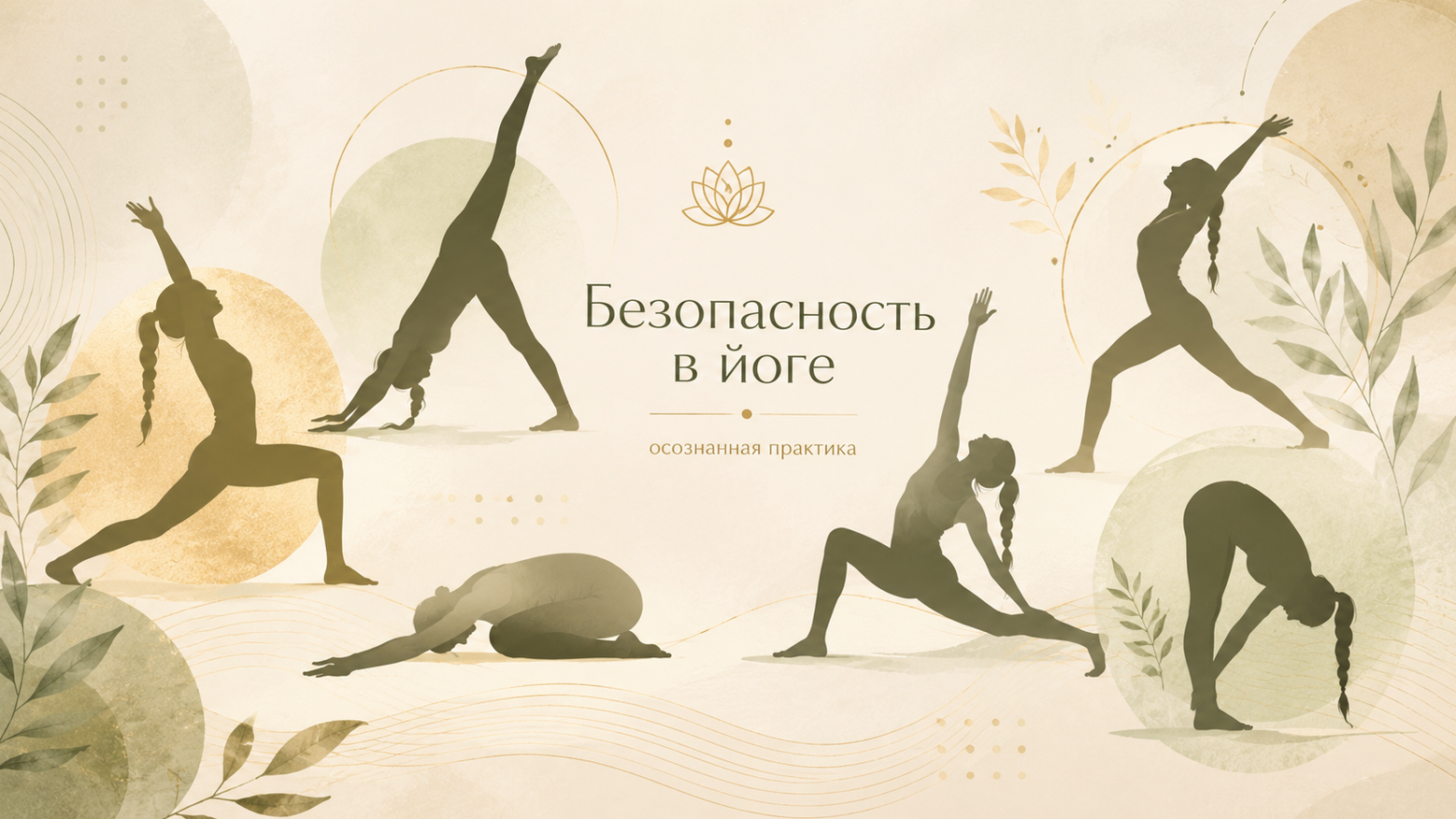
MY TOP PRIORITY IN PRACTICE IS SAFETY
Welcome everyone to the platform YOGAJOYSPACE
Before we begin, I want to talk about the main principle of all my classes — and it’s about safety.
Yoga has been part of my life for over 23 years, and I have been teaching for 12 of those years. Over these years, I have realized: true yoga is not a competition, not a chase for complex poses, and not a pursuit to perform impressive postures at any cost. Yoga is not training for the Olympic Games; yoga is not about "higher - faster - stronger," as most of us were taught in childhood.
True yoga is a path to becoming healthier, calmer, more stable, and more attentive to your body.
That is why safety is an unconditional priority for me.
Today, many perceive yoga through beautiful photos and impressive asanas. But in reality, the ability to tie yourself in a knot or perform a complex pose is not an indicator of health, mindfulness, or the quality of practice.
On the contrary, I increasingly meet people who, after experiencing "advanced" yoga, have problems with their cervical and lumbar spine, sensitive knees, consequences of injuries, or chronic tension in the body.
I have There is no goal to impress anyone with complicated poses. On the platform YOGAJOYSPACE you won't see extreme backbends, deep twists, or 'pretzels' just for a pretty picture. I always prioritize safety over ambition and outward results.
And that's why I work with the body wisely and gradually: using the 'small steps' method, gently and with respect for the current capabilities, condition, and functionality. Honestly, I take care of my body, because I had a spinal injury in childhood, which is now well compensated thanks primarily to yoga.
So, I take care of my body, and when you take my practice as a foundation for yourself, you will also take care of your body with me.
By the way, there are three areas in our body that we always carefully and consciously protect:
the neck, knees, and lower back.
And one more important point: about effectiveness indicators in practice!
I believe that a good yoga practice is one after which you feel better than before the session. When you gain more freedom of movement, more energy, joy, and inner calm. When it feels like wings are unfolding behind your back.
Therefore, in practice we always listen to ourselves. Under no circumstances should you endure pain, push yourself at any cost, or compare yourself to others.
Pain and fatigue are neither the goal nor a sign of success (this is, by the way, a common misconception: 'it hurts' and/or 'I'm tired' means you worked well). No, definitely not, this is not yoga.
If any movement causes discomfort, it can be simplified, the range of motion reduced, or a pause taken. Everyone practices according to their abilities and at their own pace.
Your body is new and different every day, and the goal of practice is to learn to hear its signals, to practice enjoying the process, not fighting the body, but being in harmony with yourself.
And by the way, these recommendations as priorities are relevant not only for beginners but also for practitioners with a good high level of physical fitness; only the range and depth of asanas will differ. We protect our body as a 'precious vessel'
and remember that the most important thing in yoga is not the complexity of the pose, but its benefit for you, your health, maintaining joy of life, youth, and activity.
Wishing everyone joy in the heart, lightness in the body, and lots of energy to live!