Articles
Shatavari for Men: Libido, Testosterone, and Sperm Quality
Shatavari for men: effects on libido, testosterone, sperm quality, and fertility. What Ayurvedic tradition and modern research show.
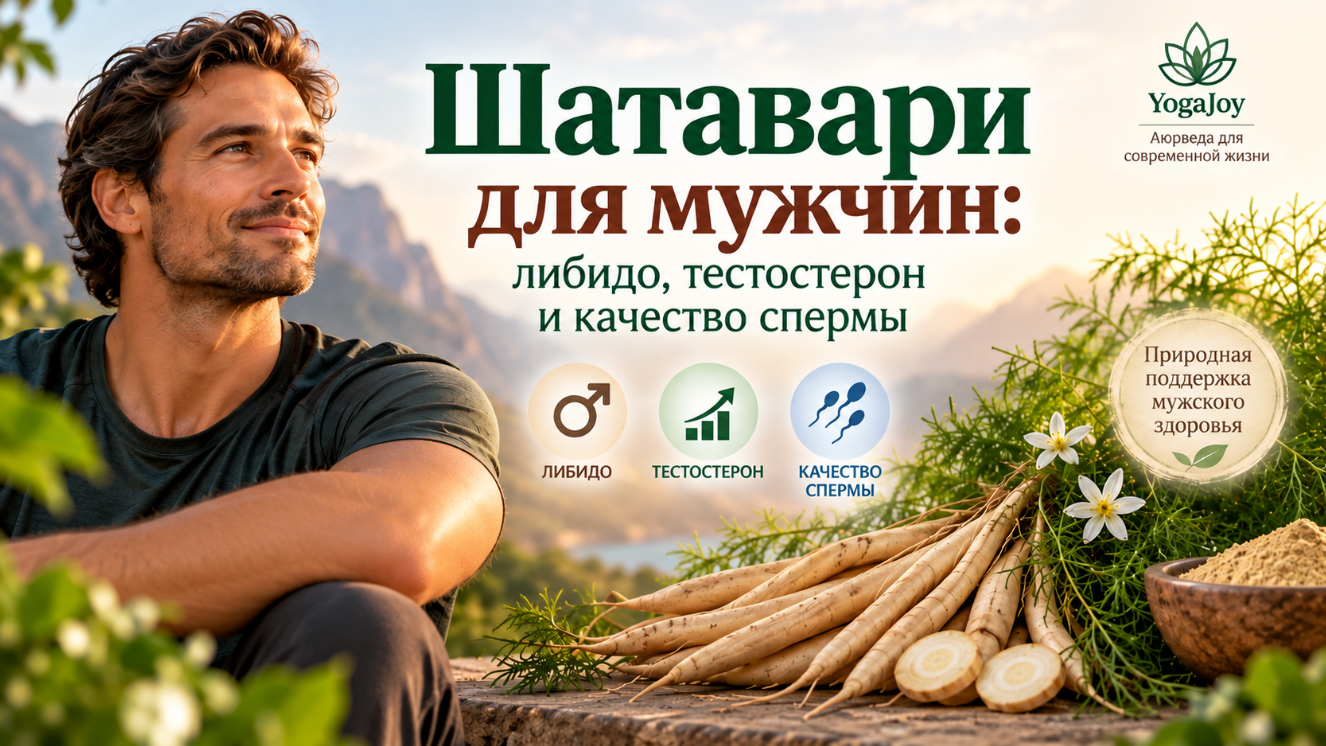
Shatavari (Asparagus racemosus) is most often called a plant for women. It is indeed widely used in Ayurveda for women's health, postpartum recovery, and support of the reproductive system.
But considering Shatavari exclusively as a "women's plant" is incorrect.
In Ayurvedic tradition, it was also used for men — primarily for restoring strength, supporting sexual health, sperm quality, and fertility.
In recent years, studies involving men have emerged, making this aspect of Shatavari particularly interesting.
If you want to first get to know the plant itself, its history, and modern research in more detail, read our comprehensive article "Shatavari in Ayurveda: from ancient texts to modern research."
Shatavari in Ayurveda for Men
In Ayurveda, there is a separate branch — vajikarana. It is related to sexual health, reproductive strength, sperm quality, and the body's ability to conceive.
Shatavari is among the plants used in this branch.
That is, traditionally it was not only about sexual desire. Male reproductive health was viewed more broadly: energy, libido, sexual function, sperm production, and the ability to have offspring.
And here it is important to immediately distinguish several concepts that are often confused in everyday life.
Libido — is sexual desire.
Erection — is the body's ability to achieve a full erectile response.
Testosterone — is one of the main male sex hormones.
Fertility — is the ability to conceive, which largely depends on the quantity and quality of sperm.
Shatavari and Sperm Quality
This is where the most interesting data involving men has appeared today.
The study involved 150 men who had one or more reduced sperm parameters.
The men were divided into two groups. One took Shatavari root powder for six months, the other took a placebo, which is a substance without an active ingredient used for comparison of results..
After six months, men taking Shatavari showed improvements in several parameters.
Researchers noted:
-
an increase in semen volume;
-
an increase in sperm concentration;
-
improved sperm motility;
-
an increase in the proportion of normally shaped sperm.
It turns out that the traditional connection of Shatavari with male semen has now received a rather interesting modern continuation.
Why Sperm Motility Is So Important
For conception, it is not enough to simply have a large number of sperm.
They need to actively move, travel through the female reproductive tract, and reach the egg.
Therefore, sperm motility — one of the important indicators of male fertility.
Their structure also matters. When we talk about normal sperm morphology, it simply refers to the percentage of cells that have a normal shape.
In the study, both motility and this indicator improved with Shatavari.
What about male libido?
Here the story is also interesting, but somewhat different.
In Ayurveda, Shatavari has long been associated with sexual strength and desire. In modern experimental studies, root extract also influenced the sexual behavior of male animals.
An increase in sexual activity and changes in several parameters of sexual behavior were observed.
Particularly interesting is the study where Shatavari was examined in sexual dysfunction related to elevated blood sugar levels. In the experimental model, the use of root extract improved sexual behavior.
So, the traditional use of Shatavari as a plant for male sexual function did not arise without reason.
At the same time, there is no large direct clinical study where men were given only Shatavari and specifically measured libido, not yet today.
Therefore, it is more accurate to say that the effect of Shatavari on male sexual desire is an interesting and promising area, and the most concrete data in men today still relates to sperm.
Shatavari and potency
The word "potency" is used very broadly.
Sometimes it means libido, sometimes erection, and sometimes the entire male sexual function.
Shatavari has traditionally been considered a plant used to support male sexual strength.
Experimental studies also show effects on sexual behavior and processes involved in normal sexual response.
But today, it is more accurate to perceive Shatavari not as a plant analogue of erection drugs, but as a plant traditionally associated in Ayurveda with the overall sexual and reproductive function of men.
This is much broader than just erection.
Does Shatavari increase testosterone?
This is probably one of the first questions that comes to a man's mind.
And the answer here is quite simple.
Today, there is no convincing clinical evidence showing that taking Shatavari alone significantly raises testosterone levels in men.
Experimental studies explore the plant's effects on the reproductive system, hormonal processes, and sexual behavior. There are also studies on Ayurvedic complexes containing Shatavari along with other herbs, where testosterone levels changed.
But the effects of a multi-component preparation cannot automatically be attributed to Shatavari.
Therefore, there is currently no basis for buying Shatavari specifically as a 'herbal testosterone booster.'
Today, interest in Shatavari for men lies somewhat in a different area.
Testosterone and libido are not the same thing either.
High testosterone does not automatically mean high sexual desire.
A man's libido is influenced by:
-
stress levels;
-
sleep quality;
-
fatigue;
-
emotional state;
-
relationships;
-
physical activity;
-
certain illnesses;
-
medications;
-
hormonal balance.
Therefore, trying to reduce all aspects of male sexuality to just testosterone oversimplifies the picture.
And here the traditional view of Shatavari is even more interesting: the plant was primarily used as nourishing and restorative, rather than as an instant sexual stimulant.
Can Shatavari work by reducing oxidative stress
This is another area that is actively being studied.
Sperm cells are sensitive to oxidative stress — a condition in which reactive oxygen species begin to damage cells faster than the body can neutralize them.
Oxidative stress can impair sperm motility and damage their cellular structures.
Saponins, flavonoids, and other biologically active substances have been found in the root of Shatavari. Many of these have antioxidant properties.
Therefore, one of the hypotheses being studied is that Shatavari's effect on the male reproductive system may be partly related to protecting cells from oxidative damage.
But for the average person, the complex biochemical mechanism is less important than the fact itself: modern research on Shatavari is gradually moving from general traditional concepts to measurable indicators — for example, sperm count and motility.
Does improved sperm mean a man will become more sexual
Not necessarily.
These are two different directions.
A man can have excellent libido but poor sperm parameters. Conversely, good sperm quality does not guarantee strong sexual desire.
Therefore, the results of the study on 150 men primarily speak about reproductive potential, not that Shatavari turns a person into a sexual giant.
And this perhaps makes the results even more interesting: we are not dealing with another vague claim about "enhancing male power," but with real changes in specific sperm parameters.
Why is Shatavari generally considered a female plant
The main reason is simple: far more traditional uses and modern studies of Shatavari are related specifically to women.
Lactation, menopause, reproductive health, sexual function — all this made the plant known primarily as a female herb.
But the history of Shatavari is broader.
In Ayurveda, the plant was used to support the reproductive system of both sexes, it’s just that the male aspect remained significantly less known for a long time.
Modern research is now gradually uncovering it.
Which Shatavari was studied
Shatavari is sold in various forms: root powder, capsules, and concentrated extracts.
In the male fertility study, it was specifically Shatavari root powder used for six months.
This is important because root powder and concentrated extract are not the same.
Therefore, one should not simply transfer the dosage from the study to any product from the store: the concentration and composition of different products can vary significantly.
What we know today
Shatavari is a much more interesting plant for men than its reputation as a "female herb" might suggest.
In Ayurveda, it has long been associated with male sexual and reproductive function.
Modern studies show particularly interesting results regarding sperm quality: its volume, sperm concentration, motility, and normal morphology.
The effect of Shatavari on male libido and sexual activity is also being studied, and experimental data exist here.
However, the claim that Shatavari increases testosterone now looks much less convincing: there are no good studies on the use of Shatavari alone, separate from other herbal components, in men on this issue yet.
Therefore, the male aspect of this plant is best described as: Shatavari is primarily interesting as a traditional restorative remedy and as a plant that is increasingly being studied today in connection with male fertility and sexual health.
And if you are interested in working with sexuality not only through plants, YogaJoy has a separate section "Sexuality" with yogic practices for tone, energy, and libido.
What we relied on when preparing the article
Modern scientific works and studies on shatavari (Asparagus racemosus) in the field of male reproductive and sexual function were used in the creation of the article.
First and foremost — a double-blind randomized study involving 150 men with reduced sperm parameters. The work was carried out by researchers Faculty of Indigenous Medicine, University of Colombo and Faculty of Medicine, General Sir John Kotelawala Defence University, Sri Lanka. After six months of shatavari use, changes were recorded in semen volume, concentration, motility, and sperm morphology.
Study of shatavari and sperm parameters — Sri Lanka Journal of Indigenous Medicine
A modern scientific review dedicated to shatavari and reproductive health of men and women, published in 2025 in Current Nutrition Reports.
Shatavari (Asparagus racemosus): A Promising Ally for Fertility — PubMed
For the section on male sexual function, an experimental study was used Asparagus racemosus, conducted in Dr. H. S. Gour University, India, which examined the effect of shatavari root on sexual behavior.
Study of the aphrodisiac effects of Ayurvedic plants — PubMed
Experimental studies on the use of Asparagus racemosus for sexual dysfunction related to hyperglycemia were also considered.
These materials allow us to see the male use of shatavari from two perspectives: as part of a centuries-old Ayurvedic tradition and as a field that is gradually receiving modern scientific validation today.