Articles
Circadian Rhythms: How Light Controls Internal Clocks and Why Living by the Sun Matters
How light controls circadian rhythms, melatonin, and sleep; why morning light, evening dimming, and a stable daily routine are important.
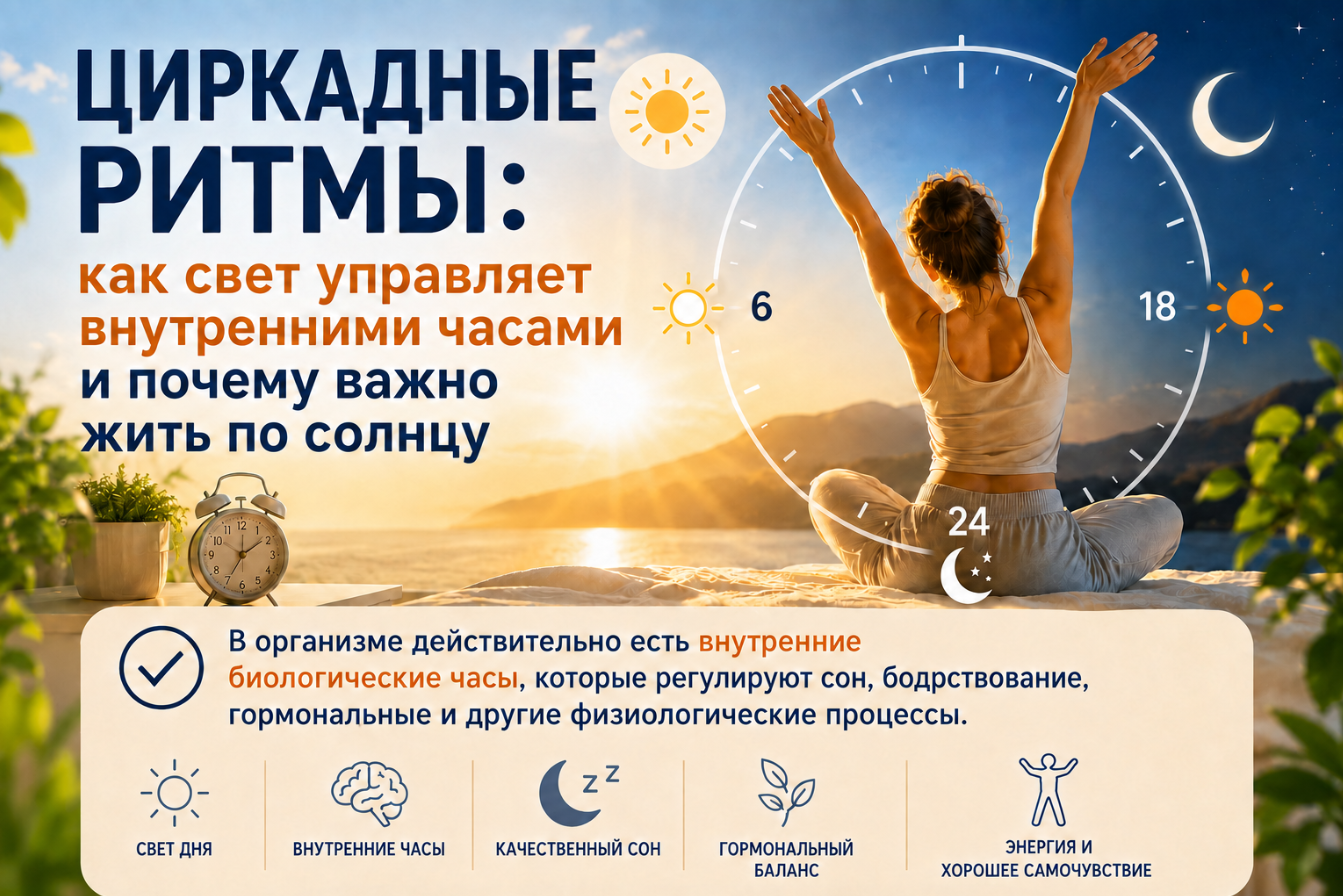
Briefly: what is important to understand
- The body truly has internal biological clocks that regulate sleep, wakefulness, hormonal, and other physiological processes.
- The main external cue for setting these clocks is light.
- Our internal rhythm is not exactly 24 hours: in a classic laboratory study, its average duration was about 24.18 hours.
- Therefore, internal clocks need to be "checked" daily against the external world — and natural light plays one of the main roles here.
- Morning light can shift the circadian rhythm earlier, while bright light late in the evening can delay it.
- There is no universal time when melatonin "turns on" for everyone. Individual rhythm, usual sleep time, and light environment are important.
- The practical principle is quite simple: more natural light and activity during the day, less bright light and stimulation in the evening, and more consistent sleep and wake times.
"Live by the sun" — an ancient idea in modern terms
Nature lives by rhythms.
Light is followed by darkness.
Activity by rest.
Day by night.
Seasons change.
Humans do not exist separately from these cycles.
In the YogaJoy signature program, this idea is expressed very simply:
Live by the sun.
This does not mean that a modern person necessarily has to fall asleep immediately after sunset and wake up with the first rays of the sun.
The meaning is deeper:
our physiology uses the alternation of light and darkness as one of the main signals of time.
Today we call this system circadian rhythms..
What are circadian rhythms?
Circadian rhythms are roughly 24-hour cycles of many processes in the body.
They are involved in regulating:
- sleep and wakefulness;
- body temperature;
- hormone secretion;
- appetite and metabolism;
- nervous system activity;
- attention and performance.
One of the main centers of this system is located in the hypothalamus — this is the suprachiasmatic nucleus,which is often called the body's central biological clock.
But what is especially interesting is something else.
Our internal clocks do not perfectly align with astronomical days on their own.
In a classic experiment, the human internal circadian period under strictly controlled conditions averaged about 24.18 hours — approximately 24 hours and 11 minutes..
This work was carried out by a group of researchers affiliated with Harvard Medical School and Brigham and Women’s Hospital,and published in the journal Science.
Study of human circadian clocks — Science journal, research page on PubMed.
It turns out that the body really needs regular adjustment of its internal clocks.
And one of the most powerful tools for this adjustment is light.
How the eyes “set” the internal clock.
Light is needed not only for us to see.
There are special photosensitive cells in the retina — ipRGCscontaining the photopigment melanopsin.
They perceive light and transmit information to brain areas associated with the central circadian clock.
Therefore, light affects not only vision but also:
- alertness;
- drowsiness;
- melatonin secretion;
- sleep onset time;
- circadian phase;
- attention;
- mood.
In 2025, researchers The Chronobiology Center of the University of Basel examined these mechanisms in detail in a scientific review published in Handbook of Clinical Neurology.
And here the principle of "living by the sun" begins to sound quite literally, not just metaphorically.
Morning and evening light have different effects
For the body, it matters not only how much light we receive, but also when.
Morning light can help shift the circadian rhythm earlier.
In 2026, researchers The Chronobiology Center of the University of Basel analyzed studies where light was applied shortly after waking up.
The review showed that under certain conditions, morning light can shift the onset of the evening rise in melatonin earlier within a single circadian cycle. The authors emphasize that the magnitude of the effect depends on brightness, spectrum, duration of exposure, and requires further study.
Review of morning light studies — University of Basel, Journal of Pineal Research, PubMed
In the evening, the direction can be the opposite.
What evening light does
Even ordinary room lighting before sleep can significantly affect melatonin.
In a study by Brigham and Women’s Hospital and Harvard Medical School 116 healthy young adults participated.
When they were exposed to normal room lighting rather than very dim light in the hours before sleep, melatonin onset was delayed and the duration of its nighttime secretion was reduced by about 90 minutes.
The study was published in Journal of Clinical Endocrinology & Metabolism.
Evening light and melatonin study — Harvard Medical School / Brigham and Women’s Hospital, PubMed
That is, late evening spent under bright artificial lighting can indeed signal the internal clock that
"the day is still ongoing."
So it’s not just about the phone
Usually, when sleep is discussed, blue light from smartphones is mentioned.
But the problem is broader.
For the circadian system, important factors are:
- light intensity;
- its spectrum;
- duration of exposure;
- distance to the source;
- time of day.
A phone in front of your eyes is one source.
But a brightly lit apartment late in the evening is also a light signal.
Therefore, sensible preparation for sleep does not necessarily mean living in complete darkness after six in the evening.
It’s much more practical to:
get enough natural light during the day and gradually reduce ambient brightness in the evening.
And does melatonin really start producing at 9:00 PM?
Not for everyone.
This is an important clarification.
In popular schemes, you can often find:
"Melatonin starts to be produced at 9:00 PM, so you should already be asleep by 10:00 PM."
Physiology doesn't work that rigidly.
The onset of the evening rise in melatonin depends on the circadian phase of the individual.
For one person, it happens earlier.
For another, later.
The rhythm is influenced by:
- the light environment;
- wake-up time;
- chronotype;
- the schedule of previous days;
- shift work;
- jet lag from crossing time zones;
- age.
Therefore, more important than a single magic number on the clock is the sequence of signals the body receives every day..
What about cortisol?
Cortisol also has a pronounced daily rhythm.
Under normal conditions, its level usually begins to rise during the pre-awakening period, reaches a high level in the first part of the day, and then gradually decreases.
But even here, you can't say that cortisol "turns on exactly at 6:00 AM" for everyone.
The hormonal system is primarily guided by the body's biological time,not just the numbers on the clock face.
That is why a person who has lived on a late schedule for years cannot simply go to bed at 9:00 PM once and expect the entire system to instantly adjust.
Don't change your schedule all at once.
In the YogaJoy signature program, there is a very practical principle:
the strategy of small steps.
If a person is used to falling asleep at 1:30 AM, trying to go to bed at 10:00 PM tomorrow often ends with them just lying awake for several hours.
It is much wiser to gradually shift:
- bedtime;
- wake-up time;
- morning light exposure;
- evening lighting;
- activity time;
- meal times.
For example, change the schedule by 10–15 minutes and observe how the body reacts for several days.
This way, the schedule is not "broken."
It is gradually reset..
The day also prepares us for sleep.
Good sleep doesn't start five minutes before we lie down.
It is influenced by the entire previous day.
Morning light.
Movement.
Meal times.
Physical and mental activity.
Stress.
Amount of light in the evening.
Regularity of routine.
Therefore, one of the simplest habits is to go outside in the morning or in the first half of the day to get natural light.
And to distribute physical activity according to the time of day and your own condition.
We talk about this separately in the YogaJoy article "When is the best time to practice yoga — morning or evening?".
Morning practice can help gently transition from sleep to activity.
Daytime practice helps to recharge and regain focus.
Evening practice gradually switches the body and mind into relaxation mode.
On YogaJoy you can choose a suitable yoga practice considering level, duration, and time of day.
What you can do today
You don’t need to start with a perfect routine.
Try four simple actions.
1. Get natural light in the morning.
It’s better to go outside rather than just look out the window.
2. Move throughout the day.
Walking, yoga, swimming, and regular physical activity help the body distinguish between periods of activity and rest.
3. Gradually reduce the amount of light and stimulating information in the evening.
You don’t have to turn everything off. It’s enough to soften the lighting and avoid turning the last hour of the day into an extension of the workday.
4. Try to maintain a relatively stable sleep and wake time.
Regularity is one of the clearest signals for your internal clock.
And in the evening, you can help your body transition from activity to rest through YogaJoy breathing practices for relaxation and calming..
"Living by the sun" today
Modern life is very different from the one in which ancient traditions were formed.
We can turn on bright lights in the middle of the night.
Work until morning.
Fly across multiple time zones in just a few hours.
Spend almost the entire day indoors.
But biological clocks have not disappeared because of this.
Therefore, the principle "live by the sun" today can be understood very practically:
not trying to literally live like a person from thousands of years ago, but remembering that our body still distinguishes between day and night.
The clearer we give these signals to our body, the easier it is for the sleep-wake system to maintain its rhythm.
And sometimes the first step to better sleep doesn’t start in the evening at all.
It starts in the morning — with light.
Sources and research
1. Czeisler C.A. et al.
Stability, precision, and near-24-hour period of the human circadian pacemaker.
Journal Science, 1999. Research group Harvard Medical School / Brigham and Women’s Hospital.
Research page on PubMed
2. Blume C., Münch M.
Effects of light on biological functions and human sleep.
Handbook of Clinical Neurology, 2025. Centre for Chronobiology, University of Basel.
Scientific review on PubMed
3. Gooley J.J. et al.
Exposure to room light before bedtime suppresses melatonin onset and shortens melatonin duration in humans.
Journal of Clinical Endocrinology & Metabolism, 2011. Brigham and Women’s Hospital / Harvard Medical School.
Research page on PubMed
4. López-Velasco C., Reichert C.F., Cajochen C.
Can Morning Light Phase Advance Human Melatonin Rhythms in Less Than 24 h?
Journal of Pineal Research, 2026. Centre for Chronobiology, University of Basel.
Scientific review on PubMed