Articles
Neck muscles — the muscles of youth: how posture, breathing, and platysma are connected to facial beauty
How neck muscles affect posture, breathing, and facial positioning. Anatomy of the platysma, lymphatic drainage, fascial lines, research, and yoga practice.
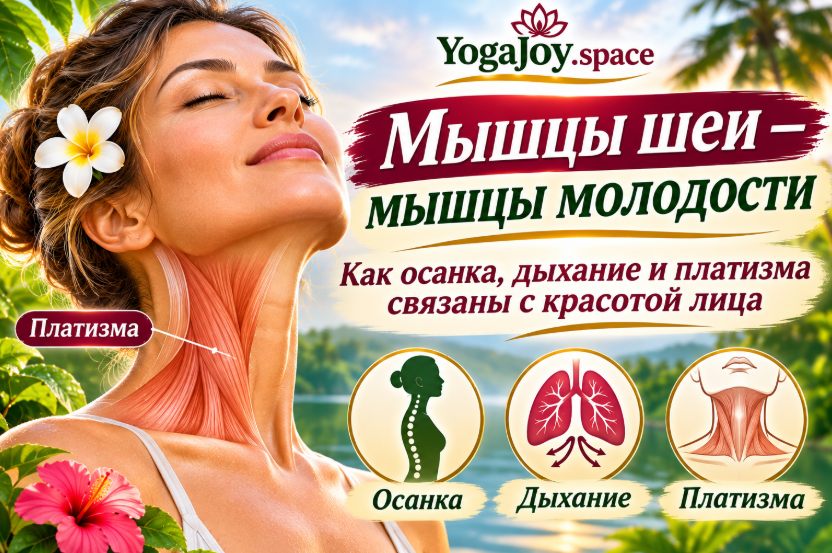
Why is it sometimes enough to straighten your shoulders, freely lift your head, lengthen and seemingly open your neck, and relax your face to look completely different?
The gaze becomes more open. The neck line becomes more expressive. The feeling that the head is heavily resting on the shoulders disappears.
But what exactly has changed?
The position of the spine? Muscle activity? Breathing? Or our inner state?
In fact, all of these are closely connected.
The neck is an amazing area of the human body. Here meet structures that control the position of the head, participate in breathing, lower jaw movement, swallowing, speech, and facial expressions.
Important vessels, nerves, and lymphatic pathways pass through here.
And one of the superficial neck muscles, the platysma, is directly connected to the tissues of the lower third of the face.
Therefore, in our series "Muscles of Youth" the neck occupies a special place.
It is here that it is especially visible how the beauty of external form is connected, or rather predetermined, by the functional freedom of the body.
In brief: why are the neck muscles called the muscles of youth?
The neck connects the head with the spine and shoulder girdle. Its muscles participate in supporting the head, turning, tilting, breathing, and lower jaw movements.
Three components are especially important for its functional youthfulness:
Strength and endurance. Muscles must provide support for the head during daily activities.
Coordination. Deep and superficial muscles work in harmony, distributing the load and allowing movement without excessive effort.
Mobility and relaxation. The neck maintains freedom of turns, tilts, and the ability to return to a comfortable position after strain.
In addition, the superficial neck muscle — the platysma — has anatomical connections with the fascia of the chest and the soft tissues of the lower face.
Therefore, working with the neck is important not only for posture. It is part of a comprehensive approach to freedom of movement, breathing, and natural facial expressiveness.
Neck anatomy: which muscles determine its position and movement?
Let's start with a brief tour inside your own body.
Imagine the head freely resting on top of the spine.
To hold it in space, the neck muscles are constantly performing subtle work.
Some create large movements.
Others help precisely regulate the position of individual vertebrae.
Still others connect the neck with the rib cage, shoulder blades, and lower jaw.
Their interaction creates that very natural neck line that we perceive as beautiful posture.
The sternocleidomastoid muscle — the main character of our article
The sternocleidomastoid muscle, or sternocleidomastoideus (SCM), is one of the most prominent muscles of the neck.
Try slowly turning your head to the right.
On the left side of the neck, a muscular band may become visible, running from the area behind the ear to the sternum and clavicle.
This is the sternocleidomastoid muscle.
It has two heads:
-
The sternal head begins at the manubrium of the sternum.
-
The clavicular head originates from the medial part of the clavicle.
Both merge and run toward the mastoid process of the temporal bone, located behind the ear, and the adjacent part of the superior nuchal line of the occipital bone.
Note the location of its attachments.
On one side — the sternum and clavicle, that is, the upper part of the rib cage.
On the other — the bones of the skull.
Thus, the SCM connects the head with the rib cage and participates in their mutual positioning.
When contracting on one side, it tilts the neck toward itself and turns the head in the opposite direction.
When both muscles work together, they participate in neck flexion, and in some positions — in extending the head relative to the upper cervical vertebrae.
And these are not all of its functions.
During intense breathing, when the head is stabilized, the sternocleidomastoid muscle can help lift the sternum and clavicles, participating in inhalation.
So, one muscle connects posture, head movement, and breathing mechanics.
Deep neck muscles — the invisible foundation of stability
Beneath the surface structures are muscles that are rarely visible from the outside.
Especially interesting are:
The longus colli muscle.
The longus capitis muscle.
They are located in front of the cervical spine.
Their task is to participate in flexion and stabilization of the neck, providing precise control of small head movements relative to the spine.
At the back of the neck are deep extensors and short suboccipital muscles.
They help control the position of the head, including during eye work and turns.
It is precisely the coordination of deep and superficial muscles that makes movements precise and economical.
When muscles work in the correct sequence for the task, it is easier for the body to maintain stability.
The scalene muscles — the connection between the neck and breathing
Another important group is the anterior, middle, and posterior scalene muscles.
They connect the cervical vertebrae with the first and second ribs.
The scalene muscles are involved in neck bends and stabilization, as well as helping to change the position of the upper ribs during inhalation.
This means that several muscles in the neck area work simultaneously in two systems — the motor and respiratory systems.
And this helps us understand why mobility of the thoracic cage is so important for neck freedom.
What happens to the neck when the head is constantly pushed forward?
Our body adapts remarkably well to everyday tasks.
When we read, work at the computer, or look at our phone, the head can gradually shift forward relative to the thoracic cage.
At the same time, interconnected changes often occur.
The lower part of the cervical spine takes on a more flexed position.
The upper part extends, allowing us to keep looking straight ahead.
The muscles at the back of the neck regulate the position of the head.
And the superficial muscles at the front can change their activity depending on the position and the task being performed.
Over time, this position can become habitual.
And the most interesting thing here is the change in the distribution of muscular work.
Instead of varied movements, we repeat the same posture for hours.
That’s why in YogaJoy practice we pay attention not only to the neck but also to the position of the thoracic spine, shoulder blades, and the entire body axis.
A free neck begins with the ability of the whole body to move in harmony.
Why can’t beautiful posture be created by just pulling the chin back?
Try pulling your chin in with effort and holding your head strictly vertical.
After a while, tension may appear.
Now release the effort, gently grow upward through the crown of your head, and feel the support of your spine.
The difference lies in the way movement is organized.
Stability can be maintained by constant superficial tension.
Or it can be formed through coordination of several muscle groups.
The second option is especially interesting for our practice and allows us to maintain youthful freedom of movement.
What science says: deep neck muscles and neuromuscular coordination
In 2009, a research team led by Gwendolen Jull published a study in a journal Manual Therapy about training the deep neck flexors.
The study involved 46 people with chronic neck pain.
The scientists compared two six-week programs.
One focused on low-intensity training of the deep neck flexors using small head movements.
The other aimed at developing neck flexor strength.
Electromyography was used to assess the activity of the deep muscles, sternocleidomastoid, and anterior scalene muscles.
The results were particularly interesting.
After special training of the deep flexors, their activity increased during the control test.
At the same time, the activity of the sternocleidomastoid and anterior scalene muscles decreased.
In other words, the organization of muscular work itself changed.
Later, these results received additional support.
In a systematic review by Blomgren and colleagues, published in BMC Musculoskeletal Disorders 2018, the researchers analyzed 12 randomized studies.
They found convincing evidence supporting the ability of special exercises for deep flexors to improve neuromuscular coordination.
At the same time, other types of training are necessary to develop neck strength and endurance under higher loads.
This is an important principle underlying the YogaJoy system (which we explore especially deeply in the “Muscles of Youth” practice series): functional youthfulness is determined not only by the strength of individual muscles but also by the quality of their interaction.
Studies: Jull et al., 2009; Blomgren et al., 2018.
Neck, shoulder blades, and rib cage: why does youthful free movement begin with posture?
The neck does not exist separately from the body.
Its position is connected with the thoracic spine, clavicles, shoulder blades, and ribs.
The pectoralis minor muscles connect the ribs to the coracoid processes of the shoulder blades and participate in their movement.
The trapezius muscles connect the occipital region and spine with the shoulder blades and clavicles.
The levator scapulae muscles run from the cervical vertebrae to the upper corners of the shoulder blades.
And the sternocleidomastoid muscles connect the head with the sternum and clavicles.
All these structures are involved in organizing the position of the upper body.
When we raise our arms, the position of the shoulder blades changes.
When we extend the thoracic spine, the spatial position of the rib cage changes, thanks in part to the intercostal muscles and the diaphragm- the queen of our posture.
When we turn our head, the neck muscles and deep spinal structures are engaged.
It is important to realize: Posture is the result of continuous coordination of movements, not a fixed position found once and for all.
Is it possible to improve posture through exercises?
In 2024, a systematic review and meta-analysis of exercise studies was published in the journal BMC Musculoskeletal Disorders focusing on the combination of forward head posture, rounded shoulders, and increased thoracic kyphosis.
The researchers included 22 studies.
The data obtained indicated that programs focusing on muscle strengthening, stretching, and comprehensive exercises can improve certain measurable parameters of head, shoulder, and thoracic spine positioning.
At the same time, there were significant differences between the studies.
But the main thing for us is the confirmation of the benefits of systematic work.
At YogaJoySpace, using a systematic comprehensive approach, we combine spinal movements, muscle activation and strengthening, shoulder girdle mobility, thoracic spine opening, work with fascial networks and breathing practices, and optimization of muscular movement patterns.
Thanks to this complex, we gradually develop a more natural and stable vertical posture, improve freedom and ease of movement and control over our center of gravity, enhance blood circulation in the upper body, and restore the face to a more youthful position. This very system forms the basis of the author’s program "Face Yoga."
Neck and breathing: how does the diaphragm help release neck muscles?
During calm breathing, the diaphragm performs the main work of inhalation.
It is assisted by the intercostal muscles and other participants in the respiratory system.
When the body's need for ventilation increases, auxiliary respiratory muscles become more actively involved.
Among them are the scalene muscles and the sternocleidomastoid muscles.
Imagine a moment of intense physical exertion.
Breathing quickens.
The rib cage begins to move more intensely.
Inhalation requires greater muscular effort.
And the neck muscles can help increase the volume of the rib cage.
This is a completely natural mechanism.
However, in everyday life, we sometimes notice a different picture.
Even at rest, each breath is accompanied by neck tension and noticeable shoulder elevation.
The reasons for such a breathing pattern can vary, so it should be assessed considering the overall condition and individual characteristics of each person.
But for your practice, this is a good opportunity to pay attention to the coordination of breathing movements and to your motor and breathing patterns.
Try to feel your breath differently.
Sit comfortably.
Place your palms on your lower ribs.
Take a calm breath in through your nose.
Feel how your ribs gently expand to the sides.
As you exhale, allow them to naturally return.
Now pay attention to your shoulders and neck.
How do they participate in breathing?
Can you keep them relaxed while allowing the rib cage to move?
This small practice helps develop awareness of the breathing mechanism.
We gradually learn to coordinate the movement of the diaphragm, intercostal muscles, thoracic spine, and neck.
And once again we realize: working with the muscles of youth is always working with the whole system, the entire body as a whole.
Platysma: how the neck muscle is connected to the lower third of the face.
Now let's move on to one of the most interesting anatomical features.
The platysma — a subcutaneous neck muscle — directly connects the superficial tissues of the upper chest with the lower part of the face.
More detailed information about the platysma as a muscle of youth, as well as how the platysma affects facial expression and why it is so important for a beautiful neck line and younger facial positions, can be found in a special material.
Angles of youth: how does head position change the perception of the face?
In facial and neck aesthetics, the cervico-mental angle — the area transitioning from the underside of the chin to the front surface of the neck — is very important.
Its appearance depends on the structure of the lower jaw, the distribution of soft tissues, the condition of the skin, and the platysma.
But there is another interesting factor — the position of the head in space..
Try looking in the mirror with your head pushed far forward.
Then return to a natural vertical body position.
Feel the support of your feet, the position of your pelvis and rib cage.
Allow your head to rest freely above your spine.
Notice how the line of your neck and lower jaw changes.
The anatomical structures remain the same, but their spatial arrangement has changed.
That is why in Face Yoga we pay such close attention to posture.
The external silhouette, the geometry of the lines of the neck, face, back, and rib cage — all reflect the body's position.
At the same time, the age-related shape of the neck is formed by many factors, and exercises primarily affect muscle function and movement habits.
The beauty of a natural neck line is born from the harmony of form and movement.
Muscles under the chin: another connection between the neck, face, and voice.
Under the lower jaw is a group of muscles involved in movements of the hyoid bone, swallowing, speech, and lower jaw function.
Among them are:
-
The digastric muscle — digastricus.
-
The mylohyoid muscle — mylohyoideus.
-
The geniohyoid muscle — geniohyoideus.
-
The stylohyoid muscle — stylohyoideus.
Below the hyoid bone are muscles connecting it to the sternum, scapula, and other neck structures.
They participate in stabilizing the hyoid bone and movements of the larynx.
The hyoid bone is interesting because it does not form a typical joint connection with other bones.
Its position is largely determined by the work of surrounding muscles and ligaments.
This means the lower jaw area is functionally connected with the neck, swallowing, speech, and breathing.
This connection is especially important for understanding our habitual facial expressions.
Clenched teeth, tense lips, immobile lower jaw — all of this can be accompanied by a feeling of overall stiffness in the face and neck.
Therefore, at YogaJoy we learn not only to strengthen muscles but also to become aware of habitual muscle tone.
Sometimes it is enough to gently part the teeth, relax the lips, and free the tongue to feel how differently one’s own face can be perceived.
The anterior fascial line: how the neck is connected to the whole body
In our “Muscles of Youth” series, we have already addressed Thomas Myers’ concept “Anatomy Trains” — Anatomy Trains.
This model proposes viewing muscles and fascia as interconnected myofascial lines.
And for understanding the neck, two of these lines are especially interesting.
Superficial Front Line
In Myers’ model, the superficial front line runs along the front surface of the body from the feet through the legs, pelvic area, abdomen, and sternum to the sternocleidomastoid muscle and head.
Imagine this line:
Feet — front surface of the legs — pelvis — abdomen — sternum — neck — head.
Here an important understanding for our practice emerges.
The position of the head can be explored through the position of the entire body.
The feet provide support.
The pelvis participates in organizing the vertical alignment.
The rib cage shapes the position of the upper torso.
And the neck connects this system to the head.
At the neck level, Myers’ model includes the sternocleidomastoid muscle and superficial connections with the platysma and facial tissues.
Thus, it becomes clear why posture work at YogaJoySpace begins much lower than the neck.
To feel freedom in the neck and the whole body, it is sometimes helpful to start with the feet, spine, and rib cage.
The neck and the lymphatic system: how does fluid drain from the face?
Here anatomy becomes even more interesting.
In the head and neck area, there is a complex network of lymphatic vessels and nodes.
It participates in maintaining tissue fluid balance and immune defense.
Lymph from different areas of the face is directed to various groups of lymph nodes.
From the chin area and central parts of the lower lip — primarily to the submental nodes.
From parts of the cheeks, lips, and tissues of the lower face — to the submandibular nodes.
From other areas of the face and head — including the parotid and additional regional groups.
Then lymph passes through the system of cervical lymph nodes and vessels into deeper pathways.
In the neck area, important roles are played by deep cervical lymph nodes located along the internal jugular vein..
Ultimately, lymph returns to the venous bloodstream near the junction of the internal jugular and subclavian veins.
Why is the sternocleidomastoid muscle important here?
It’s because of its anatomical location.
Some of the deep cervical lymph nodes lie beneath the sternocleidomastoid muscle.
It also serves as an important landmark when describing the location of lymphatic structures in the neck.
Nearby run the internal jugular veins, carotid arteries, and vagus nerves.
This is an extremely dense anatomical area.
Therefore, we consider it with special attention.
How are movement and breathing connected to lymph flow?
Lymphatic vessels have their own contraction mechanisms that help move lymph, but these are not sufficient.
Its movement is influenced by external mechanical factors as well — muscle activity, changes in tissue pressure, and respiratory movements.
The diaphragm, by changing the pressure in the chest and abdominal cavities, participates in processes that affect the movement of lymph in the major lymphatic vessels.
Movements of the neck and shoulder girdle are accompanied by changes in muscle tone and the position of surrounding tissues.
That is why we are interested in the combination of gentle movements, free breathing, and relaxation.
However, the direct acceleration of lymphatic drainage from the face using common exercises has not yet been sufficiently studied.
Facial swelling can also be associated with various physiological and medical causes.
In the YogaJoy system, we use gentle movement as part of overall body care.
Special lymphatic drainage techniques are considered separately, taking into account the specifics of their execution.
Breathing, voice, and the vagus nerve: another amazing connection
The neck is not just a space for head movement.
It houses the larynx — an organ involved in breathing and voice production.
When we speak or sing, the exhaled air passes through the vocal cords.
The vibrations of the vocal folds create sound.
The muscles of the larynx regulate their position and tension, while the position of the tongue, lips, and lower jaw helps form speech.
Different areas of the body are involved in this process again.
The diaphragm and respiratory muscles create the airflow.
The larynx participates in sound production.
The neck muscles stabilize the head and the hyoid region.
The muscles of the face and oral cavity shape articulation.
The voice is a wonderful example of the coordinated work of breathing, muscles, and the nervous system.
The vagus nerve innervates the larynx through its branches and autonomously regulates many internal organs.
However, its functions differ from those of the sternocleidomastoid muscle, which is primarily controlled by the accessory nerve.
This anatomical difference helps to gain a deeper understanding of the interaction between the nervous and muscular systems.
In yoga, the connection between voice and breath also holds a special meaning.
Through sound, we can direct attention, explore the duration of the exhale, and observe our inner state.
And here we come to the fascinating topic of the fifth chakra.
Vishuddha — the fifth chakra: energy, voice, and the space of self-expression.
In yoga philosophy, the throat area is traditionally associated with the Vishuddha chakra — the fifth energy center in the common seven-chakra system.
The Sanskrit word viśuddha It is connected with ideas of purity and purification.
In yogic symbolism, Vishuddha is associated with sound, speech, the ability to express thoughts and feelings, and inner clarity.
Its element is akasha, space or ether in the traditional system of elements.
In the treatise "Shat-chakra-nirupana", verse 28, it is said:
"In the throat region is a lotus named Vishuddha."
A meaningful translation of the beginning of the poetic description.
This lotus is symbolically depicted with sixteen petals, connected to the sounds of Sanskrit.
How fascinating this connection is!
The throat is the place where breath turns into voice.
And the voice is like a vibration of sound and one of the ways to interact with the world.
We speak, sing, chant mantras, express joy, love, gratitude, and our intentions — becoming aware of the Power of our Word.
In the yogic tradition, working with the Vishuddha chakra is associated with purification and conscious expression of inner content.
What does yoga say about the flow of energy?
In the yoga tradition, there is the concept of prana — life energy, whose movement is described through a system of energy channels called nadis.
This is a spiritual-philosophical model of human experience, different from the anatomy of nerves and vessels.
In In the “Hatha Yoga Pradipika,”chapter II, verse 2, it is said:
“When prana moves restlessly, the mind is restless; when prana is calm, the mind is calm.”
A meaningful translation of the first part of the verse.
This idea reveals one of the most important principles of pranayama — the interaction of breath, attention, and inner state.
In modern physiology, we know that breathing practices can influence autonomic nervous regulation, heart rate variability, and subjective experience of stress.
Scientific and yogic languages describe different aspects of this experience.
For practice, it is especially interesting how through breath, movement, and voice we can develop awareness of our own state.
Why is sound so important in the practice of the Vishuddha chakra?
In the yogic tradition, the bija mantra HAM.
is associated with the Vishuddha chakra.
Its pronunciation is used as an element of meditative and sound practice.
When we pronounce a sound, a real physical vibration of the vocal cords occurs.
Sound vibrations spread through the air and surrounding tissues, and a person can feel resonance in the throat, oral cavity, and face.
Take a calm breath in through your nose.
You can try to feel this.
On the exhale, softly pronounce a prolonged “M-m-m.”
Allow the sound to resonate effortlessly.
Feel the vibration of the lips and facial area. This is a simple way to unite breath, sound, and attention; for this, you can perform
the breathing practice “Bhramari.”
And there is a special beauty in yoga here: we learn to feel ourselves more deeply through completely natural processes of our own body.
Stability without tension: what does Patanjali say?
In There is another principle of yoga that fits our topic surprisingly well.In Patanjali’s “Yoga Sutras,” II.46, it is said:
Sthira Sukham Asanam — “The asana is steady and comfortable.”
For me, this is one of the most important principles of working with posture.
We develop strength so that the body can maintain stability.
But at the same time, we learn to release unnecessary effort.
The position of the head becomes natural.
The neck remains mobile.
The shoulders freely participate in movement.
The breath flows calmly.
And gradually we begin to feel the verticality of our own body as an inner support.
This is the deep connection of yoga with our series “Muscles of Youth.”
Youth is the body's ability to respond freely and accurately to life's challenges.
YogaJoy Practice: "Free Neck — Open Voice"
Duration — about 10 minutes.
This practice combines gentle work with the deep muscles of the neck, shoulder blades, rib cage, breathing, and voice.
1. Find your natural vertical alignment — 1 minute
Stand in Tadasana — Mountain Pose.
Feel the support of your feet.
Distribute your body weight evenly.
Allow your spine to naturally lengthen upwards.
Imagine the crown of your head gently reaching toward the ceiling.
Shoulders are relaxed.
Lower jaw is relaxed.
Take several calm breaths.
Feel how the position of your head is connected to the entire axis of your body.
2. Awaken the deep neck muscles — 2 minutes
Lie on your back and bend your knees.
If needed, place a thin towel under your head.
Imagine you want to make a barely noticeable nod — a very small “yes.”
Gently direct your chin slightly toward your throat.
Do not lift your head off the floor.
Hold for 3 seconds.
Completely relax.
Repeat 5–6 times.
The movement should remain small.
Try to feel the difference between precise control of the movement and large muscular effort.
3. Release the shoulder blades — 1.5 minutes
Stand facing a wall.
Place your forearms on its surface.
Slowly raise your arms up to a comfortable position.
Allow your shoulder blades to move freely along the rib cage.
Then smoothly lower your arms.
Repeat 6–8 times.
Feel how the movement of the shoulder girdle is connected to the position of the neck.
4. Add mobility to the thoracic spine — 1.5 minutes
Get on all fours.
On the inhale, gently open the rib cage, allowing the spine to slightly extend.
On the exhale, round your back and allow the shoulder blades to spread apart.
The head follows the movement of the spine without strong tilting back.
Repeat 6–8 times.
Observe how the movement of the back affects sensations in the neck and shoulders.
5. Restore freedom of rotation — 1 minute
Sit comfortably.
Gently turn your head to the right.
Return to center.
Repeat to the left.
Move slowly, within a comfortable range of motion.
Four turns to each side.
Feel how the neck muscles sequentially engage and relax.
6. Add a gentle shoulder opening — 1 minute
Stand up and hold the strap behind your back with a wide grip.
Carefully move your arms slightly backward.
Keep your elbows soft and your head in a natural position.
Allow your chest to move with your breath.
Hold for two to three calm breathing cycles.
Then release the strap and relax your arms.
7. Connect breath and sound — 2 minutes
Sit comfortably, maintaining the natural vertical alignment of your spine.
Relax your lower jaw.
Take a calm breath in through your nose.
On the exhale, softly pronounce the sound "M-m-m."
Feel its vibration around your lips and face.
Repeat 4–6 times, returning to normal breathing between sounds.
If you wish, finish the practice by quietly chanting the mantra HAM, focusing your attention on the throat area.
Feel how breath, voice, and posture unite into one.
After the practice
Stay in silence for a few moments.
Feel the support of your feet or pelvis.
The freedom of your shoulders.
The position of your head.
The lightness of your breath.
Notice what has changed.
Our goal is to gradually develop the body's ability to maintain stability, move freely, and relax.
If you experience dizziness, pain, numbness, balance disturbances, or any significant discomfort, stop the exercise. For injuries, cervical instability, vascular diseases of the neck, or other serious conditions, individual load adjustment is necessary.
The practice does not include deep head tilting backward, strong pressure on the front and sides of the neck, or forced breath retention.
How to continue your practice on YogaJoySpace?
In our system, working with the neck and posture is part of a holistic practice.
We combine posture exercises, spinal mobility development, breath work, concentration, and relaxation.
For beginners practicing in the morning — "Yoga 134."
For experienced practitioners in the evening — - "Yoga 135."
You can use the unique algorithm on our platform to select practices that are personally suitable for you today; to do this, use a goal such as "Posture" in the section "What Are Your Goals Today?"
For comprehensive work with the neck, whole body, and face — the autoprogram "Face Yoga."
In it, we pay attention to posture, the chest, breathing, neck muscles, and other muscles of youth, facial expressions, and tissue mobility.
And to continue developing your ability to relax the muscles of the whole body, you can practicethe meditation "Magic Flow."
Neck muscles in the "Muscles of Youth" system
Now let's look at our series as a whole.
The feet provide support and help control balance.
The muscles of the pelvis and abdomen contribute to the stability of the torso.
The diaphragm facilitates breathing and interacts with postural control mechanisms.
The intercostal muscles help the rib cage move.
The pectoralis minor muscles connect the ribs and scapulae.
The neck muscles support the position of the head and participate in breathing, movement, speech, and swallowing.
And the platysma continues this complex system in the superficial tissues of the lower face.
Here, the main principle of our work is especially evident.
The youthfulness of the body is the ability to maintain strength, mobility, coordination, sensitivity, and the capacity to recover.
When we develop these qualities, not only does the execution of individual exercises change.
The very sensation of the body changes.
There is more freedom in movement.
More ease in posture.
More attention to breathing.
And along with this, the opportunity to feel your own neck, face, and inner state in a new way.
Perhaps the beautiful line of the neck begins right here — with the ability to hold the head freely and confidently while maintaining softness, breathing, and space for movement.
Frequently Asked Questions
Which neck muscles are most important for beautiful posture?
For the natural position of the head, the coordinated work of the deep flexors and extensors of the neck, sternocleidomastoid, scalene, trapezius, and other shoulder girdle muscles is important.
Deep muscles help precisely control the position of the cervical spine, while superficial muscles create movements and help support the head.
Therefore, a varied practice including exercises for coordination, strength, mobility, and relaxation is most beneficial.
Is it possible to strengthen neck muscles after 50 years of age?
Yes. Muscles retain the ability to adapt to physical activity in mature age.
Special exercises allow development of strength, endurance, and neuromuscular coordination.
It is especially important to gradually increase the load and consider the condition of the cervical spine.
In YogaJoySpace practice, we start with small movements, posture work, and calm breathing, gradually combining them with full yoga sessions.
Can working with the neck improve the facial contour?
The position of the head and neck affects how the jawline and cervico-mental area are visually perceived.
Moreover, the platysma is anatomically connected to the tissues of the lower third of the face and participates in facial expressions.
Neck exercises can improve muscle coordination and mobility, help find a more comfortable posture, and reduce the feeling of tension.
However, there is not yet sufficient convincing evidence that regular neck exercises eliminate age-related sagging of facial tissues.
Therefore, in our system, posture is considered part of a comprehensive approach to the face and the whole body.
How are the neck muscles related to lymphatic drainage from the face?
Lymph from the facial tissues passes through the parotid, submandibular, submental, and other lymph nodes, then flows into the deep lymphatic pathways of the neck.
Lymph movement is ensured by the contractions of lymphatic vessels themselves and also depends on pressure changes and the activity of surrounding tissues.
Muscle activity and breathing participate in the physiological processes of fluid movement in the body.
But with pronounced or persistent facial swelling, it is important to determine its cause: regular neck exercises do not replace medical evaluation.
Scientific sources
-
Jull G. A., Falla D., Vicenzino B., Hodges P. W. (2009). The effect of therapeutic exercise on activation of the deep cervical flexor muscles in people with chronic neck pain. Manual Therapy.
https://doi.org/10.1016/j.math.2009.05.004 -
Blomgren J. et al. (2018). Effects of deep cervical flexor training on impaired physiological functions associated with chronic neck pain: a systematic review. BMC Musculoskeletal Disorders.
https://doi.org/10.1186/s12891-018-2324-z -
Sepehri S. et al. (2024). The effect of various therapeutic exercises on forward head posture, rounded shoulder, and hyperkyphosis among people with upper crossed syndrome: a systematic review and meta-analysis. BMC Musculoskeletal Disorders.
https://doi.org/10.1186/s12891-024-07224-4 -
Price J. et al. (2021). Comparative effectiveness of physical exercise interventions for chronic non-specific neck pain: a systematic review with network meta-analysis of 40 randomised controlled trials. British Journal of Sports Medicine.
https://bjsm.bmj.com/content/55/13/730 -
Wilke J. et al. (2016). What Is Evidence-Based About Myofascial Chains: A Systematic Review. Archives of Physical Medicine and Rehabilitation.
https://doi.org/10.1016/j.apmr.2015.07.023 -
Myers T. W. (2020). Anatomy Trains: Myofascial Meridians for Manual Therapists and Movement Professionals. 4th edition. Elsevier.
https://shop.elsevier.com/books/anatomy-trains/myers/978-0-7020-7813-2 -
StatPearls. Anatomy, Head and Neck: Sternocleidomastoid Muscle. Anatomy, functions, and the respiratory role of the SCM.
https://www.ncbi.nlm.nih.gov/books/NBK532881/ -
StatPearls. Anatomy, Head and Neck, Platysma. Anatomy of the platysma and its connections with the tissues of the lower face.
https://www.ncbi.nlm.nih.gov/books/NBK545294/ -
StatPearls. Anatomy, Skin, Superficial Musculoaponeurotic System (SMAS) Fascia. Anatomy of the superficial fascial system of the face.
https://www.ncbi.nlm.nih.gov/books/NBK519014/ -
StatPearls. Anatomy, Head and Neck, Lymph Nodes. Location of lymph nodes of the head and neck, lymphatic drainage pathways.
https://www.ncbi.nlm.nih.gov/books/NBK513317/ -
National Center for Biotechnology Information. Anatomy, Head and Neck, Scalenus Muscle. Functions of the scalene muscles in neck stabilization and breathing.
https://www.ncbi.nlm.nih.gov/books/NBK519058/ -
Patañjali. Yoga Sūtras, II.46–II.47. Principles of stable asana and effort reduction.
https://yogastudies.org/sutra/yoga-sutra-chapter-2-verse-46/ -
Svātmārāma. Haṭha Yoga Pradīpikā, chapter II, verse 2. The connection of breathing, prana, and the state of mind.
https://sacred-texts.com/book/hatha-yoga-pradipika/shell/chapter-ii-on-pranayama -
Pūrṇānanda. Ṣaṭ-cakra-nirūpaṇa, verse 28. Traditional description of the Vishuddha chakra.
https://www.wisdomlib.org/hinduism/book/shat-cakra-nirupana-english/d/doc1144849.html - AG