Articles
Why you can wake up exhausted after 8 hours of sleep: what happens in sleep phases
Why you can wake up exhausted even after 8 hours of sleep, how N3 and REM work, how long a sleep cycle lasts, and how accurately smartwatches detect its phases.
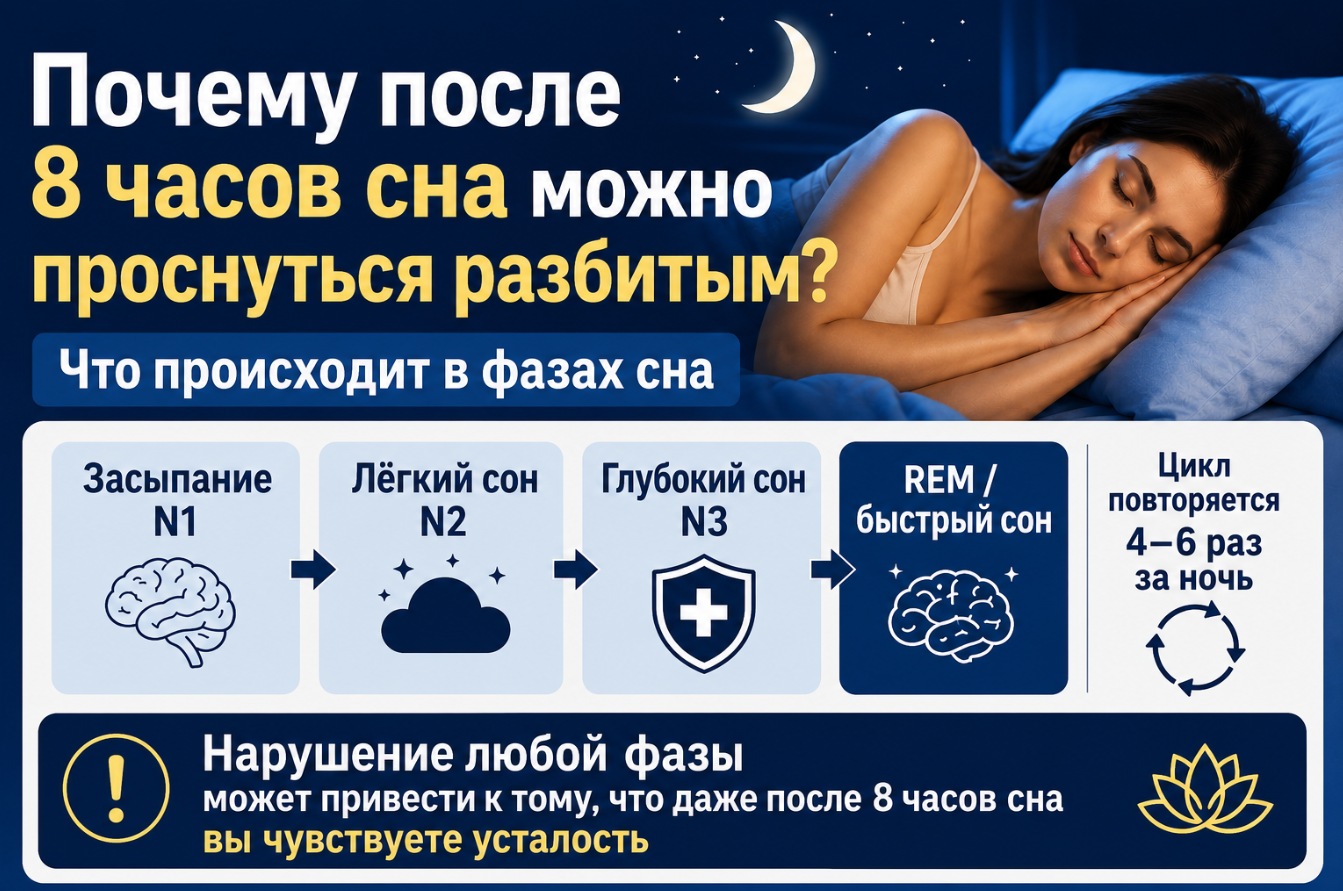
Briefly: what is important to understand
- Eight hours in bed does not necessarily mean eight hours of full recovery.
- Sleep consists of several stages that change throughout the night.
- Deep sleep N3 is usually more abundant in the first part of the night, REM closer to morning.
- Sleep cycle does not last exactly 90 minutes: its duration varies and differs among individuals.
- Therefore, calculating sleep only by the scheme “6 / 7.5 / 9 hours” is too simplistic.
- Morning grogginess is sometimes related to sleep inertia — especially if awakening occurred from deep sleep.
- Smartwatches, fitness bracelets, and rings estimate sleep phases approximately: they do not measure brain electrical activity directly.
Eight hours is just a quantity.
Sometimes a person sleeps for eight hours and still wakes up feeling as if the night never ended.
This is possible because sleep duration is only one of its parameters.
Also important are:
- sleep continuity;
- its depth;
- night awakenings;
- breathing;
- the distribution of sleep stages;
- the moment when awakening occurs.
Therefore, two nights of the same length can give completely different feelings in the morning.
How sleep works
During the night, we alternate between two major phases:
NREM sleep and REM sleep.
NREM includes three stages:
N1 — the transition from wakefulness to sleep.
N2 — stable sleep.
N3 — deep slow-wave sleep.
After these comes REM — the rapid eye movement phase.
Then the cycle repeats.
According to data from the National Heart, Lung, and Blood Institute at the U.S. National Institutes of Health (NIH),a person usually goes through about 4–6 cyclesper night, and one cycle lasts approximately 80–100 minutes..
Sleep phases and stages — National Institutes of Health, NHLBI
At the same time, the night is unevenly structured: deep N3 sleep is usually more abundant in the first part, while REM becomes longer closer to morning.
Deep N3 sleep: an important part of recovery
Deep slow-wave sleep is especially important — the stage N3.
During this time, heart rate and breathing slow down, the person is harder to awaken, and characteristic slow waves appear on the EEG.
Deep sleep is associated with physical recovery processes and some memory mechanisms.
But it is important not to fall into the opposite extreme.
It cannot be said that only N3 “restores the body,” and the other stages are less necessary.
Normal sleep is a sequence of different states, each performing its own functions.
REM is not just about dreaming
During REM, the brain becomes significantly more active.
This stage is particularly associated with processing emotional information and emotional memory.
A scientific review in the journal Sleep Medicine Reviews shows that sleep overall plays an important role in emotional regulation, and REM likely plays a special role in processing emotionally significant information. The authors emphasize that some mechanisms remain subjects of ongoing research.
Scientific review of sleep and emotional processing — PubMed, Sleep Medicine Reviews
In other words, the body does not need “maximum percentages of deep sleep” or “maximum REM.”
What is needed is a normal sleep architecture overall..
Is it true that a sleep cycle lasts exactly 1.5 hours?
No.
90 minutes is a convenient average value, but not a biological timer.
In physiological descriptions, the first cycle often lasts approximately 70–100 minutes, while subsequent cycles may last about 90–120 minutes..
Even more interesting is the research from the Chronobiology Center at the University of Basel.
Scientists analyzed 6064 sleep cycles in 369 people and found significant individual variability: cycle durations differ between people and even change throughout a single night.
Study on sleep cycle durations — University of Basel, Sleep Health journal, PubMed
Therefore, the idea:
"You must sleep exactly 6, 7.5, or 9 hours, otherwise you'll wake up in the wrong phase"
is too simplistic.
Much more important are sufficient sleep duration, regularity, and quality.
So why is it sometimes very hard to wake up?
One reason is sleep inertia..
This is a transitional state after waking when a person is no longer asleep but the brain has not fully engaged in wakefulness.
Symptoms may include:
- sluggishness;
- heaviness;
- confusion;
- reduced attention;
- and the feeling that you want to immediately fall back asleep.
Sleep inertia is especially pronounced when waking abruptly from deep slow-wave sleep.
Moreover, studies show it can occur even after a normal eight-hour sleep. Without significant sleep deprivation, it usually decreases substantially within the first several minutes.
Scientific review of sleep inertia — PubMed, Sleep Medicine Reviews
Therefore, it is important to distinguish between:
"the first 20 minutes after waking I feel like a sleepy fly"
and
and
"I wake up exhausted and remain powerless all day."
These are different situations.
One night contains much more information than just the number of hours. Nature Medicine In 2026, a study was published on a model SleepFM.
trained on more than 585,000 hours of polysomnographic recordings from about 65,000 people..
Polysomnography includes several types of signals at once: brain EEG, heart activity, muscle activity, and breathing.
Based on data from a single night, the model was able to predict an increased future risk of 130 different conditions, including dementia, heart attack, heart failure, and stroke.
SleepFM study — Nature Medicine journal
It is important to correctly understand the result.
This is Not a diagnosis based on one night..
And the study does not prove that a certain sleep structure itself causes the listed diseases.
It shows something else:
a large amount of information about the state of various body systems is contained in the characteristics of sleep.
Therefore, the question "how many hours did you sleep?" describes sleep very approximately.
How accurately do smartwatches, fitness bracelets, and rings determine sleep stages?
Today, many people first check the report in the morning:
"Deep sleep — 48 minutes. REM — 1 hour 27 minutes."
But it is important to understand where these numbers come from.
Common consumer smartwatches, sports watches, fitness bracelets, and smart rings do not measure the brain's electrical activity — EEG..
They assess sleep indirectly: they use data on movement, pulse rate, heart rate variability, and other signals, after which an algorithm estimates when a person was sleeping and in which sleep stage they were.
Medical polysomnography works differently: it records, among other things, the brain's electrical activity, eye movements, and muscle tone. These signals are precisely what are used to determine sleep stages.
There is an interesting study Harvard Medical School and Brigham and Women’s Hospital,where three popular devices were compared simultaneously with polysomnography:
- Apple Watch Series 8;
- Fitbit Sense 2;
- Oura Ring Gen 3.
All three recognized the fact of sleep quite well, but the accuracy of determining individual stages was noticeably lower and varied between devices.
The question was studied even more broadly in a 2025 meta-analysis: 24 studies and 798 participants.
The authors concluded that consumer devices are useful for monitoring general sleep patterns but lag behind polysomnography on key indicators.
Therefore, the statement:
"Today there was 43 minutes of deep sleep"
should not be taken as a laboratory analysis.
It is much wiser to use such devices to observe trends:
when you go to bed,
when you wake up,
how stable your routine is,
how the total sleep duration changes from week to week.
And specific minutes of N3 and REM are better considered as approximate algorithm estimates.
When to pay attention not to the clock, but to the sleep itself
If a person regularly sleeps long enough but still wakes up feeling exhausted, it is useful to assess:
- how often they wake up at night;
- whether there is pronounced snoring;
- whether close ones notice breathing pauses;
- whether there are morning headaches;
- whether there is strong daytime sleepiness;
- whether alcohol is consumed in the evening;
- how excited the mind is before sleep;
- whether drowsiness passes after waking up or persists for hours.
If pronounced fatigue and daytime sleepiness occur repeatedly, especially with snoring or breathing disorders, it is worth discussing this with a specialist.
And if the main problem is difficulty switching from activity to rest in the evening, then you can work with the state itself.
At YogaJoy, we separately analyze why relaxation is a skilland not just immobility:
"Why is relaxation one of the keys to youth?" — YogaJoy
For evening switching, you can use:
YogaJoy breathing practices for relaxation and calming.
And about how evening practice differs from morning practice:
"When is the best time to practice yoga — morning or evening?" — YogaJoy
The main point
Good sleep cannot be described by a single number.
Not only:
"I slept eight hours."
Not only:
"One cycle is 90 minutes."
And not only:
"The watch showed 52 minutes of deep sleep."
Duration is important.
But along with it, continuity of sleep, its architecture, breathing, regularity of the routine, and how a person feels after waking up are important.
Therefore, it is more useful to ask yourself not only the question:
"How long did I sleep today?"
But also another:
"How much did this sleep really restore me?"
Sources and research
National Heart, Lung, and Blood Institute, NIH.
Sleep phases, NREM, N3, REM, and sleep cycles.
NIH — Sleep Phases and Stages
Cajochen C. et al., University of Basel.
Ultradian sleep cycles: Frequency, duration, and associations with individual and environmental factors.
Sleep Health, 2024.
Research on PubMed
Tassi P., Muzet A.
Sleep inertia.
Sleep Medicine Reviews.
Scientific review on PubMed
Tempesta D. et al.
Sleep and emotional processing.
Sleep Medicine Reviews.
Scientific review on PubMed
Thapa R. et al.
A multimodal sleep foundation model for disease prediction.
Nature Medicine, 2026.
SleepFM study — Nature Medicine
Lee Y.J. et al.
Meta-analysis of consumer sleep tracking devices compared to polysomnography.
Journal of Clinical Sleep Medicine, 2025.
Meta-analysis on PubMed
Svensson T. et al.
Comparison of Apple Watch Series 8, Fitbit Sense 2, and Oura Ring Gen 3 with polysomnography. Harvard Medical School / Brigham and Women’s Hospital.
Research on PubMed