Articles
Neck tension? Pain in the occiput and neck? Tight neck muscles? Spasm of the suboccipital muscles!
Why working with the suboccipital area should include gentle neck exercises, breathing, muscle relaxation, and attention to head position.
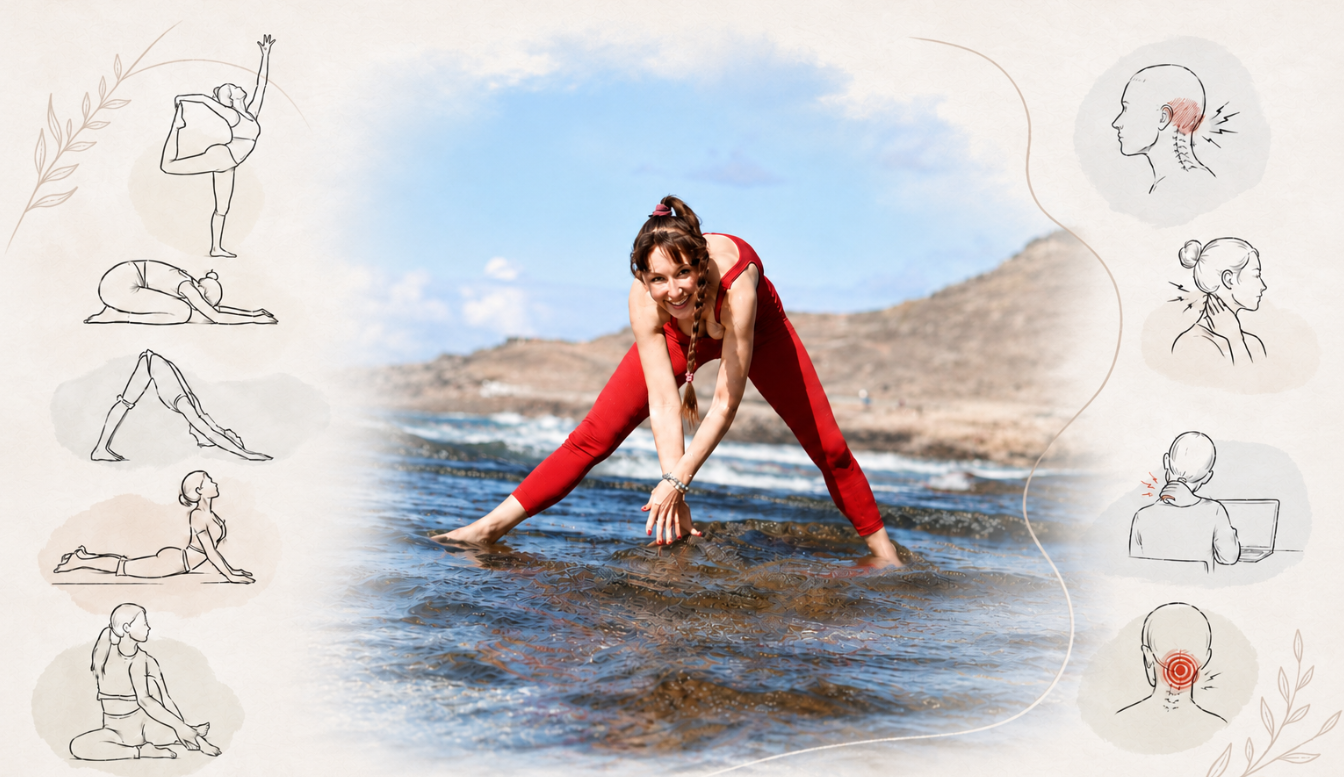
Neck tension, a feeling of heaviness at the base of the skull, stiffness after working at the computer — sensations familiar to many.
One of the areas that can contribute to such tension is the suboccipital muscles — a small group of deep muscles at the junction of the head and the upper cervical spine.
Despite their small size, this area actively participates in head movements and helps the nervous system receive information about its position.
Therefore, working with the neck is not just stretching. It is useful to combine gentle movements, attention to head position, breathing, and relaxation.
Where are the suboccipital muscles located?
The suboccipital muscles are located deep beneath the base of the skull.
They connect the occipital bone with the first and second cervical vertebrae — the atlas and axis.
This group includes four small muscles involved in fine head movements: extension, tilting, and rotation.
The deep muscles in this area have a high concentration of sensory receptors involved in proprioception — the brain's ability to determine the position and movement of body parts.
Simply put, this area helps the nervous system understand where the head is and how it moves relative to the neck and torso.
Why does tension appear under the occiput?
The causes of tension can vary.
It can appear after prolonged staying in one position, working at a computer, extended phone use, unfamiliar physical exertion, or emotional stress.
When we look at a screen for a long time or hold our head in one position, the neck muscles are forced to support it for a prolonged period almost without movement.
Gradually, a feeling of stiffness, fatigue, or tension may develop.
Stress can also change muscle tone: a person involuntarily raises their shoulders, clenches their jaw, or holds their neck more rigidly.
Therefore, it is often useful to work not with a single muscle but with the entire habitual movement pattern.
Can tension in the suboccipital muscles be related to headaches?
In some people, increased stiffness of the upper neck muscles is indeed observed along with headaches related to the cervical spine.
It is important to understand: pain in the occiput is not always caused by muscles..
Headaches and neck pain can have many causes, so it is incorrect to explain any pain solely as a "spasm of the suboccipital muscles."
If the pain is new, severe, recurring regularly, appeared after an injury, or is accompanied by dizziness, vision problems, weakness, numbness, speech difficulties, or other unusual symptoms, medical evaluation is necessary.
How is neck tension related to head position?
The head constantly balances on top of the spine.
When we look down for a long time or push our head forward toward the screen, the load distribution on the neck muscles changes.
Some muscles are forced to work in a static mode for a long time.
Therefore, for the neck, it is not about the idea of a single "perfect posture" to maintain all day, but about the ability to regularly change position and move.
The body tolerates varied movement much better than many hours of immobility, even in a formally correct posture.
Why is massage sometimes not enough?
Massage can temporarily reduce the feeling of tension and help relax.
But if after massage a person returns to the same many-hour immobile positions and habitual movement patterns, unpleasant sensations may return.
Therefore, a more sustainable approach includes not only local relaxation but also regular movement.
It is helpful to pay attention to:
- gentle mobility of the neck;
- the thoracic spine;
- shoulder position;
- breathing;
- periodic breaks when working at the computer;
- overall physical activity level.
How to gently relax the neck and suboccipital area?
Working with this area should not be aggressive.
Small and comfortable head movements performed without pain or sudden jerks are suitable.
You can start with simple observation.
Sit or stand comfortably.
Notice the position of your head relative to your shoulders.
Without trying to "perfectly straighten up," imagine the crown of your head gently directing upward, and the back of your neck becoming slightly longer.
You don’t need to forcefully press your chin to your chest.
Take several calm inhales and long exhales.
Then make a few very small and slow head turns to the right and left, observing the sensations.
Amplitude is less important here than the quality of movement.
Why involve breathing?
When a person experiences stress or concentrates on difficult work, breathing often becomes less free, and the muscles of the shoulder girdle and neck become more tense.
Therefore, in practice, it is useful not only to move the neck but also to bring attention back to the breath.
There is no need to take very deep breaths deliberately.
Sometimes it is enough to stop holding your breath and calmly observe the natural inhale and exhale for a few minutes.
This helps make the practice less mechanical and better notice unnecessary tension.
How can yoga help here?
Yoga allows working not only directly with the neck.
Movements of the thoracic spine, shoulder girdle, spine, and breathing practices create a more comprehensive bodywork.
Instead of trying to isolate and "stretch one tight muscle," we learn to notice how the following are connected:
- head position;
- shoulders;
- rib cage;
- spine;
- breathing;
- overall tension.
Regularity is especially important.
A few minutes of gentle movement, repeated systematically, is often more beneficial than rare intense attempts to "unlock" the neck.
What is the myodural bridge?
The suboccipital area has an interesting anatomical feature.
Researchers describe the so-called myodural bridge — the myodural bridge:connective tissue structures linking certain suboccipital muscles to the dura mater of the spinal cord.
This structure really exists.
Its possible role in the mechanics of the cranio-cervical region and cerebrospinal fluid movement is being studied.
However, the functions of the myodural bridge are still under investigation, so it would be incorrect to claim that specific neck exercises directly "improve cerebrospinal fluid circulation" or brain function.
This is an interesting area of modern anatomy, but not yet a basis for such therapeutic promises.
The main point
The suboccipital muscles are a small but functionally important part of the complex system controlling head position and upper neck movements.
If this area feels tense, it makes sense not to try to forcibly "break the spasm," but to work more gently:
- change body position more often;
- take breaks during prolonged work;
- maintain mobility of the neck and thoracic spine;
- use calm movements;
- pay attention to breathing and overall tension;
- practice yoga regularly.
Yoga can be one way to work comprehensively with the body.
And if you have pain, it is important to find out its cause and get yoga practice recommendations from a specialist.
You can also watch a lecture on this topic "Tension in the neck? Pain in the occiput and neck? Tight neck muscles? Suboccipital muscle spasm!"
Sources
-
Kulkarni V., Chandy M.J., Babu K.S. Quantitative study of muscle spindles in suboccipital muscles of human foetuses. Neurology India. 2001;49(4):355–359. PMID: 11799407.
-
Ma Y. et al. The morphology, biomechanics, and physiological function of the suboccipital myodural connections. Scientific Reports. 2021;11:8064. DOI: 10.1038/s41598-021-86934-4.
-
Mueller J. et al. Resistance, Motor Control, and Mindfulness-Based Exercises Are Effective for Treating Chronic Nonspecific Neck Pain: A Systematic Review With Meta-Analysis and Dose-Response Meta-Regression. Journal of Orthopaedic & Sports Physical Therapy. 2023;53(8):420–459. DOI: 10.2519/jospt.2023.11820.
-
Mingels S. et al. Effectiveness of therapeutic exercise for the management of cervicogenic headache: A systematic review. 2023. PMID: 37479561.