Articles
Relaxation is not sleep: why you need to learn how to relax
Why sleep and relaxation are not the same, how Shavasana differs from ordinary rest, and how to truly let go of tension.
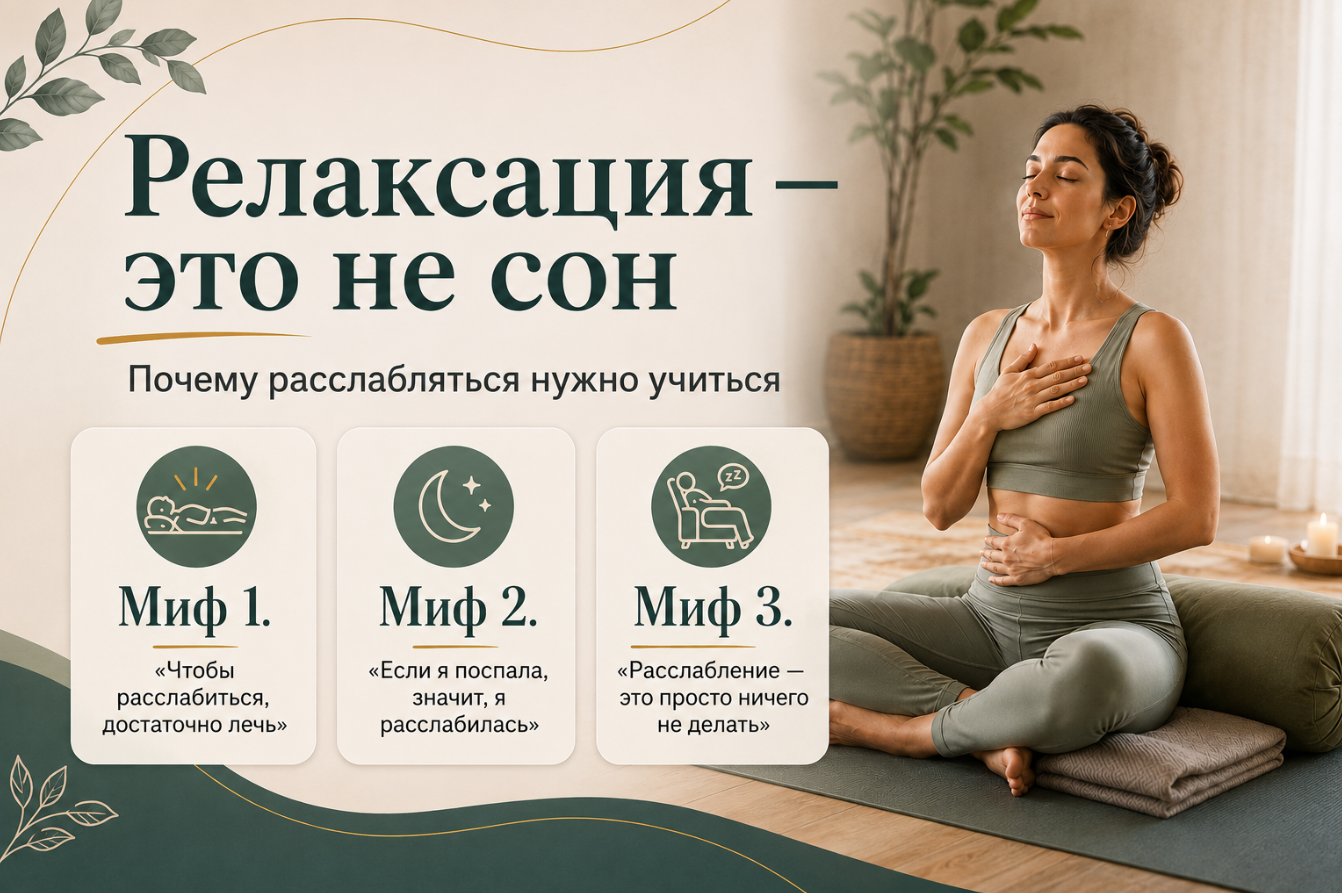
Relaxation is not sleep: why you need to learn how to relax
Briefly: what is important to understand
-
Sleep, lying down, and relaxation are not the same.
-
You can sleep eight hours and wake up tired.
-
You can lie still but continue to hold tension in your body and mind.
-
Scientific research showed: recovery after exertion in Shavasana happened faster than during ordinary rest lying down or sitting, go to meditation practices.
-
Relaxation is a skill: first we notice tension, then we learn to release it.
-
Sometimes 10–20 minutes a day is enough for this.
Myth 1. “To relax, it’s enough to lie down”
Sometimes — yes. If a person already knows how to relax.
But lying down itself does not mean that the body and mind have entered a state of rest.
You can lie down and continue mentally solving problems.
You can close your eyes but keep your jaw clenched.
You can stay still but maintain tension in your shoulders, abdomen, face.
The body lies down — but the state of tension remains.
And this is not just a subjective feeling.
In one study of Shavasana and recovery after physical exertion three options were compared: Shavasana, ordinary lying on the back, and resting while sitting.
During Shavasana, heart rate and blood pressure returned to baseline values faster.
Important: participants were not just lying down. They performed yogic relaxation technique.
Hence a simple conclusion:
Shavasana is not just a body position. It is a practice of relaxation.
Myth 2: "If I slept, it means I relaxed."
Sleep is necessary for recovery. But sleep and relaxation are not the same thing.
You can fall asleep after a stressful day and wake up with the same tense shoulders, heavy head, and feeling of an internal race.
You can sleep for a long time but still not feel rested.
Relaxation allows you to consciously notice the state of your body and change it.
Release your face.
Relax your jaw.
Lower your shoulders.
Stop pulling in your stomach.
Soften your breathing.
Stop solving problems for a few minutes.
For this, you can use meditations for deep relaxation.
Myth 3: "Relaxation is simply doing nothing."
Outwardly, relaxation may indeed look like inactivity.
But inside, the attention is working.
We notice:
-
where the body is tense;
-
how we are breathing;
-
where the mind has wandered again;
-
which muscle we continue to hold unnecessarily;
-
whether we can release it.
Therefore, sometimes truly relaxing turns out to be harder than doing an active workout.
In movement, attention is constantly occupied with something.
In stillness, it becomes noticeable how much tension we hold all the time..
The body and mind relax together.
When we are anxious, the body reacts.
The jaw clenches.
The shoulders rise.
The abdomen tightens.
Breathing becomes shorter.
But the connection works in reverse as well.
If we consciously release muscles, return attention to breathing, and stop supporting the internal race, the state gradually changes.
Therefore, relaxation usually involves several levels:
body → breathing → attention → state of mind.
Sometimes it’s easiest to start with the body.
Feel the support.
Release your face.
Lower your shoulders.
Relax the stomach.
Take a few calm breathing cycles.
Here, the following can help breathing practices for relaxation and calming.
How to understand that relaxation is really happening?
There is no need to wait for a special mystical state.
The signs are usually very simple:
-
breathing becomes calmer;
-
the face softens;
-
the shoulders drop;
-
the body feels heavier or warmer;
-
thoughts slow down;
-
the need to do something immediately disappears;
-
a feeling appears: "you can exhale".
Sometimes the opposite happens: a person stops for the first time and suddenly notices how tense they are.
This is also the beginning of the practice.
First — notice.
Then — learn to let go.
And then — return to this state more easily each time.
Relaxation is a skill.
We learn to perform asanas.
We learn to control the breath.
We learn to concentrate attention.
Relaxation can also be learned.
The more often a person consciously returns to a state of calm, the faster they begin to notice unnecessary tension before it accumulates.
You don’t have to wait for the weekend, vacation, or complete exhaustion.
Sometimes 10–20 minutes is enough.
Shavasana.
Calm breathing.
Meditation.
Silence.
Gentle practice.
Or a special anti-stress practice..
The main thing is not just to stop the body’s movement.
The main thing is but to truly change the state..
And you can read more about why the ability to relax is connected with recovery, energy, and the feeling of youth in the article "Why Relaxation Is One of the Keys to Youthfulness?".