Articles
Why take food breaks? Is it fasting for weight loss?
What are fasting breaks and Ekadashi, why are they needed, and how to practice them correctly? Learn about the effects of fasting breaks on metabolism, energy, mental clarity, and healthy longevity.
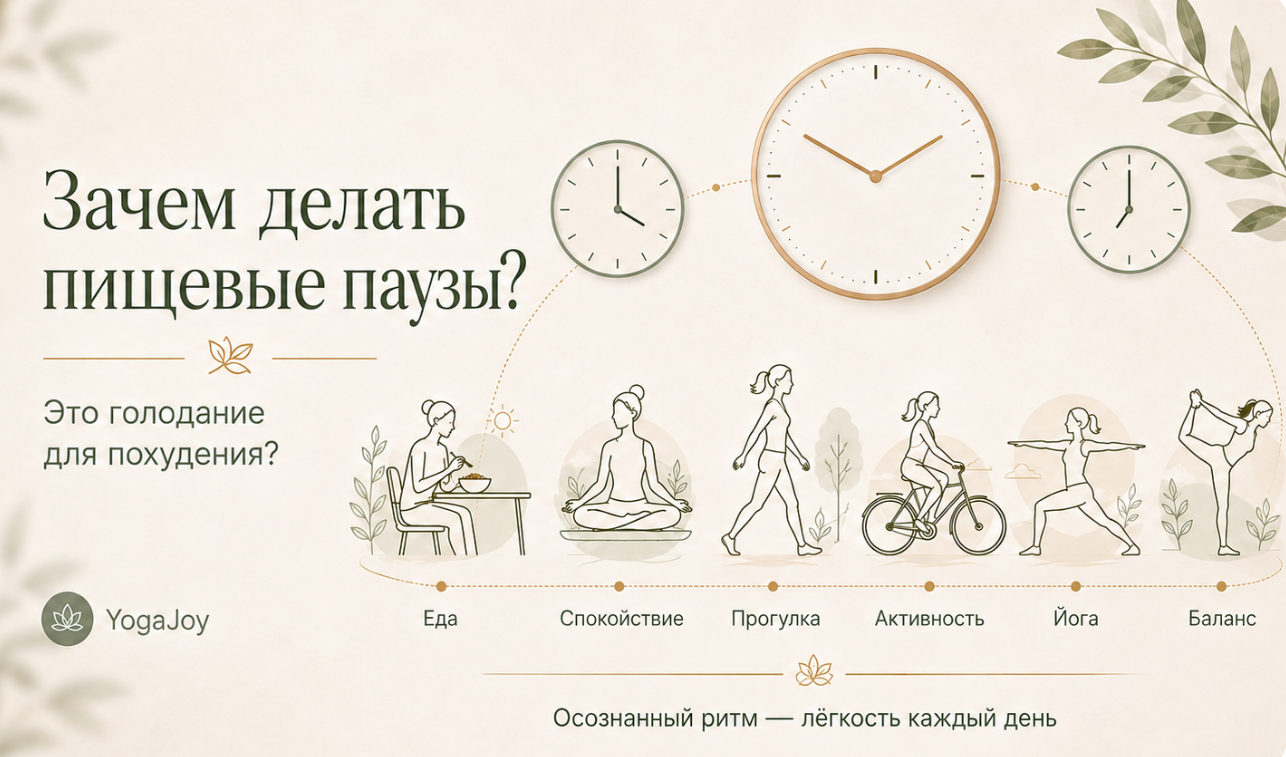
Why take food breaks? Is it fasting for weight loss?
Food breaks are predetermined periods between meals when the body does not receive calories.
Essentially, it is a way to give our digestive and metabolic systems a chance to shift from the mode of "eating – processing – waste elimination," that is, constant external energy intake, to using the body's own energy reserves.
It is important to understand that the purpose of food breaks is not to "starve," but to create a certain physiological rhythm of "food → processing → pause for using internal energy reserves," according to which, with regular practice, the body begins to release excess accumulated over years or even decades.
At the same time, it is important to understand: food breaks are not some magical method for weight loss. Modern research shows that limiting the "eating window" can support metabolic flexibility, insulin sensitivity, and cellular renewal processes, as well as better synchronize nutrition with circadian rhythms, which collectively has multifaceted effects on the body.
In this sense, the idea and effects of food breaks surprisingly coincide with the ancient tradition of Ekadashi — special food breaks lasting 36 hours, observed on specific lunar cycle days when people consciously simplify their diet or temporarily abstain from food. These are the 11th and 26th lunar days. These days are the best for resting from food; the pause happens more easily and comfortably with deep cleansing effects on all seven bodies.
But the meaning of Ekadashi is much broader than physiology: it is simultaneously rest for the body due to reduced food load, but mainly it is an opportunity to turn attention inward. While modern scientists explain the benefits of food breaks through metabolic mechanisms, the yogic tradition adds the intention of discipline and mindfulness.
It is an opportunity to observe your habits and desires, turn attention inward, and train the ability to consciously choose rather than automatically follow impulses.
Therefore, Ekadashi can be considered on several levels at once: as a food break for the body, a metabolic experiment, a practice of mindfulness and discipline.
And simply put: we do not fast for the sake of fasting. We create space where the body and mind can temporarily exit the usual mode of constant consumption.
And that is why Ekadashi can become not just another diet, but a regular practice of renewal — of the body, eating behavior, and state of mind.
What effects can you get by regularly practicing Ekadashi?
🔥 1. GET SLIMMER — thanks to metabolic reset through energy balance control.
A fasting period increases the time when the body uses its own energy reserves. This can help control calorie intake and body weight. Research shows that the weight loss effect from fasting breaks is primarily related to reduced external energy intake (in the form of food), rather than the "magic of fasting."
✨ 2. FEEL YOUNGER — thanks to cellular adaptation
During fasting, signaling pathways related to AMPK, mTOR, autophagy, mitochondrial adaptation, and protection of cells from oxidative stress are activated, along with all restorative processes in general. That is why all types of fasting breaks (intermittent fasting, Ekadashi, etc.) are actively studied in the context of healthy longevity.
⚡ 3. BE MORE ENERGETIC AND HAVE A CLEAR MIND — thanks to improved metabolic flexibility
When glucose intake from food decreases, the liver increases ketone production from fats. The brain starts using ketone bodies more actively, which become an additional energy source for the brain. Also, when digestion temporarily takes a back seat, some metabolic resources and body signals shift from constant food processing to supporting other processes, including wakefulness and inner focus — which is why many perceive fasting breaks not as deprivation but as a state of greater clarity.
How to properly observe Ekadashi
(these are the 11th and 26th lunar days; by the way, for beginners, it’s better to start with the 26th day for the first experience)
1. The evening before, have a light meal, preferably a vegetarian dish, such as stewed vegetables.
2. During Ekadashi day, you can drink water (herbal infusions).
3. For beginners who find it difficult to abstain from food, you can start with a mono-diet: choose one product for the day, for example, cucumbers or kefir (according to your preference), and spend the whole day on this mono-diet.
4. Breaking the Ekadashi fast the next morning is best done with a light meal, such as oatmeal cooked in water with a little ghee added.
5. In total, the fasting break will last about 36 hours.
6. On Ekadashi day, you can perform certain yogic and breathing practices that improve the state of body and mind and make the experience of abstaining from food easier and more comfortable. You can watch these special Live Yoga practices with me both live and recorded on our website YOGAJOYSPACE; follow the schedule in our events calendar.
EKADASHI IS A LUXURIOUS GIFT FOR YOUR DIGESTIVE SYSTEM AND WHOLE BODY
LET’S DO IT TOGETHER
ATTENTION ‼️
Long fasting breaks are not suitable for everyone.
For example, during pregnancy, eating disorders, diabetes on glucose-lowering therapy, certain chronic diseases, and when taking specific medications, such a regimen should be agreed upon with a doctor.
Sources on research:
https://www.sciencedirect.com
https://bmjmedicine.bmj.com
https://pubmed.ncbi.nlm.nih.gov
/38357669/
The information is provided solely for educational and informational-entertainment purposes and is not medical advice, diagnosis, or a substitute for consultation with a qualified medical professional. Before changing your diet or practicing prolonged fasting breaks, it is recommended to consider your individual health condition and consult a doctor if necessary.