Articles
Ashwagandha: benefits, how to take it, and what research proves
What are the benefits of Ashwagandha? Its effects on stress, sleep, testosterone, women's health, and memory. Dosages, contraindications, and results of scientific studies.
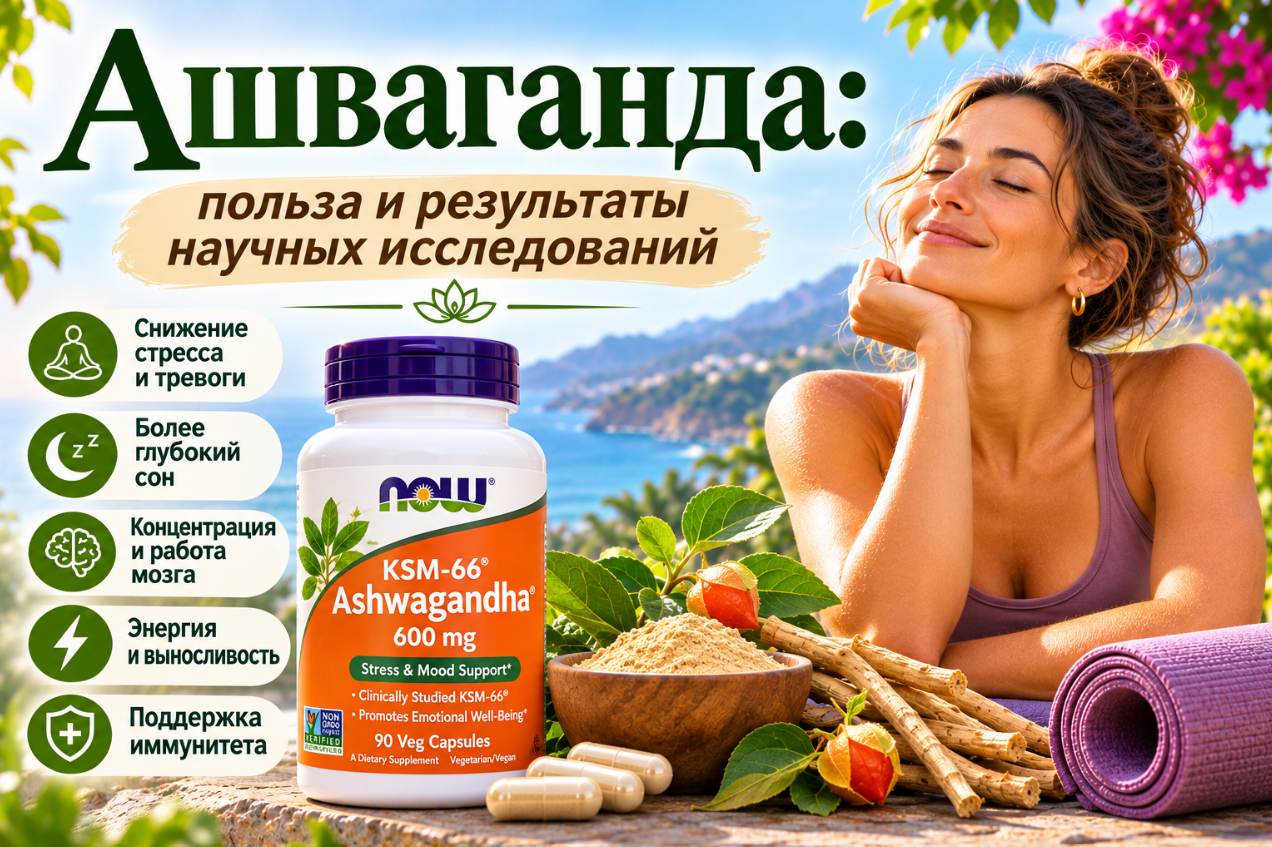
Ashwagandha: benefits, how to take it, and what research proves
Ashwagandha (Withania somnifera) is a medicinal plant used for centuries in Ayurveda (Indian classical medicine). Today, it is studied by scientists worldwide, primarily in relation to stress, sleep disorders, hormonal health, and physical performance.
Studies have found positive effects, some of which have already been confirmed by several clinical trials. However, ashwagandha is not suitable for everyone, and different products can vary significantly in composition.
Let's explore what benefits can be expected, how to choose an extract, typical dosages, and important contraindications to consider.
Ashwagandha in one minute: the essentials
-
Stress and anxiety. Clinical studies show a reduction in subjective stress and, in some cases, cortisol levels.
-
Sleep. Ashwagandha may improve sleep quality and duration. The most noticeable results were obtained in cases of sleep disorders and courses lasting eight weeks or more.
-
Men's health. Studies have noted moderate increases in testosterone, improvements in certain indicators of sexual desire, and sperm quality.
-
Women's health. Positive results have been observed for menopausal symptoms, sleep disturbances, and decreased sexual desire.
-
Memory and attention. A 2026 meta-analysis found improvements in certain cognitive indicators, but there is no evidence yet for dementia prevention.
-
Physical endurance. Positive results have been found, especially for prolonged aerobic exercise.
-
How to take it. Many studies used 250–600 mg of standardized extract daily for 6–12 weeks. There is no single recommended dose for all products.
-
Safety. Drowsiness and digestive disturbances are possible; rare cases of liver damage have been reported. Special precautions are necessary during pregnancy, and for liver and thyroid diseases.
Key points: The most studied uses of ashwagandha are stress and sleep. Results for men's and women's health, memory, and endurance also deserve attention but require larger studies.
Does ashwagandha help with stress and anxiety?
This is one of the most studied properties of the plant.
In 2026, a meta-analysis was published 22 randomized studies involving 1,391 participants. When combining the results, people taking ashwagandha showed reduced levels of stress, anxiety, and depressive symptoms compared to control groups.
In another meta-analysis that included nine clinical trials, researchers found a decrease not only in perceived stress but also in cortisol levels.
Cortisol is a hormone that helps the body adapt to stress. It is essential for humans, so the goal is not to reduce its concentration as much as possible.
Researchers are interested in the possibility of improving the regulation of stress responses and well-being during prolonged psychological stress.
What does this mean in practice? Some ashwagandha supplements can reduce feelings of stress and anxiety. The effect varies between studies and is not guaranteed for every individual.
In 2022, the international expert group WFSBP/CANMAT included ashwagandha in their recommendations for herbal treatments for anxiety disorders, noting preliminary support for its use. For clinically significant anxiety, such remedies should not replace prescribed treatment.
Sources: Meta-analysis of stress and anxiety, 2026, Cortisol studies, 2024, WFSBP/CANMAT recommendations.
Read also in the YogaJoy article about how breathing, movement, and mindfulness help manage stress "How to Calm the Nervous System During Stress".
Does ashwagandha help improve sleep?
Yes, positive results have been found in several clinical studies.
A meta-analysis of five trials involving 400 adults showed improved sleep compared to placebo.
In individual studies, participants fell asleep faster, slept longer, and experienced less wakefulness after nighttime awakenings.
More pronounced results were observed in people with insomnia and with a duration of intake of at least eight weeks.
Practical conclusion: Ashwagandha may be helpful for subjectively poor sleep, especially if sleep disturbances are accompanied by stress. However, it is not a fast-acting sleeping aid, and its use for chronic insomnia does not replace examination and treatments with established effectiveness.
Meta-analysis of sleep studies, PLOS ONE, 2021.
Ashwagandha for women: menopause, sleep, and libido
Women’s health is one of the areas where new clinical data have emerged.
Can it help with menopause?
A study published in September 2026 involved 66 women aged 45–65 years after menopause.
For 12 weeks, one group took 600 mg of ashwagandha root extract daily, while the other took a placebo.
Researchers found:
-
Significant improvement in sleep quality.
-
Reduction in the severity of menopausal symptoms.
-
Improvement in some quality of life indicators.
There was also a slight reduction in body fat percentage, but no significant improvement in bone mineral density was found.
These are interesting results, especially for women experiencing both sleep disturbances and menopausal symptoms.
However, the study was relatively small and lasted three months. Ashwagandha is not yet an established alternative to hormone replacement therapy for menopause.
Clinical study of postmenopausal women, Menopause, 2026.
Does ashwagandha affect women's sexual desire?
A randomized study in 2022 involved 80 women with reduced sexual desire.
After eight weeks of taking the root extract, researchers found improvements in sexual desire, arousal, satisfaction, and overall sexual function compared to placebo.
Positive results were also obtained in a later 2025 study.
Thus, ashwagandha has grounds for further research in the field of women's sexual health. How lasting these effects are and which women benefit most still need to be clarified.
Clinical study on women's sexual health, 2022.
Ashwagandha for men: testosterone, libido, and sperm quality
Does ashwagandha increase testosterone?
A 2026 meta-analysis combined 23 randomized studies with a total of 1706 participants.
In men, taking ashwagandha was accompanied by an average increase in testosterone of approximately 57 ng/dL compared to control groups.
In women, no statistically significant increase in testosterone was found.
The result is noteworthy, but an increase in a laboratory marker does not automatically mean an improvement in sexual function and does not make ashwagandha a treatment for confirmed hormonal deficiency.
Meta-analysis of hormonal effects, Planta Medica, 2026.
Does it improve libido and reproductive health?
An Indian study in 2025 involved 100 men aged 30–50 years.
After eight weeks of root extract use, improvements were found in certain indicators of sexual desire and satisfaction.
Some parameters of semen volume, count, concentration, and sperm morphology also increased.
However, improvement in semen analysis is not equivalent to proven increased chances of conception.
Study on male sexual health, 2025.
Does ashwagandha improve memory and concentration?
The brain requires constant energy metabolism, and attention and memory depend on many interconnected processes.
In 2026, a meta-analysis of 20 studies involving 1249 people was published. The authors found positive changes in certain indicators:
-
Memory.
-
Attention and information processing speed.
-
Executive functions — the ability to plan, shift attention, and control actions.
The most noticeable result was observed for memory.
However, the quality of evidence varied, and the studies used different preparations and assessment methods.
What can be said today: the effect of ashwagandha on cognitive functions is a promising area. However, it cannot yet be claimed that its use prevents Alzheimer's disease or other age-related memory disorders.
Meta-analysis of cognitive and physical effects, Frontiers in Pharmacology, 2026.
Does ashwagandha help increase endurance and strength?
A 2026 meta-analysis combined 13 randomized trials involving 599 people.
On average, ashwagandha improved some indicators of physical performance.
The most consistent results were obtained for aerobic endurance — the ability to sustain physical activity for a sufficient duration.
Results for maximal muscle strength were less definitive.
Most participants in these studies were relatively young, so it is too early to generalize the results to all age groups.
Meta-analysis of physical performance, Nutrients, 2026.
Which ashwagandha to choose and how much to take?
This is an important practical question since the products sold differ from each other.
Studies used root powder and various concentrated extracts. Their effects cannot be compared solely by the number of milligrams on the package.
Root or leaves?
The most common raw material for Ayurvedic use and a significant part of modern clinical studies is the ashwagandha root.
Different parts of the plant have different chemical compositions.
Therefore, when choosing a product, it is useful to look for a clear indication of which part of the plant is used.
What is a standardized extract?
Ashwagandha contains biologically active compounds called withanolides.
Manufacturers may indicate their percentage content in the extract.
But a higher percentage of withanolides alone does not prove that the product is more effective or safer.
The composition, manufacturing method, and whether a specific extract has been studied in clinical trials are important.
What dosages were studied?
Many trials used 250–600 mg of standardized extract per day.
Other amounts were found depending on the product.
The duration of most studies was 6–12 weeks.
This allows for evaluation of short-term use results but does not establish a universal regimen for all products.
Powdered dried root and concentrated extract cannot be considered equivalent in dosage.
When to take it — morning or evening?
There is no convincing evidence that a specific time of day always provides better results.
Different regimens were used in studies, including taking it once or twice a day.
When choosing, follow the instructions of the specific product and consider tolerance.
The main thing when buying: choose a product with a clear composition, indication of the plant part, dosage, standardization, and manufacturer. Quality control of raw materials is especially important for ashwagandha.
NIH — Ashwagandha: Research, Products, and Safety.
Contraindications and Safety of Ashwagandha
In most short-term clinical studies, root preparations were fairly well tolerated.
Possible side effects include drowsiness, nausea, abdominal discomfort, and diarrhea.
But the natural origin of the plant does not mean the absence of medical risks.
Liver diseases. Rare cases of liver damage associated with ashwagandha use, including severe complications, have been reported in Australia and other countries. Ashwagandha preparations should be avoided in existing liver diseases.
Thyroid diseases. Ashwagandha may affect thyroid hormone levels. Medical approval is necessary for hyperthyroidism, other thyroid diseases, and when taking thyroid medications.
Pregnancy and breastfeeding. Use is not recommended.
Drug interactions. Caution is required when taking sedatives, anticonvulsants, hypoglycemic agents, antihypertensives, and immunosuppressants.
Other restrictions. Medical evaluation is necessary for autoimmune diseases, hormone-dependent prostate cancer, and before planned surgeries.
If yellowing of the skin, darkening of urine, severe nausea, or other signs of possible liver damage appear, discontinue use and seek medical help.
Reliable data on the safety of continuous ashwagandha use for many months or years is currently insufficient.
Sources: NCCIH — Use and Safety of Ashwagandha, Australian regulator TGA, 2026.
Which beliefs about ashwagandha are exaggerated?
Many expectations have formed around this popular plant. Some are based on laboratory experiments, others on small clinical studies.
"Ashwagandha increases testosterone in everyone." Positive results have been obtained in men, but they do not mean the same effect for every individual.
"Ashwagandha cures depression." Studies show possible relief of certain symptoms, but ashwagandha is not a substitute for established treatments for depressive disorders.
"Ashwagandha helps with weight loss." A 2026 meta-analysis found no convincing evidence of weight or fat percentage reduction when combining studies.
"Ashwagandha rejuvenates the body and prevents dementia." Such claims significantly exceed the available clinical evidence.
"Ashwagandha is completely safe because it is a plant." Data on possible side effects and drug interactions suggest otherwise.
Thus, the most justified expectations are related to stress reduction and improved sleep, while some other effects already have positive clinical results but still require clarification.
Should you take ashwagandha?
Ashwagandha may be of interest to adults experiencing stress or sleep disturbances, especially if short-term use of the studied extract is considered.
Results related to male and female health, memory, and physical endurance are also interesting, but choosing a supplement solely for these effects is premature.
Before starting intake, it is important to assess contraindications and possible interactions with medications.
The main principle: choose ashwagandha not because it is called a universal adaptogen, but based on a specific goal and research results.
For those who want to learn more: the history and science of ashwagandha
Ashwagandha in Ayurveda: a centuries-old history
Ashwagandha holds a special place in traditional Indian medicine.
Its name comes from the Sanskrit words aśva — "horse" and gandha — "smell." This is usually associated with the characteristic scent of the root.
In Ayurvedic tradition, the plant was also associated with strength and endurance.
Ashwagandha is known in the classical medical tradition of Ayurveda, linked to texts such as the "Charaka Samhita" and "Sushruta Samhita."
These works were developed over a long period, with their early editorial layers dating approximately to the last centuries BCE and the first centuries CE. The exact date of ashwagandha's first use cannot be established.
In traditional terminology, several concepts are associated with the plant:
-
Balya — strengthening and maintaining strength.
-
Rasayana — restoring and maintaining vital energy.
-
Vajikarana — a branch of Ayurveda related to reproductive health.
In traditional practice, ashwagandha root was used in the form of powders, decoctions, and multi-component formulations.
It was used for conditions that ancient physicians described as exhaustion, body weakness, and lack of vital energy.
In 2021, Indian researchers Vinod Kumar Joshi and Apurva Joshi published a detailed analysis of the traditional use of ashwagandha based on historical Ayurvedic sources.
Joshi and Joshi — a historical-pharmacological review, Journal of Ethnopharmacology, 2021.
Ashwagandha, Rasayana, and Panchakarma
In Ayurveda, Rasayana is associated with restoration, strengthening the body, and maintaining vital energy.
Panchakarma is another traditional system that includes preparatory and cleansing procedures.
Ashwagandha is not part of the five main Panchakarma procedures. Its traditional role is mainly related to restoration and maintenance of the body.
Therefore, in Ayurvedic practice, it may be considered part of the restorative phase or included in specific medicinal formulations.
Historical use is not equivalent to modern proof of efficacy but helps to understand why researchers became interested in this particular plant.
More about the place of ashwagandha in Rasayana and traditional Ayurveda can be read in our article "Stress, fatigue, and sleep: what is known about ashwagandha".
What does ashwagandha contain?
Modern pharmacology studies the biologically active substances contained in the plant.
The greatest interest is in vitanolides — natural compounds from the group of steroidal lactones.
The word "steroidal" here refers to features of the chemical structure and does not mean that ashwagandha contains anabolic steroids.
Alkaloids and other compounds have also been found in the plant.
Their concentration depends on the part of the plant, growing conditions, and the method of extract preparation.
That is why the composition of products from different manufacturers can vary significantly, and the results of testing one extract cannot be automatically applied to any other.
Why did modern medicine begin studying Ashwagandha?
Historically, the plant was used for conditions that today might be described as fatigue, stress, recovery, and sleep disturbances.
The development of modern pharmacology has allowed these traditional beliefs to be tested with objective methods.
Researchers began measuring cortisol levels, sleep parameters, hormonal indicators, physical performance, and cognitive test results.
Thus, the centuries-old history of the plant became the starting point for modern clinical studies.
Today, Ashwagandha is studied not only in India but also by research groups in Europe, the USA, Australia, and other countries.
The greatest scientific value of these studies lies in their ability to distinguish the real effects of individual products from traditional beliefs and advertising claims.
This material is for informational and educational purposes and does not replace medical consultation. In cases of liver disease, thyroid disorders, pregnancy, breastfeeding, and medication use, special attention to safety is required when using Ashwagandha.