Articles
Chlorophyll: benefits, liquid supplements, and scientific research
What is chlorophyll for and is it worth drinking? What is proven about the benefits of liquid chlorophyll for skin, weight loss, and body cleansing.
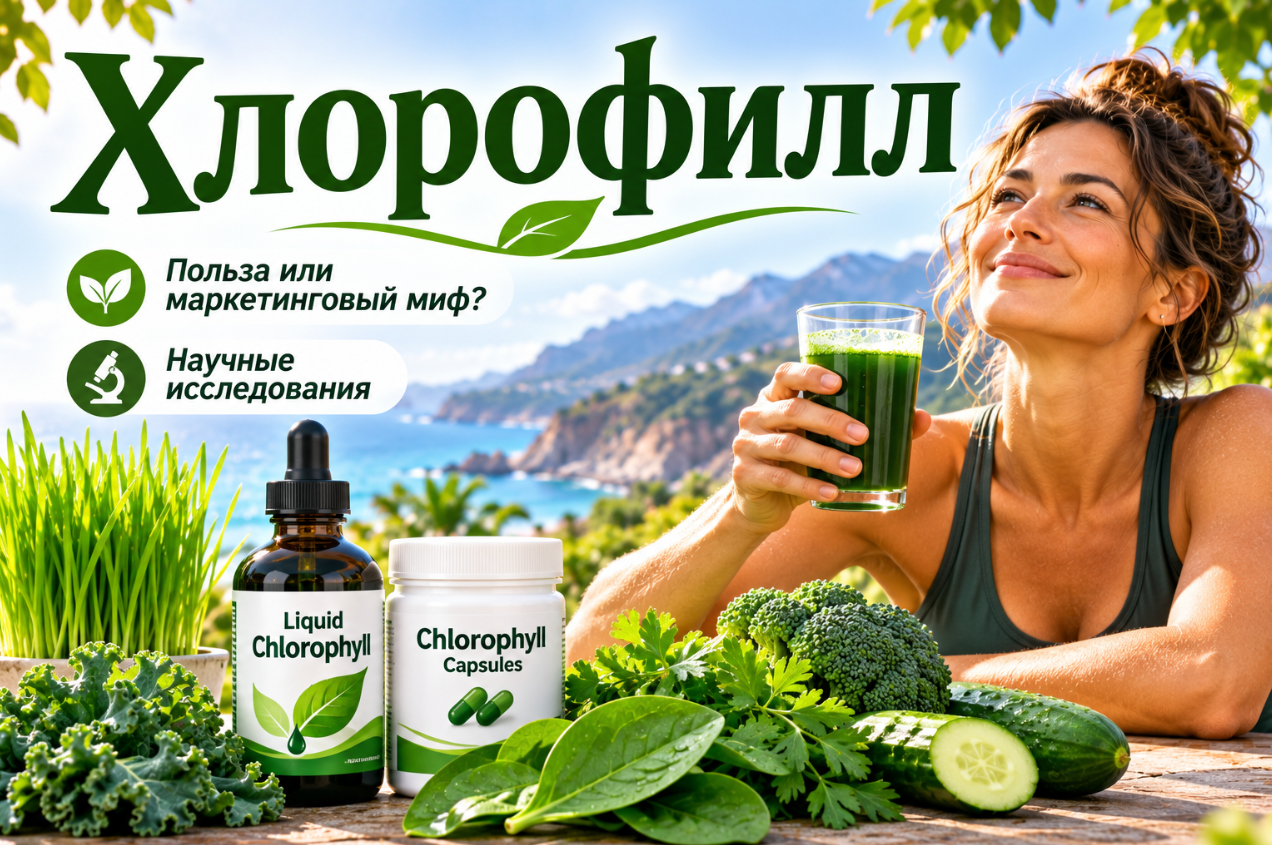
Chlorophyll: benefits, liquid supplements, and scientific research
Chlorophyll is the green pigment in plants essential for photosynthesis. As a dietary supplement, it is promoted for detoxification, weight loss, skin improvement, and eliminating unpleasant odors.
What of this is truly supported by science?
What is liquid chlorophyll?
Natural chlorophyll is found in spinach, parsley, broccoli, and other green plants.
In liquid dietary supplements, chlorophyllin is more commonly used — a water-soluble semi-synthetic derivative of chlorophyll, usually containing copper.
These are different substances. Therefore, the results of chlorophyllin studies cannot be automatically applied to natural chlorophyll.
Source: Linus Pauling Institute, Oregon State University — chlorophyll and its derivatives.
What have scientific studies shown?
1. Effects on mold toxin exposure
In 2001, Patricia Egner and colleagues from Johns Hopkins University in the USA, together with Chinese researchers, conducted a randomized study involving 180 people.
Those taking chlorophyllin had levels of one biomarker of aflatoxin exposure 55% lowerthan the placebo group.
Aflatoxins are toxic substances produced by certain mold fungi. They can increase the risk of liver cancer.
Researchers' conclusion: chlorophyllin may reduce the impact of aflatoxins on the body. However, lowering the biomarker does not prove that the supplement prevents cancer.
Egner et al., Proceedings of the National Academy of Sciences, 2001.
2. Eliminating unpleasant body odor
In 2004, Japanese scientists Hiroshi Yamazaki and colleagues studied seven patients with trimethylaminuria — a rare metabolic disorder causing a characteristic unpleasant body odor.
Taking chlorophyllin reduced the amount of trimethylamine in urine — a substance linked to this odor.
Conclusion: A possible positive effect was found for a specific rare condition. However, the study was very small and does not prove that chlorophyllin eliminates normal body odor in healthy people.
Yamazaki et al., Life Sciences, 2004.
3. Improving skin condition
In 2015, American researchers Thomas Stephens and colleagues studied the topical application of chlorophyllin gel in ten people with acne and enlarged pores.
After three weeks, some skin condition indicators improved.
Conclusion: The results are preliminarily positive, but the lack of a control group and small sample size do not allow confident assessment of effectiveness.
Additionally, a topical gel, not liquid chlorophyll for oral intake.
Stevens et al., Journal of Drugs in Dermatology, 2015.
Does chlorophyll help with weight loss?
In 2014, Swedish researchers studied the effects of green plant membrane extract in 38 overweight women.
Over 12 weeks, participants receiving the extract lost an average of 5 kg, while those receiving a placebo lost 3.5 kg.
However, the study examined a complex of plant membranes containing many substances, not pure chlorophyll or chlorophyllin.
Conclusion: This study cannot be considered proof of the effectiveness of common liquid chlorophyll supplements for weight loss.
Swedish randomized study, Appetite, 2014.
Does chlorophyll cleanse the blood and remove toxins?
There is no convincing clinical evidence that taking liquid chlorophyll cleanses the blood, improves tissue oxygen supply, or provides general 'detoxification.'
The effect of chlorophyllin on aflatoxins found in the study is a specific biochemical effect, not confirmation of a universal 'detox.'
Specialists at the Cleveland Clinic note that most widely advertised health benefits of liquid chlorophyll are not supported by sufficient clinical data.
Cleveland Clinic — review of scientific data on chlorophyll supplements.
Is it necessary to take chlorophyll supplements?
For a healthy person, there is no established need to take chlorophyll as a dietary supplement.
Green vegetables contain natural chlorophyll along with fiber, vitamins, and other nutrients.
Taking chlorophyllin may be accompanied by digestive disturbances and changes in stool or urine color. There is insufficient data on the long-term safety of specific usage regimens.
Conclusion: Research on chlorophyllin has revealed some interesting effects, but there is no convincing evidence yet for most popular claims — weight loss, blood cleansing, and overall health improvement.
The material is for informational and educational purposes and does not replace medical consultation.