Articles
How Yoga Came to the West: From Indian Ascetics to Modern Science
Yoga: from mysterious Indian ascetics and the first translations of ancient texts to Vivekananda, Iyengar, the Beatles, meditation, and modern scientific research.
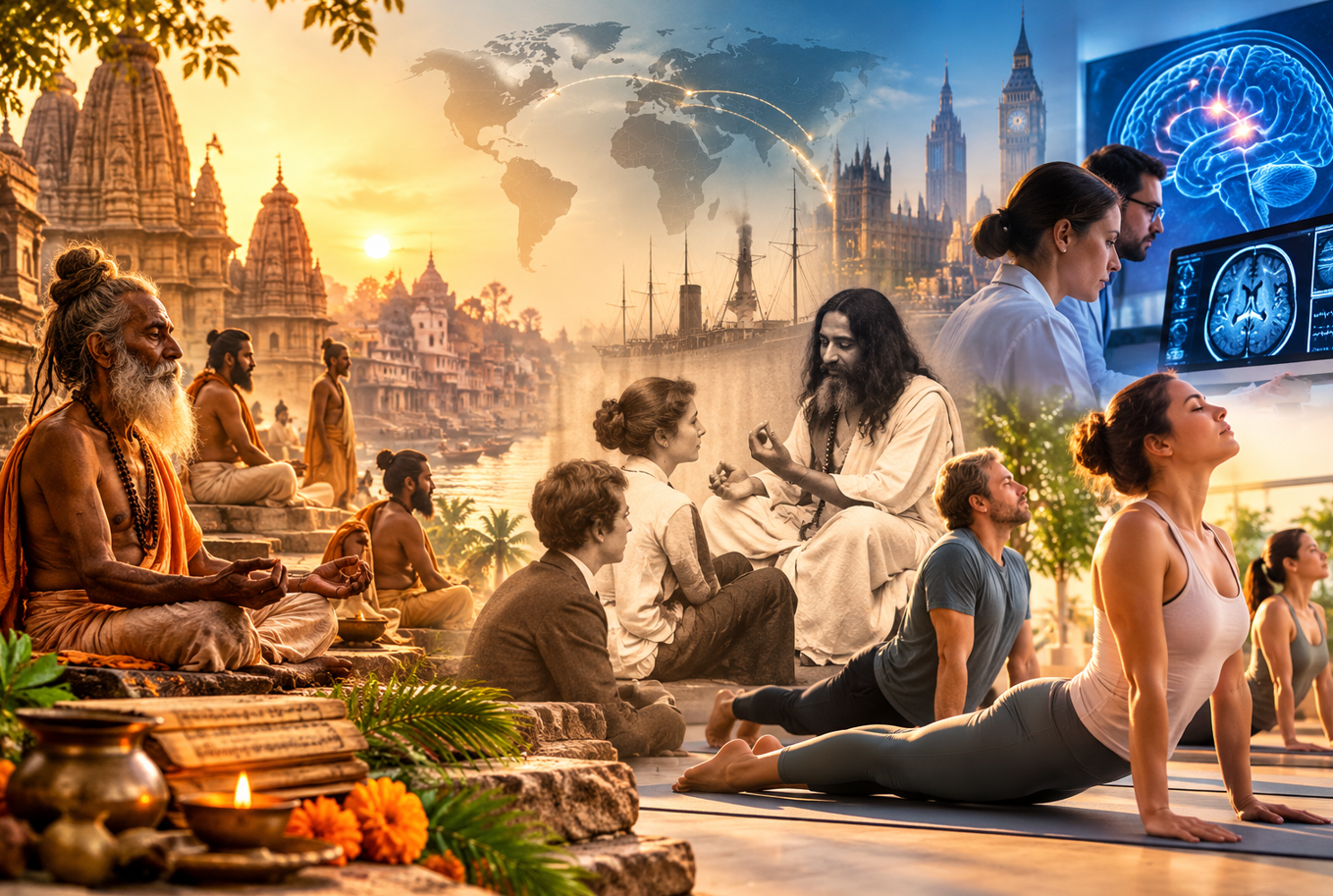
Briefly about the essentials
Europe got acquainted with yoga in a very different way than one might imagine today. At first, travelers told stories about strange Indian ascetics who could remain in unusual poses for hours and subject their bodies to severe trials. Then Europeans began translating ancient Indian texts and discovered behind these external manifestations a vast world of philosophy, meditation, and work with consciousness.
At the end of the 19th century, Swami Vivekananda was the first to directly teach yoga to a Western audience. In the 20th century, Paramahansa Yogananda introduced thousands of Americans to meditation and Kriya Yoga, Swami Kuvalayananda brought yoga into the laboratory, and Krishnamacharya and his students played a huge role in its spread. asana practices. Iyengar brought his art of working with the body to Europe, and the Beatles' trip to India made meditation a part of mass culture.
Thus, yoga traveled from travelers' tales and translations of ancient texts to studios, universities, and scientific research.
When Europe first saw yogis
Long before European yoga schools appeared, travelers, merchants, and diplomats visiting India encountered people called yogis, sadhus, or fakirs.
Ascetics who held their hand raised for years, remained motionless for long periods, observed strict fasts, or took unusual body postures made a special impression.
The French traveler Jean-Baptiste Tavernier (1605–1689), who visited India many times, described Indian ascetics and their practices in 1676. His images and stories were repeatedly copied by European publishers. This gave rise to one of the first enduring European images of the yogi — a mysterious person capable of almost incredible control over their body.
But Europeans poorly distinguished the many Indian traditions. The word “fakir” could refer to a Muslim wanderer, a Hindu ascetic, or a person demonstrating unusual bodily abilities.
Therefore, the first acquaintance with yoga was through an external image — bright, exotic, and largely incomprehensible.
Behind it lay a much more complex story.
Yoga in India long before European interest
By the time European travelers began describing Indian yogis, the practice was already backed by a centuries-old tradition.
In "Yoga Sutras" of PatanjaliIn the Yoga Sutras, which modern scholars usually date to around the 4th century CE, asana is part of the eight-limbed system of yoga. The text speaks very briefly about the body’s position: it should be steady and comfortable. The main theme of Patanjali is much broader — control of attention, breath, and senses, concentration, meditation, and samadhi.
Pranayama — the practice of breath control.
Samadhi — a deep state of concentration that completes Patanjali’s eight-limbed system.
Over time, the physical aspect of yoga became increasingly developed.
From around the beginning of the 2nd millennium CE, hatha yoga methods spread in India, where the body, breath, mudras, bandhas, and various ways of controlling internal processes gained great importance. International researchers Hatha Yoga Project have traced the development of these practices through medieval Sanskrit manuscripts.
By the 15th century, the famous “Hatha Yoga Pradipika” already described specific asanas, pranayamas, and other practices.
In the following centuries, the number and variety of described postures noticeably increased.
The text "Hathabhyasapaddhati", probably created in Maharashtra in the 18th century, is especially interesting. Here, asanas already form sequences. There are jumps, squats, transitions supported by the hands, and exercises requiring strength, flexibility, and good physical conditioning. Researchers Jason Birch and Mark Singleton consider this text an important testimony to the development of dynamic asana practice even before the emergence of modern international yoga schools.
There are also remarkable visual evidences.
In the first half of the 19th century in Jodhpur, during the reign of Maharaja Man Singh (1783–1843), the walls of the Mahamandir complex were painted with images of 84 asanas. These murals have been preserved and today allow us to literally see how diverse the physical practice was at that time.
Thus, Europe encountered a tradition in which asanas, breathing exercises, meditation, and other methods of working with the body and mind had existed for many centuries.
But Europeans truly began to get acquainted with it primarily through books.
The first door turned out to be a bookish one.
At the end of the 18th century, British scholars began systematically studying Sanskrit and Indian literature.
One of the central figures of this period was Sir William Jones (1746–1794) — a British judge, philologist, and an outstanding linguist.
In 1783, Jones arrived in Calcutta, and already in 1784 he founded The Asiatic Society of Bengal — a scientific society engaged in the languages, history, and culture of Asia. It became one of the most important centers of early European Indology.
Working alongside Jones was Charles Wilkins (circa 1749–1836), an employee of the East India Company and one of the first Europeans to seriously study Sanskrit.
In 1785, his English translation of the Bhagavad Gita.
appeared in London. This event is hard to overestimate. One of the main Indian texts became directly accessible for the first time to a broad educated English-speaking audience.
And yoga in the Bhagavad Gita looked completely different from the old European engravings depicting ascetics.
This spoke about action, knowledge, devotion, concentration, self-control, and inner freedom.
Europe gradually discovered that the word "yoga" referred not only to unusual body postures but to an entire system of views on humans and their consciousness.
Upanishads and Schopenhauer
The next door was the Upanishads — ancient Indian philosophical texts about consciousness, humans, ultimate reality, and liberation.
The French orientalist Abraham Hyacinthe Anquetil-Duperron (1731–1805) obtained a Persian translation of the Upanishads and translated it into Latin. In 1801–1802, this work was published under the title Oupnek'hat.
The translation was not made directly from Sanskrit but through the Persian text, yet it was thanks to this that the Upanishads became known to European philosophers.
One of their most famous readers was the German philosopher Arthur Schopenhauer (1788–1860).
Indian thought made a strong impression on him. He constantly returned to the Upanishads and saw in them confirmation of many questions that occupied him.
Thus, India gradually became for Europe not only a distant exotic country but also a source of serious philosophical thought.
Henry Colbrook: yoga becomes a subject of study
Henry Thomas Colbrook (1765–1837) played a major role in this process.
He worked in India for more than thirty years, studied Sanskrit, and became one of the leading European specialists in Indian philosophy of his time.
After returning to England, it was Colbrook who initiated the creation of the Royal Asiatic Society, founded in London in 1823.In his works, he introduced the European scientific audience to various schools of Indian philosophy, including the tradition of Patanjali.
Yoga gradually moved from the world of travelers' tales into another world — libraries, universities, and scientific societies.
But almost simultaneously, another question arose.
If yogis are truly capable of unusually controlling their breathing and bodies, what happens to their organism?
1851: a doctor tries to understand yoga
In 1851, a small book titled
"A Treatise on the Yoga Philosophy" was published in Benares..
Its author was the Indian doctor Nobin Chander Paul (N. C. Paul, 1829–1880).
For its time, the book was unusual.
Paul wrote about pranayama, breath retention, lungs, body temperature, oxygen and carbon dioxide levels. He was especially interested in stories about yogis capable of remaining almost motionless for a very long time and sharply slowing their breathing.
Mid-19th century medicine, of course, was very different from modern medicine. But the approach itself was new: traditional yogic practices began to be considered from the perspective of physiology.
This question — what really happens to the body during yoga? — would lead, several decades later, to real laboratory experiments.
Theosophists and the new fashion for India
In the second half of the 19th century, Indian philosophy began to spread by another route — through Western esoteric movements.
In 1875, the Theosophical Societyowas founded in New York. One of its main figures was Helena Blavatsky (1831–1891).
Theosophists showed great interest in India, Hinduism, Buddhism, ideas of karma, reincarnation, and the hidden potentials of human consciousness.
Indian concepts increasingly appeared in European and American books, magazines, and lectures. For many Western intellectuals, the theosophical environment was their first introduction to Eastern religious traditions.
But physical hatha yoga remained a secondary matter in these circles for a long time.
At the end of the 19th century, the image of a person performing complex asanas was still often associated with street fakirs, ascetics, and demonstrations of unusual abilities. Even some popularizers of Indian philosophy viewed this aspect of yoga with caution.
Therefore, philosophy, meditation, and work with consciousness were initially the most actively embraced in the West.
And here appears a person who changed the entire history.
Vivekananda: now India speaks for itself
Swami Vivekananda (1863–1902) was an Indian monk and a disciple of the famous spiritual teacher Ramakrishna.
In September 1893, the thirty-year-old Vivekananda spoke at the World Parliament of Religions in Chicago.
His speeches made a huge impression. After that, he began giving lectures in the USA, and then in England.
Yoga history researcher Dermot Killingley calls Vivekananda the first Indian to teach yoga in the West.
But his classes did not resemble a modern yoga class at all.
The focus was on concentration, meditation, the nature of consciousness, mind control, pranayama, and the philosophy of Patanjali.
In 1896, his book Raja Yoga was published. It was based on the lectures Vivekananda gave to his American students and included his interpretation of Patanjali's Yoga Sutras.
Vivekananda tried to speak to Western listeners in a language they could understand. He constantly compared yoga to research and experimentation: a person should not just believe—they should practice and observe the results.
Thus, Western readers received a new image of yoga.
Not a mysterious fakir.
Not a philosophical text in a library.
But a practical method of working with one's own consciousness.
Yogananda: meditation reaches a wide audience
The next major figure was Paramahansa Yogananda (1893–1952).
In 1920, he came from India to Boston as a delegate to the International Congress of Religious Liberals. That same year, he founded Self-Realization Fellowship — an organization through which he began spreading the teachings of Kriya Yoga and meditation.
In the 1920s and 1930s, Yogananda traveled across the United States and spoke to audiences of thousands. He talked about meditation, concentration, managing life energy, and the possibility of direct inner experience.
His famous "Autobiography of a Yogi," published in 1946, introduced an even wider audience to the Indian spiritual tradition.
Thus, yoga gradually ceased to be the interest of a small circle of orientalists and esotericists.
But almost simultaneously, another direction was developing—yoga began to be adapted to ordinary everyday life and its effects on the body were seriously studied.
Shri Yogendra: yoga for the ordinary person
One of the first reformers of this direction was Shri Yogendra (1897–1989).
In 1918, near Bombay, he founded The Yoga Institute.
His teacher Paramahamsa Madhavadasaji supported the idea of spreading yoga among grihasthas—people living ordinary family lives.
Therefore, Yogendra taught men, women, and children. Yoga could become part of everyday life without requiring retreat to a monastery or renunciation of family.
In 1919, Yogendra went to the USA and established the Yoga Institute of America there.
This was an important turning point.
Yoga gradually became a practice that could be taught in a regular school, explained in modern language, and incorporated into a familiar lifestyle.
Kuvalayananda: yoga enters the laboratory
The next step was taken by Swami Kuvalayananda (1883–1966).
He was interested in the question that Nobin Chander Pal had asked back in the 19th century: what happens inside the body during yogic practice?
In 1924, Kuvalayananda founded an institute in Lonavla Kaivalyadhama and began publishing the scientific journal Yoga Mīmāṃsā.
Now experiments began instead of speculation.
One of the first was an X-ray image taken during the performance of nauli—a technique of abdominal muscle control.
Then they studied blood pressure during asanas, pressure inside the stomach and chest, the composition of exhaled air, and the physiology of pranayama.
A modern review of the first hundred years of this work shows that it was at Kaivalyadhama in the 1920s and 1930s that one of the first consistent scientific research programs on hatha yoga emerged.
Thus, yoga entered the laboratory.
Krishnamacharya and Mysore
In those same decades, Mysore became one of the most important centers of physical yoga.
Here taught Tirumalai Krishnamacharya (1888–1989)—an expert in Sanskrit, Indian philosophy, and practical yoga.
In the 1930s and 1940s, he developed intensive classes where asanas were combined with breathing and movement. The poses were not only held individually but also linked together with transitions.
From his school came people who would later have a huge influence on global yoga: B. K. S. Iyengar, K. Pattabhi Jois, Indra Devi, and later Krishnamacharya's son T. K. V. Desikachar.
The history here is particularly interesting because the Mysore Palace library housed the manuscript already mentioned. "Hathabhyasapaddhati" From the 18th century. Researchers Jason Birch and Mark Singleton consider it quite likely that Krishnamacharya knew this text or the tradition associated with it.
At the same time, Indian physical culture of that period was influenced by gymnastics, sports, and new systems of physical education. Krishnamacharya found himself at the point where the ancient yogic tradition met the rapidly changing 20th century.
Several styles that are now known worldwide grew out of this environment.
Iyengar and Menuhin: Yoga Comes to Europe
One of the most beautiful stories begins in 1952.
Yehudi Menuhin (1916–1999) — one of the most famous violinists of the 20th century — came to India. He was suffering from fatigue and had trouble sleeping. There he was introduced to B. K. S. Iyengar (1918–2014), a student of Krishnamacharya.
The meeting was supposed to be brief, but in the end, the session lasted about three and a half hours.
Menuhin became seriously passionate about yoga, and a friendship began between him and Iyengar that would last nearly half a century.
In 1954, Menuhin invited Iyengar to Europe..
This was Iyengar's first trip outside India. He taught in Switzerland and the United Kingdom, and then began regularly returning to Europe.
Now Europeans were becoming familiar with a very detailed physical practice: standing poses, bends, backbends, inverted asanas, pranayama.
Iyengar paid great attention to the placement of the feet, knees, pelvis, spine, shoulders, and arms. Asana became the subject of subtle and prolonged work.
By 1968, classes using the Iyengar method were already being taught within London's educational system.
Yoga was increasingly entering everyday European life.
1968: The Beatles Go to India
At the same time, another movement was happening — meditation was reaching a mass audience.
One of the most famous figures of this period was Maharishi Mahesh Yogi (circa 1918–2008), popularizer of Transcendental Meditation.
In 1968, John Lennon, Paul McCartney, George Harrison, and Ringo Starr came to his ashram in Rishikesh, at the foot of the Himalayas — The Beatles.
They meditated, attended lectures, and wrote music. A significant portion of the material that later appeared on the White Album was created during this period.
The story of the band's relationship with the Maharishi later proved complicated, but the cultural impact was enormous.
Photos of the world's most famous musicians at an Indian ashram were seen by millions of people.
The words "meditation," "mantra," "guru," and "ashram" finally moved beyond small circles of orientalists and spiritual seekers.
For a huge number of people, interest in India began right here — and then led to meditation, pranayama, asanas, and yoga philosophy.
From Ashram to Regular Studio
In the second half of the 20th century, yoga spread faster and faster.
At the same time, different traditions maintained their own character.
Iyengar developed detailed and precise work with asanas.
K. Pattabhi Jois — the dynamic practice of Ashtanga Vinyasa.
Schools associated with Swami Sivananda combined asanas, pranayama, relaxation, meditation, and philosophy.
Indra Devi became one of the well-known yoga teachers in the Western world and played a notable role in spreading yoga among women.
Gradually, it was no longer necessary to travel to India to get acquainted with yoga.
Schools opened, teachers appeared, books were translated and published. Yoga entered the system of supplementary education, sports and wellness centers, and later — rehabilitation and stress management programs.
The audience was changing too.
A practice, many lines of which had been connected for centuries with a male ascetic environment, became part of the lives of very different people.
And at the same time, scientific research continued.
What Science Knows Today
A hundred years after Kuvalayananda's first experiments, research methods have become immeasurably more precise.
Today, the effects of yoga on chronic pain, sleep, stress, anxiety, balance, physical function, breathing, and cardiovascular indicators are being studied.
For example, A Cochrane review combined 21 studies with 2,223 participants suffering from chronic nonspecific low back pain. Yoga improved back function and reduced pain compared to no exercise, although the average effect was small.
Research continues.
And a detailed discussion about what exactly modern science already knows about the effects of yoga on the body and mental state, deserves a separate article.
Yoga is becoming part of global culture
By the end of the 20th century, yoga was no longer perceived in the West as a rare Indian teaching accessible only to orientalists, travelers, or students of individual masters. It became part of everyday life.
At the same time, a unified “Western yoga” did not emerge. Some traditions preserved special attention to asanas, others to meditation and pranayama, and in many schools, physical practice is still combined with philosophy and inner discipline. New directions also appeared, focusing mainly on the physical aspect of practice.
The boundaries between them are far from rigid. A person may come to classes for back health or flexibility, and after a few years become interested in breathing and meditation. Another may start with meditation and only later discover asanas. For some, yoga remains a spiritual tradition; for others, it becomes a way to maintain the body and mental state.
Over time, another way of looking at yoga was added to this diversity — the scientific perspective. Practices that have been passed down from teacher to student for centuries and described in traditional texts can now be simultaneously observed through physiology, psychology, and medicine.
That is why the history of yoga in the West turned out to be much more interesting than simply transferring the practice from one country to another.
The audience changed. The language changed. The methods of teaching changed. Some aspects of yoga came to the forefront for a time, while others were rediscovered decades later.
When European travelers of the 17th century described Indian ascetics, it was hard to imagine that a few centuries later yoga would become a familiar part of the lives of millions far beyond India.
Today, traces of this long history can still be seen in global yoga — the ancient work with the body and breath, meditation, philosophy, the searches of Indian teachers of the 19th–20th centuries, and the interest of modern science.
And perhaps it is precisely the ability to exist simultaneously in several dimensions — physical, respiratory, intellectual, and inner — that has allowed yoga to travel such a long path and remain a living practice.
S.M.