Articles
Yoga for Beginners - Where to Start Yoga at Home?
Where to start yoga at home for beginners: what you need, how much and when to practice, how to choose your first exercises, and which mistakes to avoid.
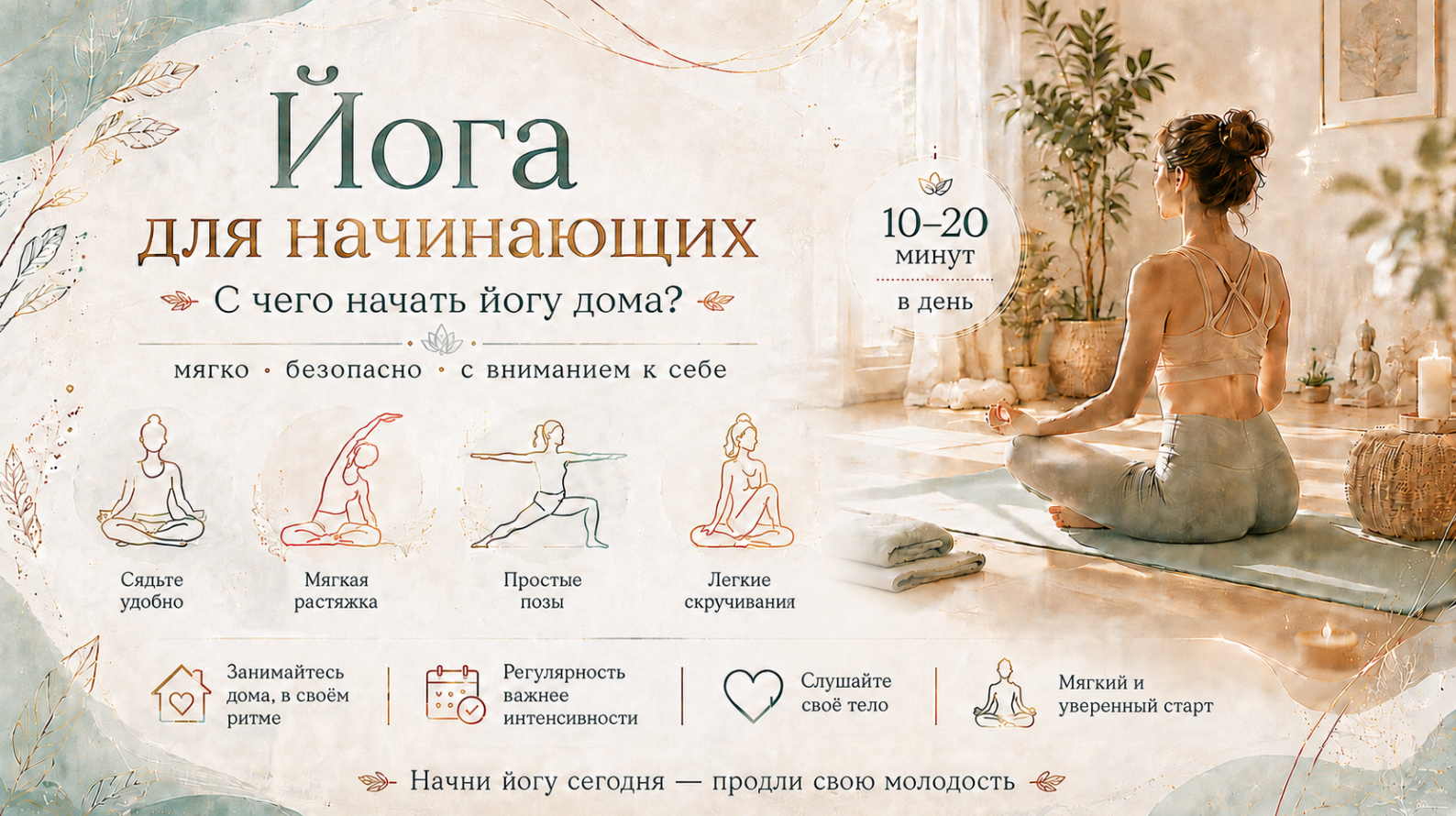
Yoga for Beginners - Where to Start Yoga at Home?
For your first practice, you practically need nothing.
The following will work well:
Any comfortable clothing that does not restrict movement;
A simple non-slip mat;
Just a little free space;
10–20 minutes of time;
and most importantly — attention to yourself.
Three Important Points
1. How long should the practice be?
You don’t have to immediately set aside an hour. To establish a regular practice, it is often much more effective to start with 10–15 minutes and gradually make it a habit.
Consistency is more important than intensity and duration.
Better 15 minutes of mindful practice several times a week than one long and exhausting session after which your body aches and you don’t want to return to the mat at all.
Over time, you will feel for yourself how much practice you need.
And there is no universal standard here either. Sometimes the body needs an active flow, and sometimes gentle recovery. And sometimes the best practice is a few calm movements, breathing, and a few minutes of silence.
2. When is the best time to practice?
Yoga does not have a single correct time of day.
Therefore, you can choose the practice time not so much by the clock but byyour state and current goal.You should understand that
Morning yoga practice can help gently awaken the body, feel energy, and clarity of mind.
Yoga during the day helps to switch gears, restore concentration, and relieve accumulated tension.
Evening yoga helps to slow down, release the body from the day’s tension, and transition into a calmer state.
This is one of the important principles of home practice:not forcing yourself to perform the same sequence regardless of what is happening with you today.
Every day you may have new tasks and goals: today you may need vigor, tomorrow concentration, perhaps after a long day — relaxation, and after traveling — recovery.
Yoga becomes alive precisely when the practice begins to respond to the person.
You can on the platform YOGAJOYSPACE easily find Live Yoga that suits your level of difficulty and matches your goal right here and now in the moment. To do this, go to the Home page section "What are my goals today?" and choose a category. Our unique service will select all yoga practices, breathing and special practices, meditations, and music for you based on your request, as well as articles lectures
3. Where to start the practice itself?
It is important to start not with the most difficult asanas
Start by simply spending a few minutes on the mat. Sit or lie down comfortably.
Close your eyes. Feel the support beneath you, observe your breathing without changing it immediately. One of the main techniques for beginners is observing your breath..
Look: How does your belly move? What happens with your rib cage? Where is there tension in your body? How do you feel today? This is already part of the practice. Turning your focus inward.
Then you can gradually add gentle movements: spinal movements, joint warm-ups, simple bends, gentle twists, standing poses, and a few basic asanas.
Know that there is no mandatory special list of asanas that every beginner must perform.
Yoga The practice should suit you and your condition, not you trying to fit the practice.
What if I am completely inflexible?
This is probably one of the most common questions. And my answer is simple:
flexibility is not a requirement for practicing yoga. You do not need to be able to reach the floor with your hands, sit in a split, or easily perform complex asanas.
Moreover, trying at all costs to "reach" the desired form can distract you from the main thing — the sensations of your own body.
Instead of asking: "How deep can I go?" try asking yourself in each asana: "What do I feel right now?" This way, a completely different quality of practice gradually emerges — not achievement, but exploration of yourself, your body, and mind.
The most common mistake of beginners
is trying to do more than necessary. More asanas. Deeper bends. Stretching harder. Holding longer. More complex sequences.
But yoga does not get deeper by the number of poses performed.
Sometimes one simple asana done with full attention can give the practice much more than a complex sequence the body performs automatically.
Therefore, at the beginning of the journey, I would suggest a completely different guideline:
not "do more," but "feel more."
Feel the breath. Feel the support. Feel the spine. Feel the movement. Feel the moment when the body truly works and when you start to push yourself too hard.
And gradually you will discover that yoga is not only what happens on the mat.
It is the ability to hear yourself better.
Where to start right today?
You don’t need to wait for Monday.
You don’t need to become more flexible first.
You don’t need to buy special clothes.
You don’t need to know the names of all asanas.
Just roll out your mat.
Stop for a few minutes.
Make a few calm movements.
Breathe.
And listen to your body.
Let your first practice be imperfect. Let it be yours.
Because real yoga doesn't begin when you learn to perform complex asanas.
It begins when you start to connect with yourself.
And if the main goal is to make your practice regular and not quit after a few weeks, read the article "How to ease into yoga at home and make it a habit".