Articles
Panchakarma: the history of ancient Ayurvedic therapy and modern research
History of Panchakarma: how Charaka, Sushruta, and Vagbhata developed ancient Ayurvedic therapy, its five procedures, and what modern research shows.
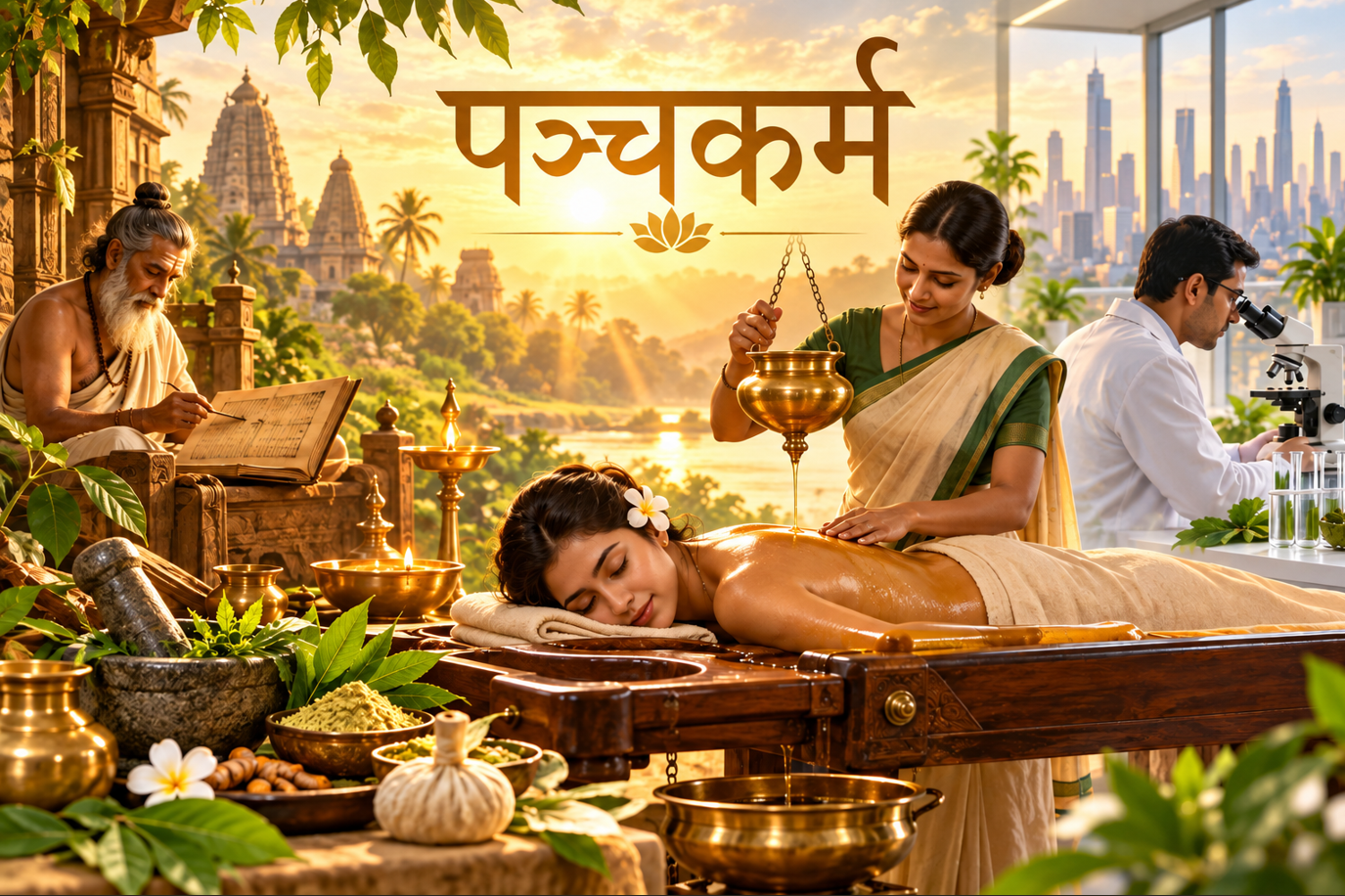
Panchakarma is one of the most important systems of classical Ayurveda, with a history spanning over two thousand years. Its development is linked to ancient Indian medical schools, the works of Charaka, Sushruta, and Vagbhata, as well as the formation of a complex system of therapeutic procedures, preparation, and body recovery.
In this article, we will trace how Panchakarma originated, why different Ayurvedic schools had varying lists of the five main procedures, and the role of oils, heat treatments, and therapeutic nutrition in the therapy. Special attention will be given to how the Indian medical tradition became known to European doctors and what modern scientific research says about Panchakarma.
If you are interested in the practical side of Panchakarma — what procedures are performed, what benefits they can bring, how long the course lasts, and how it is conducted in India — read the separate article "What is Panchakarma: procedures, benefits, and contraindications".
What are Vata, Pitta, and Kapha?
Classical Ayurveda is based on the concept that nature and the human body consist of five primary elements: space, air, fire, water, and earth. Their combinations explained the properties of substances, body structure, and the processes occurring within it. Earth was associated with density and solidity, water with moisture and fluidity, fire with heat and transformation, air with movement, and space with cavities and gaps where movement becomes possible.
From this concept arises the doctrine of the three doshas — Vata, Pitta, and Kapha. Each dosha combines certain qualities of the primary elements and related bodily functions. Vata is dominated by the qualities of air and space, Pitta by fire and water, and Kapha by water and earth. Through their balance, the Ayurvedic doctor considered the individual's characteristics and the nature of arising imbalances.
Vata: air and space — movement and variability.
Air, manifested as wind in movement, was associated with mobility, lightness, dryness, and cold. Space provides room for movement: in the body, it corresponds to cavities, lumens, and passages. Together, these qualities help explain why Vata is linked to everything that moves and changes.
In Ayurveda, Vata was connected with breathing, body movements, speech, the progression of food through the digestive tract, and the elimination of waste. When assessing a person, the doctor paid attention to the pace of movements and speech, skin dryness, sensitivity to cold, appetite variability, and sleep patterns. For example, rapid movements, dry skin, and poor cold tolerance formed a combination of signs characteristic of pronounced Vata.
Pitta: fire and water — transformation and heat.
Fire heats and changes substances. In Ayurvedic understanding, this property was linked to the body's ability to digest food and maintain its own warmth. The watery component of Pitta expresses fluidity; therefore, it was described as hot, intensely active, and liquid at the same time.
The combination of fire and water explains Pitta's main qualities — heat, "sharpness," and fluidity. Sharpness here means the intensity and strength of action. When evaluating Pitta, the doctor considered appetite and thirst strength, sweating, heat tolerance, and skin characteristics. Strong hunger, abundant sweating, and sensitivity to overheating were seen as a characteristic combination of its signs.
Kapha: water and earth — stability, strength, and tissue nourishment.
In Ayurvedic understanding, earth is associated with the body's density and solidity, and water with tissue moisture and softness. Their combination explains Kapha's qualities: heaviness, coolness, softness, oiliness, and stability.
Kapha was linked to the body's strength and integrity, tissue nourishment, and the firmness of connections between its structures. In individual characteristics, these qualities manifested as a sturdy build, smooth skin, measured movements and speech, and calm reactions. The doctor assessed how pronounced these properties were and how they combined with signs of other doshas.
All three doshas are present in every person. Therefore, Ayurvedic assessment involves considering their combination: which qualities are stronger, which are consistently inherent to the person, and which have changed along with their well-being. This distinction forms the basis for understanding prakriti — the original constitution, and vikriti — current deviations from it.
Therefore, two identical Panchakarma courses cannot exist.
The specific program is formed based on examination results. It may include dietary and lifestyle adjustments, intake of ghee or medicinal oils internally, external oil treatments, massage, heat therapy, herbal preparations, nasal procedures, therapeutic enemas, and other methods. After intensive stages, the diet is gradually restored, considering digestive condition.
The classical scheme consists of three parts:
Purva Karma — preparation;
Pradhana Karma — main procedures;
Paschat Karma — recovery after them.
During preparation, in particular, snehana — the use of oils and fats internally or externally — and swedana, heat therapy with sweating are applied. After the main procedures, a restorative diet regimen follows. This three-stage structure is preserved in modern Indian recommendations published Central Council for Research in Ayurvedic Sciences — CCRAS.
Thus, for a modern person, Panchakarma is easiest to understand not as a single procedure but as an individualized course of Ayurvedic therapy combining nutrition, medicinal substances, oils, heat, massage, and special therapeutic procedures.
But behind this system lies a history spanning more than two thousand years.
Why is it called "Panchakarma"?
Sanskrit pañca means "five," and karma in this case — "action" or "therapeutic procedure."
Hence Panchakarma — "five therapeutic actions". This explanation and the classical list of procedures are provided by Charaka Samhita Online.
However, here begins an interesting historical detail.
In the tradition "Charaka Samhita" the five main procedures include:
-
Vamana — therapeutic induced vomiting;
-
Virechana — therapeutic intestinal cleansing;
-
Niruha Basti — administration of medicinal decoctions through the rectum;
-
Anuvasana Basti — administration of oil-based preparations;
-
Nasya — administration of medicinal substances through the nose.
In the surgical tradition Sushruta considers two types of basti together, and among the five methods includes Raktamokshana — bloodletting.
Therefore, in different books, you can find slightly different answers to the question: "Which exactly five procedures are included in Panchakarma?"
This is the legacy of different classical schools of Ayurveda.
Before Panchakarma: where the very idea of cleansing originated
The origins of Ayurvedic medicine go back to deep antiquity, but its systematic presentation appears in large medical compilations — samkhitas.
It is during this period that the concept forms that disease may be linked to an imbalance of the doshas — Vata, Pitta, and Kapha, and treatment should consider not only the disease but also the person: their constitution, strength, age, digestion, lifestyle, climate, and season.
Modern historians usually date the formation of classical Ayurvedic medicine to roughly the last centuries BCE and the first centuries CE. Meanwhile, the texts themselves were composed gradually, repeatedly supplemented and edited.
One of the most important such texts became "Charaka Samhita".
Charaka: Panchakarma becomes a system
The history of the "Charaka Samhita" itself resembles a long chain of knowledge transmission.
The tradition speaks of the teacher Punarvasu Atreya, his student Agnivesha, who composed an early medical treatise, then of Charaka, who reworked this material, and a later editor Dridhabala, who restored lost parts of the work.
Therefore, the "Charaka Samhita" is not a book written by one person over a few years, but the result of the long development of a medical school. Historians debate the exact dates of individual layers of the text; the version that has come down to us was formed over several centuries.
For the history of Panchakarma, the last sections of the "Charaka Samhita" are especially important.
An entire part of the text — Siddhi Sthana — is dedicated to the proper conduct of cleansing procedures, patient selection, preparation, dosages, and course management. The second chapter is directly titled Panchakarmiya Siddhi — "Successful Performance of the Five Procedures".
Here we no longer have a brief mention of "cleansing," but rather a fairly complex medical system.
The doctor must determine who is suitable for a specific procedure, how to prepare the patient, which remedy to choose, how much to use, and how to adjust the course depending on the body's reaction.
In other words, the idea of individualizing Panchakarma is already embedded in the classical system itself.
Why oil and warming appear before the main procedures
Panchakarma does not begin immediately with one of the five main procedures.
First, the body is prepared.
One of the key methods became snehana — "Snehana," the use of fats and oils. This can be external application of oil and massage, and in certain programs — internal intake of medicinal ghee or oil.
Then is applied swedana — warming, which induces sweating.
In modern practice, this can be steam chambers, localized warming, herbal steam, and other options.
In the Ayurvedic model, the purpose of preparation was to bring the disturbed doshas to a state where they could be directed to the site of subsequent elimination.
That is why most procedures that modern people associate with Panchakarma — oil massages, application of medicinal oils, steam, herbal poultices, warming — are not themselves the original "five karmas."
These are methods of a broader program of preparation and treatment.
Sushruta: another medical school
The second great classical source became "Sushruta Samhita"..
If the Charaka tradition is especially closely linked with internal medicine, Sushruta is famous primarily for surgery.
Historical dating is complicated. Sushruta himself is traditionally dated roughly to the middle of the first millennium BCE, whereas the text "Sushruta Samhita" in the form we have is significantly younger and contains later revisions. Knowledge was transmitted and reworked for a long time before the manuscript versions known to us appeared.
Sushruta pays much more attention to blood and surgical interventions.
Therefore, in his tradition appears Raktamokshana — therapeutic bloodletting..
Various methods were used, including venesection and leeches. That is why the list of five procedures in the Sushruta school differs from the Charaka list.
This difference has been preserved to this day.
Vagbhata: the system becomes more compact
The next major figure was Vagbhata, who is usually dated approximately to the 7th century AD.
He is credited with two of the most important medical works — Ashtanga Sangraha and "Ashtanga Hridaya".
Vagbhata collected and reworked a huge body of earlier Ayurvedic medicine related to the traditions of Charaka and Sushruta. The "Ashtanga Hridaya" turned out to be significantly more compact than the large early samhitas and became an extremely influential textbook, especially in southern India.
It is here that the idea of shodhana — cleansing therapyis very clearly formulated, which includes the main methods of Panchakarma.
Gradually, a branched system of preparatory and restorative methods formed around these procedures.
Thus, Panchakarma became not just "five actions," but a whole course of treatment.
Why nutrition occupies such an important place
For Ayurveda, nutrition is a natural part of the healing program.
Food is considered one of the main factors that daily influence the state of the doshas and digestion.
Therefore, the doctor takes into account prakriti, the current state of the doshas, the ability to digest food, age, body strength, season, habitual diet, and illness.
After intensive cleansing procedures, regular food is not returned immediately.
It is used samsarjana krama — a gradual restorative regimen in which the diet is progressively complicated as digestion recovers.
Therefore, the diet is not an addition to Panchakarma.
It is part of the system itself.
When European medicine first encountered Panchakarma
With the expansion of British presence in India, European doctors increasingly came across local medical traditions.
At first, the attitude was ambivalent. Some British doctors considered Indian medicine archaic. Others actively collected information about medicinal plants and treatment methods and consulted Indian physicians for knowledge.
Of particular interest for our story is Thomas Alexander Wise (1802–1889) — a Scottish doctor who worked many years in India.
In In 1845 in Calcutta he published a major work Commentary on the Hindu System of Medicine.
The book was one of the early attempts to present Ayurveda in detail to a European medical audience in English.
Wise describes emetics, laxatives, two types of therapeutic enemas, nasal medicinal procedures, bloodletting, body massage with oils, warm and steam baths, as well as diet after cleansing procedures.
In other words, a mid-19th century British doctor essentially describes most of the system we now recognize as Panchakarma.
He also notes the sequence after strong cleansing procedures: digestion was considered weakened, so the patient was given light food, rice broths, and nutrition was gradually restored.
Before the European doctor was not just a collection of Indian massages or herbs.
It was a complex medical program with preparation, intervention, and recovery..
Ayurveda begins to be studied as a historical medical system.
By the late 19th and early 20th centuries, the study of Indian medicine became significantly more serious.
One notable figure was August Friedrich Rudolf Hoernle (1841–1918) — a German-British orientalist who worked many years in India.
In the early 20th century, he published Journal of the Royal Asiatic Society a series of works Studies in Ancient Indian Medicineand researched the history of the Charaka Samhita, Sushruta Samhita, and ancient medical manuscripts.
By this time, Europe's attitude was gradually changing: Ayurveda was increasingly viewed not as a set of unusual local practices but as a medical system with its own history, theory, and internal logic.
What changed in the 20th century
In India itself, the traditional practice of Panchakarma continued to exist in various regional schools, especially in Kerala.
Over time, alongside the five classical procedures, a whole range of auxiliary methods began to be used more frequently:
-
Abhyanga — oil massage;
-
Swedana — warming treatments;
-
Shirodhara — continuous application of a warm oil stream to the head area;
-
Kizhi — warming with herbal or other medicinal pouches;
-
Pizhichil — prolonged application of warm oil;
-
various forms of therapeutic baths, compresses, and local procedures.
Therefore, a modern person coming for Panchakarma in Keralamay not encounter all five classical methods at all.
The doctor selects procedures individually.
What modern science tries to understand
Today, researchers are interested not only in whether a particular procedure helps a person.
They are trying to understand, what happens physiologically.
Metabolism, blood lipids, gut microbiota, stress responses, autonomic nervous system, inflammatory markers, and cardiovascular parameters are being studied.
One of the most interesting experiments was published in Scientific Reports in 2016.
Researchers compared 65 healthy participants of a six-day program based on the principles of Panchakarma with 54 people from a control rest group. The program included special nutrition, herbal preparations, massage, yoga, and meditation.
After it, changes were found in several substances in blood plasma—primarily some phosphatidylcholines and other components of lipid metabolism. The study was interesting because Panchakarma was studied using modern metabolomics—the analysis of a large number of metabolic molecules simultaneously.
Another direction is gut microbiota.
Small studies examined changes in gut bacteria after Virechana and Basti. A recent review notes that this field is still emerging and there is not enough data yet for general conclusions about Panchakarma's impact on the microbiome. More details: Ayurvedic Therapies to Target the Microbiome: Evidence and Possibilities — PubMed.
Vamana, Basti, Nasya, and other procedures, as well as comprehensive Ayurvedic programs for various conditions, are studied separately.
There is a specific challenge for science here: Panchakarma is originally individualized. One patient receives one set of procedures, another a different one; nutrition, preparations, duration, and sequence vary. Therefore, researchers have to find ways to study not only individual procedures but also complex individualized programs.
What has remained unchanged in Panchakarma
Over two thousand years, the preparations, tools, and conditions for procedures have changed. Modern clinics, laboratory tests, standardized oils, warming equipment, and disposable medical materials have appeared.
But the core logic of Panchakarma, described in classical texts, remains recognizable: preparation, individually selected procedures, and subsequent recovery. Nutrition, oils, medicinal preparations, heat, and other methods are combined into one program and tailored to the condition of the specific person.
Therefore, the popular word today "detox" only partially conveys the meaning of Panchakarma. In the Ayurvedic tradition, it is not about a single "cleansing" procedure but a much more complex system whose goal is to help restore a disturbed state to individual balance.
This is one of the main ideas of Panchakarma: not to bring all people to one conditional "ideal" state, but to work with individual constitution and the changes that have occurred specifically in that person.
Therefore, Panchakarma today remains not a standard set of procedures but an individually structured course in which each stage is connected to the previous one and has its place in the overall program of restoring balance.
Also read on YogaJoy
Rasayana: the Ayurvedic system of rejuvenation, restoration, and longevity
Excess weight and obesity in Ayurveda
All YogaJoy articles about Ayurveda
Main external sources
Charaka Samhita Online — Panchakarma
Charaka Samhita Online — Panchakarmiya Siddhi
CCRAS — Guidelines of Clinical Evaluation
Thomas Alexander Wise, Commentary on the Hindu System of Medicine, 1845 — Wellcome Collection
Scientific Reports—study of Panchakarma and metabolomics
PubMed—Ayurveda and gut microbiota