Articles
How to maintain youth and slow aging: what is rasayana in Ayurveda
How to preserve youth and slow aging? Rasayana is an Ayurvedic system for restoring the body, health, and active longevity.
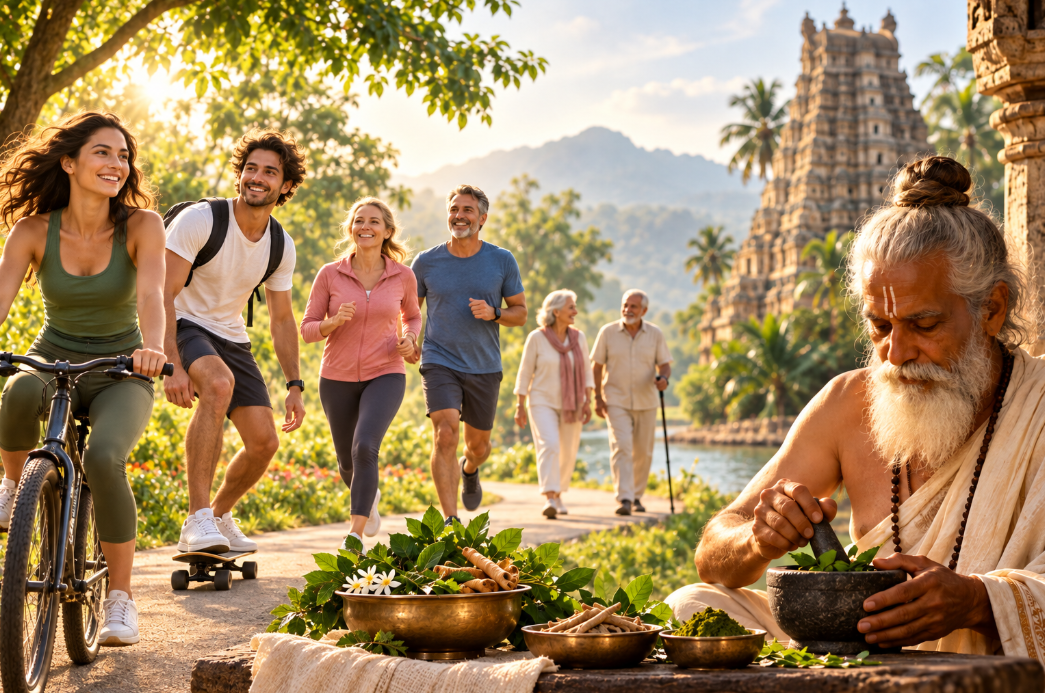
Briefly about the essentials
Humanity has long sought ways to prolong youth. Today, this is the focus of gerontology — the science of aging; biology studies cells and mitochondria, medicine examines the effects of nutrition, exercise, sleep, stress, and other factors on how the body changes with age.
But long before modern gerontology appeared, a similar question was posed in Ayurveda — the traditional medical system of India, which views health through nutrition, lifestyle, the state of body and mind, prevention, and treatment of diseases.
In Ayurveda, a separate branch developed — rasayanaIts task was not to treat a specific disease, but to preserve vital energy, memory, physical abilities, health, and a maximally long and full life.
Rasayana is not a magic pill against aging. It is a comprehensive system of restoration that can combine nutrition, regimen, rest, medicinal plants and formulations, cleansing and restorative procedures, work with the state of mind, and specially organized living conditions.
Today, individual methods, plants, and entire rasayana programs are already becoming subjects of clinical research.
And therefore an interesting question arises:
what can the ancient system of preserving youth offer a person of the 21st century?
Rejuvenation of the body begins from within
When we notice age, we first see its external signs: the skin changes, facial expression, hair, posture, movements.
But external aging does not exist separately from the processes occurring inside the body.
The skin itself is an organ. Its condition is influenced by cellular and metabolic processes, hormonal changes, inflammation, the state of connective tissue, and the tissues’ ability to regenerate. At the same time, the skin is especially sensitive to external influences — primarily ultraviolet light, smoking, environmental pollution, and lifestyle.
Modern research therefore considers skin aging as the result of a combination of internal biological processes and external factors.
Skin aging from mechanisms to interventions
Today, aging of the body is understood much more broadly than just the “wear and tear” of individual organs. In the modern concept Hallmarks of Aging interconnected processes are described: genomic instability, changes in epigenetic regulation, mitochondrial dysfunction, cellular senescence, stem cell exhaustion, chronic inflammation, impaired intercellular communication, and other mechanisms.
Hallmarks of Aging: An Expanding Universe
Therefore, rejuvenation of the body cannot be reduced only to appearance.
Today there are many methods that directly affect the external signs of age: laser technologies, radiofrequency procedures, focused ultrasound, surgical lifts. They can change the condition of the skin and subcutaneous tissues, stimulate collagen remodeling, and provide a noticeable aesthetic effect.
Such methods have their place in modern cosmetology. But their task is local: they work with specific tissues and external manifestations of aging.
Tightening the skin does not yet mean changing the aging processes throughout the entire body.
It is possible to influence facial collagen, but such a procedure is not intended to restore muscle strength, joint condition, metabolism, sleep, digestion, nervous system function, or the body's overall ability to adapt and recover.
At the same time, energy-based cosmetic procedures require proper application. In 2025, the American FDA specifically warned about registered serious complications following certain types of radiofrequency microneedling treatments: burns, scarring, loss of subcutaneous fat tissue, deformities, and nerve damage; in some cases, medical or surgical intervention was required.
FDA: Potential Risks with Certain Uses of Radiofrequency Microneedling
Therefore, the issue of rejuvenation is much broader than just how smooth or firm the skin looks.
The entire body ages — and it makes sense to maintain youthfulness at the level of the whole organism as well.
The better the body's internal resources and recovery ability are preserved, the more prerequisites remain for a healthy outward appearance.
This is exactly where rasayana becomes especially interesting.
What is rasayana — and how it was understood two thousand years ago
In one of the main classical texts of Ayurveda — "Charaka Samhita" — a separate large section is dedicated to rasayana.
The text is traditionally associated with the name Charaka — one of the main authorities of ancient Indian medicine. The exact dating remains a subject of historical research: the text was compiled from earlier materials, edited, and supplemented over a long period.
At the beginning of the section on rasayana, there are lines:
दीर्घमायुः स्मृतिं मेधामारोग्यं तरुणं वयः ।
प्रभावर्णस्वरौदार्यं देहेन्द्रियबलं परम् ॥
Their meaning can be conveyed as follows: rasayana was associated with long life, memory, intellect, health, preservation of youth, good condition of the body and senses, physical strength, and the vital expressiveness of a person..
The original text and a modern commentary were published in a scientific-educational edition Charak Samhita New Edition.
Rasayana Chikitsa Adhyaya — Charak Samhita New Edition
For a text that is about two thousand years old, the very formulation of the question seems surprisingly modern.
It is not only about how to get rid of a certain symptom.
It is about how to preserve a person's quality of life as they age.
Rasayana: comprehensive restoration and preservation of youth
At the core of this approach lies Ayurveda's characteristic view of a person as a holistic system.
In the traditional Ayurvedic model, a person's condition is considered through three functional principles — vata, pitta, and kapha. At the same time, both their innate, congenital characteristics and changes that have appeared during life under the influence of age, nutrition, lifestyle, stress, diseases, and the environment are taken into account. Such an individualized approach is indeed one of the central features of the traditional Ayurvedic model.
The task is not to bring all people to a single conditional ideal. It is necessary to see acquired imbalances and strive to return the person to a more harmonious state for them..
Therefore, rasayana was never limited to a single method of influence.
Depending on the person's condition and the chosen program, it could include nutrition, regimen, rest, medicinal plants and complex formulations, external procedures, work with the mind state, and in certain intensive schemes — preliminary body cleansing.
Cleansing is not synonymous with rasayana, but it can be one of the stages of the program..
This is clearly seen in the classical description Kutipraveshika Rasayana. In "Charaka Samhita" first a specially organized space is described, then cleansing is mentioned — shodhana, restoration of strength, and subsequent application of rasayana.
The logic is sequential:
prepare the body → perform cleansing when indicated → restore → nourish and support.
Traditional pharmacy also plays a major role in Ayurveda.
This is not just a few herbs known today. There was a whole system for preparing remedies: fresh plant juices — svarasa, herbal pastes — kalka, decoctions — kwatha, cold infusions — hima, hot infusions — phanta. Powders, oils, ghee-based formulations, and thick multi-component preparations such as avalehaThese medicinal forms are described in detail in the tradition of Ayurvedic pharmaceutics.
Bhaishajya Kalpanaa — The Ayurvedic Pharmaceutics
The plant and its part, the method of preparation, the combination of components, the form of the remedy, the dosage, and the condition of the individual person all matter.
Behind this lies the broader Ayurvedic view of a person as part of the surrounding nature. Food, plants, sleep, movement, season, climate, daily routine, and emotional state are considered factors constantly interacting with the body.
Rasayana transforms this perspective into a practical system.
It works not only with that, what a person takes in, but also with that, how they live..
The deepest form of rasayana: temporarily transforming the entire life
This principle is especially evident in Kutipraveshika Rasayana — one of the most intensive classical forms of rasayana.
Kuti — a specially prepared space. The classical text describes a protected environment designed for prolonged human stay away from undesirable external influences.
Preparation and cleansing are carried out beforehand. Then diet, rasayana remedies, rest, and a specific regimen are prescribed.
It turns out that not only the medicine changes.
The entire environment in which the organism lives changes. The whole environment in which the organism lives changes..
In everyday life, a person may chronically suffer from lack of sleep, work without rest, eat irregularly, and live for years in a state of constant tension — and then seek the one remedy that should restore their youth.
The logic of rasayana is different.
For a certain period, habitual factors are maximally limited, and conditions are created for the person to recover.
At the same time, classical Ayurveda knew a more accessible form — Vatatapika Rasayanawhich did not require complete isolation from everyday life.
The most intensive forms of rasayana still required significant resources: time, a doctor, specially organized space, nutrition, medicines, and care.
Today, such care can be obtained at a specialized Ayurvedic clinic — with accommodation, prescribed nutrition, treatments, and medical supervision.
What rejuvenation means in practice
If you remove the advertising connotation from the word "rejuvenation," it becomes much more specific.
Youth is not only what a person sees in the mirror. It is the ability to do what you want to do without constantly thinking about your age.
To walk several kilometers around the city without searching for a bench due to knee pain. To climb stairs without heavy shortness of breath. To ride a bicycle. To ski. To swim. To carry groceries independently. To travel without planning the entire route around physical limitations.
It is the ability to calmly hold a cup in your hand, fasten small buttons, confidently drive a car, master a new computer program, read a complex book, and remember what the previous chapters were about.
Modern medicine pays increasing attention not only to lifespan but also to how many years a person maintains independence and functional abilities.
A person ages by the calendar — but this does not mean that with each passing year they must give up another part of their life.
For Rasayana, this approach is far from new. In classical texts, alongside longevity stand memory, intellect, strength, health, senses, and youth.
That is, not only the number of years lived mattered.
What mattered was how a person remains during those years.
What modern science already shows
Rasayana is gradually moving from the realm of exclusively traditional medicine into the field of modern clinical research.
In April 2026, Sumit Raina, D.K. Goyal, and Punita Pandey from Uttarakhand Ayurved University published a systematic review of clinical studies on Rasayana in older adults.
The review included eight clinical studies — ranging from open observations to randomized and non-randomized trials. Multicomponent Rasayana formulations, Medhya Rasayana, and programs combining Rasayana with yoga were studied.
Overall, studies have shown improvements in functional abilities, cognitive indicators, and quality of life; under medical supervision, favorable safety data have also been reported. The authors consider the results promising and see the next step as larger randomized studies that will allow for a more precise determination of effectiveness and optimal protocols.
Ayurvedic Geriatric Care Through Rasayana: A Systematic Review of Clinical Evidence
This is an important turning point: the traditional system, which for centuries has linked rasayana with maintaining vital functions in old age, is now being studied in real patients using modern clinical methods.
Can rasayana help preserve brain function
As people age, concerns extend far beyond the body.
Sometimes changes are noticed in other areas: it becomes harder to maintain attention, names are recalled more slowly, more time is needed to learn new things, and familiar intellectual tasks become tiring more quickly.
In Ayurveda, there is a concept Medhya Rasayana. Medha associated with intellect, memory, and the ability to absorb knowledge.
In one clinical study, 72 older adults with mild cognitive impairment received Ayurvedic rasayana, practiced comprehensive yoga, or combined both approaches for eight weeks.
The authors found improvements in cognitive indicators across all three groups, with the combined program showing advantages in several measures of learning, attention, information processing speed, and working memory. The study was three-group but not randomized, which is important to consider when interpreting the results.
The historical connection itself is particularly interesting here.
What the ancient tradition described as support medha — for memory and intellect — can now be studied using standardized tests of attention, memory, learning, and information processing speed.
What modern science is discovering about rasayana plants
There is another research approach: to study not the entire complex program at once, but individual plants traditionally used in Ayurveda and Rasayana.
Amalaki
Amalaki — Phyllanthus emblica, the Indian gooseberry, holds an important place in many classical formulations and is one of the main components of Chyawanprash.
A 2023 meta-analysis included nine randomized studies involving 535 participants. Researchers found changes in several cardiometabolic markers, including LDL cholesterol, triglycerides, and hsCRP — an inflammation marker. However, the results of different studies varied significantly, so further clinical research is needed.
Clinical effects of Emblica officinalis fruit consumption on cardiovascular disease risk factors
Ashwagandha
Ashwagandha — Withania somnifera traditionally associated with recovery and resilience of the body.
Modern studies are particularly active in exploring it in relation to stress and anxiety. A 2022 meta-analysis included 12 randomized studies with 1002 participants. In the ashwagandha groups, stress and anxiety levels decreased more than in the placebo groups. The authors simultaneously noted high heterogeneity among the studies and rated the confidence in the evidence as low.
Ashwagandha: systematic review and meta-analysis of randomized controlled trials
For the topic of youthfulness, the focus here is not on wrinkles, but on a completely different aspect of life: chronic tension changes sleep, rest, behavior, and a person's ability to recover.
Brahmi
Brahmi — Bacopa monnieri is traditionally classified as Medhya Rasayana.
A meta-analysis of nine randomized studies involving 518 participants found positive changes in certain cognitive indicators, especially attention speed.
Meta-analysis of randomized controlled trials on cognitive effects of Bacopa monnieri extract
This creates an interesting historical connection: a plant that has been associated in Ayurveda for centuries with memory and intellect is now being studied specifically for cognitive indicators.
Boswellia
In Boswellia serrata — shallaki a different emphasis.
It is studied, in particular, for osteoarthritis. A meta-analysis of seven randomized studies involving 545 people showed reduced pain and stiffness and improved joint function compared to controls.
Effectiveness of Boswellia and Boswellia extract for osteoarthritis patients
And here the word “rejuvenation” becomes very down-to-earth.
If a person can get up from a chair normally again, enjoy an evening walk, ride a bike, or spend a day on their feet without pain — for them, this can mean much more than any biological age number.
Why rasayana is difficult to study like a conventional medicine
Modern clinical experiments are easier to conduct when conditions can be strictly standardized.
There is a drug. There is a specific dose. There is a group that takes it and a comparison group. Then the outcome is measured.
Rasayana is structured differently.
Within one program, nutrition, sleep, daily routine, physical activity, and rest duration can all change simultaneously. Procedures and herbal remedies are added. The very environment in which a person spends several weeks changes.
If a person's condition changes after the course, the researcher has to determine: what contribution was made by nutrition, what by rest, what by procedures, what by herbal medicines, and what by the combination of all these factors.
This is a special methodological challenge.
That is why modern studies of complex interventions increasingly try to evaluate not only the effect of an individual component but also the outcome of the program as a whole.
For rasayana, such an approach is especially natural: its structure was originally built around simultaneous changes in several aspects of a person's life..
What happens when a person arrives in Kerala?
The best way to feel the difference is through a simple example.
A person arrives in Kerala with their usual life: a phone almost always nearby, coffee on the go, work, late evenings, habitual alcohol, and tiramisu in a café near home in the evening.
In an Ayurvedic center, the usual scenario changes.
First, a doctor's consultation is conducted.
Individual characteristics of the person and the changes that, from the Ayurvedic system's point of view, have appeared and accumulated over a lifetime are assessed.
Then a program is developed.
Diet is prescribed. A daily routine is established. Procedures are performed at specific times. Oils, herbal preparations, decoctions, and other traditional remedies are used. If the doctor deems it necessary, the program includes preparatory and cleansing stages followed by recovery.
And here another important change occurs.
The person no longer needs to make dozens of small daily decisions: what to eat, when to eat, when to lie down, when to stop, when to finally give themselves rest.
For several weeks, a different environment appears.
In a sense, this is a modern continuation of an old idea: Kutipraveshikato temporarily remove a person from their usual rhythm and create a space where recovery becomes the main task.
Therefore, a full rasayana program is hard to compare with a situation where a person simply buys a jar of ashwagandha or Chyawanprash and places it on the kitchen shelf.
The scale of the approach is completely different.
Today, you no longer need to be a raja for this.
Intensive forms of rasayana in ancient times required significant resources.
It was necessary to organize a special space, provide a doctor, medicines, nutrition, care, and most importantly, give the person the opportunity to leave everyday duties for a long time.
Today, this organizational task has become much easier.
In modern Kerala, there are Ayurvedic centers where accommodation, nutrition, procedures, and medical supervision are combined into one program.
A person from Europe, Canada, or the USA can come for several weeks, undergo the prescribed course, and then return to their usual life.
Such a course still requires time and resources.
But a complex restorative program, once requiring enormous individual organization, has now become practically accessible to a much wider range of people.
Or maybe youth is, above all, freedom?
We are used to measuring age in years.
But in everyday life, a person feels it quite differently.
Age is especially noticeable when it begins to limit choices.
When you can no longer go to the mountains because your knees hurt.
When you don't want to plan a long trip because walking for a long time is difficult.
When the bicycle stands in the garage not because you're tired of it, but because your body no longer allows you to ride it.
When a person used to run up the stairs,but now first looks for the elevator.
When you want to learn something new, but attention and memory increasingly fail you.
Therefore, perhaps one of the most valuable measures of youth is the preservation of freedom..
The freedom to go.
To pass through.
Rise up.
Ride around.
Learn.
Work.
Rest.
And choose for yourself how to fill the next day.
Rasayana originated in a completely different world and explained the body in a different language.
But its goal to preserve human strength, mental abilities, health, and vitality is understandable today without translation from Sanskrit.
It is not about immortality.
It is about delaying as long as possible the age when decisions are made for a person about what they can no longer do.
Youth continues in everyday life.
Rasayana offers a broader view of preserving youth beyond appearance and beyond a single remedy.
The same idea—to influence a person's condition from different angles—also runs through many YogaJoy practices.
We explain in detail in an article how movement, breathing, and attention can complement each other. "Yoga, Breath, and Meditation: Why the Combination Is More Effective".
Read on YogaJoy
A separate article is dedicated to the connection between recovery and the ability to deeply relax— "Why Relaxation Is One of the Keys to Youthfulness?"
Read on YogaJoy
And the practical side of the topic is continued in the material "Yoga for Rejuvenation and Hormonal Health: How It Works".
Read on YogaJoy
Perhaps the secret to preserving youth is exactly this: not to look for one miraculous button, but to maintain the body's ability to live, move, adapt, and give a person the freedom to do what truly matters to them for as long as possible.