Articles
PCOS, Yoga, and modern research
What yoga research shows for PCOS: testosterone, AMH, LH, hirsutism, and menstrual cycle. Results of clinical studies.
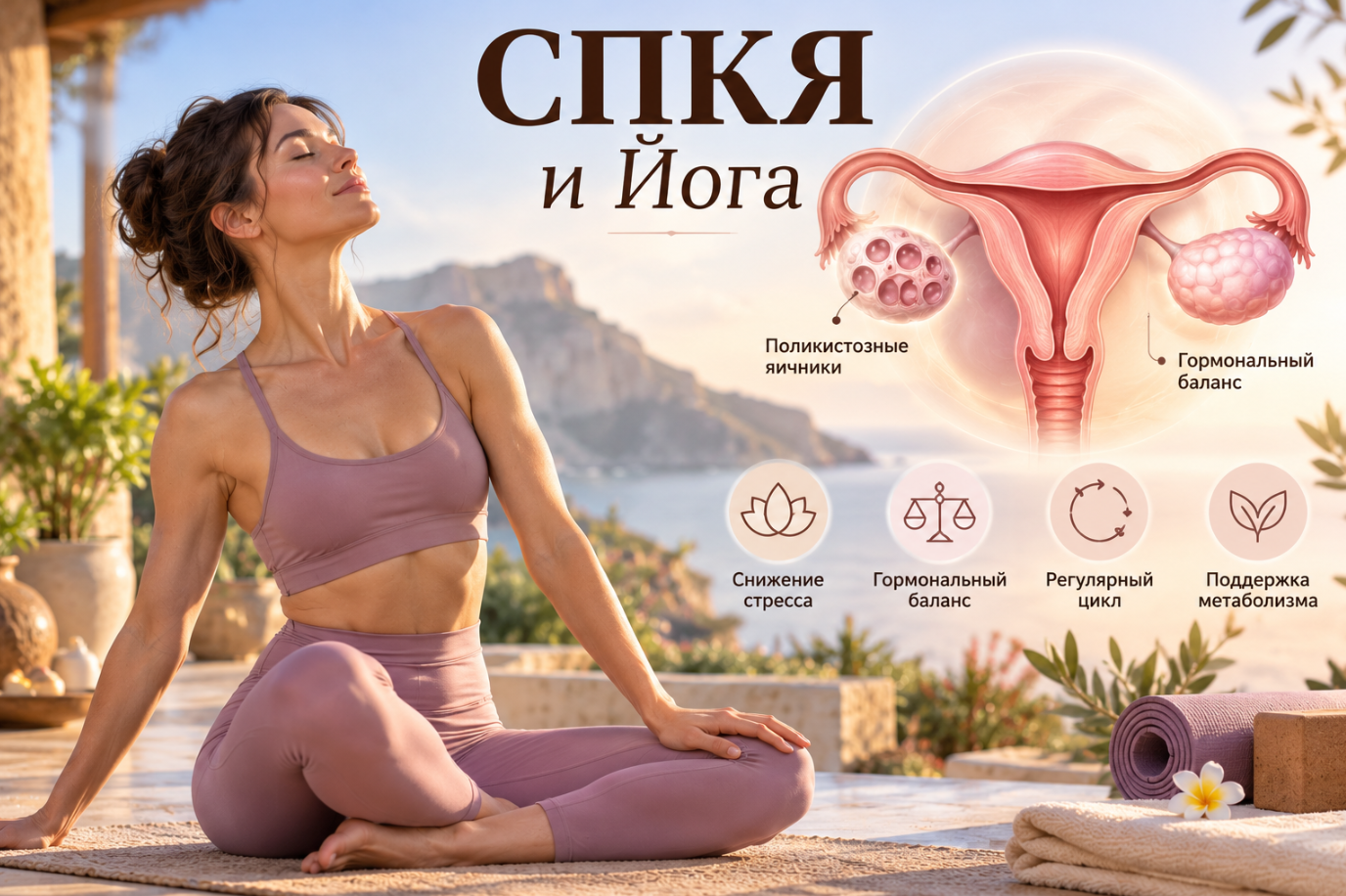
Polycystic Ovary Syndrome — PCOS — is one of the most common hormonal disorders in women of reproductive age. It can manifest as irregular menstruation and ovulation disorders, elevated androgen levels, acne, pronounced hair growth on the face and body, and difficulties conceiving. PCOS is also associated with metabolic changes, including insulin resistance. According to the World Health Organization, the syndrome affects approximately 10–13% of women of reproductive age. World Health Organization
Modern yoga research on PCOS allows for the assessment of very specific changes — levels of testosterone, luteinizing hormone, and anti-Müllerian hormone, severity of hirsutism, frequency of menstruation, and some metabolic indicators.
But before moving on to these studies, it is worth looking back through the centuries.
Similar clinical signs were described even in ancient India
In ancient Indian medicine, a woman's condition was assessed by a combination of signs: the nature of menstruation, fertility, changes in appearance, and overall health.
A particularly interesting small fragment "Kashyapa Samhita" — one of the early Ayurvedic treatises, dedicated in part to women's health, pregnancy, and childhood diseases.
The exact dating of the text remains a subject of debate. In Ayurvedic historiography, its original tradition is often attributed approximately to the 6th century BCE,however, the version that has come down to us was formed later and was revised multiple times. The authorship of the surviving text itself cannot be considered definitively established. PubMed
In the section "Kalpa Sthana," in the description of the condition Pushpaghni,it speaks of a woman who pushpa appears at the proper time but is found to be "infertile"; further, it mentions full, hairy cheeks.This exact combination of signs is contained in the Sanskrit text itself. Vedic Reserve
Today, pronounced facial hair in a woman prompts a doctor to consider possible hyperandrogenism — increased action or levels of androgens.Hirsutism is an important clinical sign of PCOS, although it alone does not establish the diagnosis. The Association of Reproductive Specialists
We will not turn Pushpaghni into an ancient name for PCOS. There is no basis for that. What is interesting is this: the medical tradition already then combined in one clinical picture the features of menstrual function, fertility, and external changes in a woman..
This is a good example of how significant an instrument observation was for a doctor — the ability to see signs, question the patient, and correlate what at first glance might seem like different problems.
Primary source: "Kashyapa Samhita," "Kalpa Sthana" — Sanskrit textt
When yoga began to be considered in the context of the female cycle
Classical Hatha Yoga texts do not contain a special system for treating PCOS. And this is natural: the modern diagnosis appeared much later.
But over time, yoga practice increasingly adapted to female physiology.
This direction became especially noticeable in the 20th century. Geeta Iyengar,daughter of B. K. S. Iyengar and one of the most well-known yoga teachers for women, developed in detail the features of practice during different phases of the menstrual cycle, pregnancy, and menopause.
In her approach, practice was no longer viewed as the same set of asanas every day. The sequence changed depending on the woman's condition. In 2002, Geeta Iyengar dedicated a separate lecture to this topic, later edited and published as a guide for practice throughout the month. iyengaryoga.org.uk
This was not yet PCOS research. But by that time, the idea had already formed: yogic practice can be adapted to changes in female physiology and its influence on the body's condition can be observed..
The next step was measuring this influence in clinical studies.
90 girls with PCOS: yoga and regular physical exercises
One of the most interesting studies was conducted in India.
It involved 90 girls aged 15–18 with confirmed PCOS. They were randomly divided into two groups.
One group practiced a comprehensive yoga program, the other performed regular physical exercises of comparable duration. Sessions lasted one hour per day for 12 weeks.. PubMed
Researchers studied several important indicators for PCOS.
After the yoga program, compared to the physical exercise group, there was a more pronounced decrease in anti-Müllerian hormone — AMH..
It decreased Luteinizing hormone — LH, as well as the ratio LH to follicle-stimulating hormone — FSH.
The level decreased of testosterone.
The severity decreased of hirsutism, which was assessed using a special scale.
And, what is especially interesting, the frequency of menstruation increased. PubMed
At the same time, no significant differences in FSH and prolactin were found between the groups.
It turned out to be a rather unusual picture: changes affected several indicators related to the endocrine system and manifestations of PCOS.
Scientific publication: Effects of a holistic yoga program on endocrine parameters in adolescents with polycystic ovarian syndrome
Which researchers call “yoga”
This study did not examine a single asana.
The program was a comprehensive practicethat included various elements of yoga. This approach is generally characteristic of many studies: the effect is evaluated after a series of sessions, not after one specific pose.
Therefore, from the obtained results, it is not possible to conclude that any particular asana reduces testosterone or affects AMH.
This is also important because traditional yoga itself is much broader than physical body postures: it can include breathing practices, relaxation, concentration, and meditation.
On YogaJoy, this is explained in more detail in the article “Yoga, Breathing, and Meditation: Why the Combination Is More Effective.” YogaJoy
Yoga and Testosterone
A separate randomized study was conducted in the USA.
It involved 31 women with PCOS aged 23 to 42 years. The yoga group practiced for one hour three times a week for three months.
22 participants completed the full course.
In women who completed the mindful yoga program, the level of free testosterone decreased on average from 5.96 to 4.24 pg/ml. Improvements were also noted in some anxiety and depression indicators. Journal of Osteopathic Medicine
The study is small, so it cannot be considered separately from other works. But it is interesting because it again shows changes specifically in the androgenic aspect of PCOS.
Scientific publication: Regular Mindful Yoga Practice as a Method to Improve Androgen Levels in Women With Polycystic Ovary Syndrome
What the 2026 systematic review showed
Individual studies can yield interesting results, but it is much more important to look at them together.
In March 2026 a systematic review of yoga studies on PCOS was published, focusing on the effects on AMH, androgens, and metabolic indicators.
It included five publications, but three of them referred to the same large randomized study. After accounting for duplicate data, the analysis represented 258 unique participants. PubMed Central (PMC)
The authors note changes in several areas — hormonal, metabolic, and menstrual. However, the studies varied significantly in programs, duration, control groups, and measured indicators, so it was impossible to combine the results into a full meta-analysis.
Another systematic review from 2026 included nine randomized studies and came to a similar conclusion: some studies observed changes in androgens, AMH, LH, insulin resistance, hirsutism, menstrual indicators, and psychological state, but the number of independent studies is still small, and yoga programs vary too much among themselves. PubMed Central (PMC)
Scientific reviews:
Yoga as a complementary intervention for polycystic ovary syndrome management — 2026
Can yoga restore ovulation?
This is one of the most important questions, especially when PCOS causes difficulties with conception.
It is necessary to distinguish here menstruation and ovulation.
Bleeding can also occur with disrupted ovulation. The international guideline on PCOS explicitly states that ovulatory dysfunction is possible even with a relatively regular cycle; if necessary, it is confirmed by additional tests, such as progesterone measurement. The Association of Reproductive Specialists
Therefore, an increase in the frequency of menstruation after a yoga program is an interesting result, but it does not yet prove the restoration of regular ovulation.
The same applies to the reduction of testosterone, LH, or AMH. These changes allow us to judge the direction of physiological processes but do not automatically lead to the conclusion of restored fertility.
For such a conclusion, studies are needed in which ovulation and pregnancy occurrence are directly monitored in sufficiently large groups of women.
Why the results still deserve attention
PCOS is not a single isolated blood test marker. Its development and manifestations involve the reproductive, endocrine, and metabolic systems, and the condition often also affects a woman's psychological well-being. World Health Organization
That is why studies of comprehensive practices are of particular interest.
Yoga can include movement, breathing, relaxation, and attention work. Modern research does not yet allow us to precisely separate the contribution of each of these components. Possibly, their combination plays a certain role.
On YogaJoy, this idea is explored in more detail in the article "Yoga for Rejuvenation and Hormonal Health: How It Works." YogaJoy
At the same time, the current level of evidence does not yet allow us to speak of yoga as an independent treatment for PCOS. International guidelines consider lifestyle and physical activity as an important part of syndrome management, but diagnosis and treatment are tailored individually depending on cycle disorders, hyperandrogenism, metabolic risks, and the woman's reproductive goals. AORM
The story itself turns out to be interesting.
In the ancient "Kashyapa Samhita," the medical tradition recorded the combination of conception problems and pronounced facial hair growth. In the 20th century, yoga therapy began to pay closer attention to the features of female physiology. And today, the influence of practice can be assessed by hormonal and clinical indicators.
There are still few studies, but they provide a basis for asking increasingly precise questions: which programs work better, which changes last longer, and whether regular practice can directly affect ovulation.
It is the answers to these questions that will determine the place yoga will occupy in the future among additional methods of supporting women with PCOS.