Articles
Inositol: what is it for, who does it help, and should you take it?
What is inositol for, does it help with PCOS, and is it worth taking? Myo-inositol, D-chiro-inositol, effects on hormones, and research results.
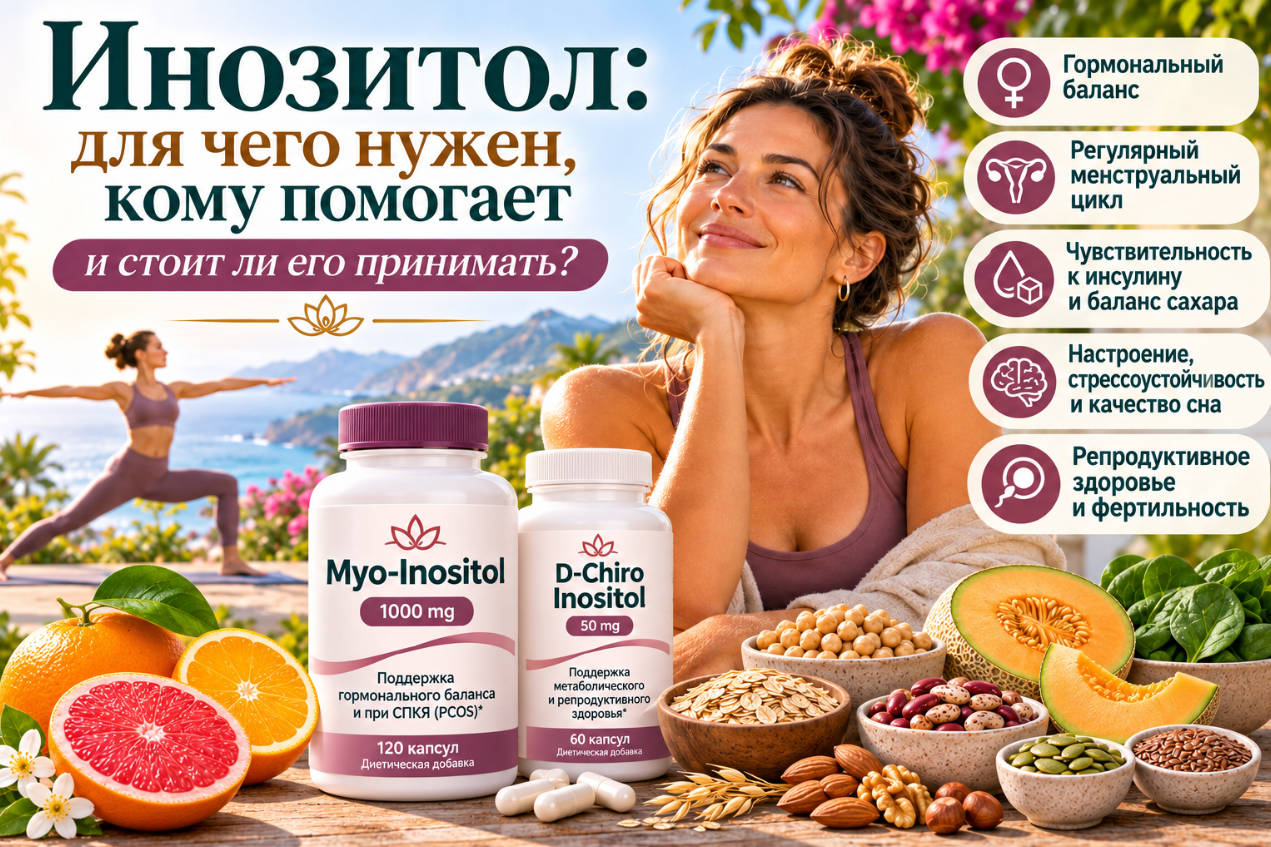
Inositol is a natural substance that the body produces on its own and obtains from food. Healthy individuals usually do not need to take it additionally.
The greatest scientific interest lies in the use of inositol for polycystic ovary syndrome (PCOS), carbohydrate metabolism disorders, and some pregnancy complications. However, research results do not always coincide.
What is inositol and what is it for?
Inositol is involved in the functioning of cell membranes and signal transmission within cells, including those related to insulin action.
It was previously called vitamin B8, but it is not considered a true vitamin. Inositol is found in legumes, grains, nuts, and fruits. There is no established mandatory daily intake.
Source: Cleveland Clinic — Inositol.
Does inositol help with PCOS?
In 2024, an international group of researchers led by Victoria Fitz analyzed 30 clinical studies involving 2,230 women. Possible improvements in certain metabolic indicators and ovulation were found, but the overall evidence base was limited.
In 2026, Mengxue Duan and colleagues from Chengdu University of Traditional Chinese Medicine combined the results of 13 meta-analyses.
Compared to placebo or folic acid, in some combined analyses inositol:
-
reduced the insulin resistance index HOMA-IR by an average of 1.14 units;
-
lowered levels of some androgens, including testosterone;
-
was associated with a higher ovulation rate — the relative measure was 2.75.
However, among 85 evaluated outcomes, none received a high level of evidence certainty. Therefore, the observed effects cannot be considered definitively confirmed.
Duan et al., Frontiers in Endocrinology, 2026.
Other ways to affect PCOS symptoms are discussed in our article "PCOS, Yoga, and Modern Research".
Does inositol prevent gestational diabetes?
Scientific results here are especially contradictory.
Positive result. In 2026, Spanish researchers Raquel Poyatos-León, Vicente Martínez-Vizcaíno and their colleagues combined the results of 12 randomized studies involving 4,765 women.
When taking myo-inositol, the relative risk of developing gestational diabetes was 44% lowerthan in the control groups. However, no convincing improvements were found in most other pregnancy outcomes.
Poyatos-Leon et al., American Journal of Obstetrics and Gynecology, 2026.
Opposite result. In 2025, researchers from 13 hospitals in the Netherlands published the results of a large double-blind study of 464 pregnant women with PCOS.
Gestational diabetes developed in 17.0% of women taking myo-inositol and 15.8% of those receiving placebo. No statistically significant difference was found.
The overall incidence of the three studied complications—gestational diabetes, preeclampsia, and preterm birth—also did not decrease: 25.0% versus 26.8%.
Dutch randomized study, JAMA, 2025.
Importantly, the studies covered different groups of pregnant women. The Spanish review included women without previously diagnosed diabetes, while the Dutch trial was conducted exclusively among women with PCOS. Additionally, the search for studies for the meta-analysis was completed before the Dutch results were published.
Conclusion: The potential preventive effect of inositol deserves further study, but it cannot yet be considered a proven means of preventing gestational diabetes.
Does inositol help with conception?
Some studies noted improvements in ovulation and certain reproductive parameters.
However, there is still insufficient reliable evidence that inositol increases the likelihood of giving birth to a child.
International guidelines of 2023, prepared under the leadership of Professor Helena Teede from Monash University in Australia, consider the use of inositol for treating infertility in PCOS as an experimental method.
International clinical guidelines on PCOS.
Is there any benefit after menopause?
Inositol has also been studied in women with metabolic syndrome after menopause.
An Italian randomized study involved 80 women. All followed a diet, but half additionally received myo-inositol.
After one year, 8 out of 40 women in the inositol group no longer met the diagnostic criteria for metabolic syndrome. In the placebo group, only 1 out of 40. Some metabolic parameters also improved.
This is an interesting result, but one small study is not enough to recommend inositol to all women after menopause.
Italian study, Menopause International, 2012.
What forms of inositol exist?
Myo-inositol is the most common form, often used in studies.
D-chiro-inositol is another natural form involved in cellular signal transduction processes.
Combinations of the two forms are often sold in a 40:1 ratio.
However, international clinical guidelines do not yet specify a particular form, ratio, or dosage as the most effective.
Should you take inositol?
For healthy men and women, there is no convincing reason to regularly take inositol as a preventive dietary supplement.
For PCOS, it can be discussed with a doctor as an additional option, considering the limited evidence. During pregnancy, one should not start taking it independently for the prevention of complications.
Inositol was generally well tolerated in studies, although gastrointestinal disturbances are possible. The long-term safety of specific regimens has not been sufficiently studied.
Inositol has certain therapeutic potential but is not yet a remedy with convincingly proven effectiveness for widespread use.
The material is for informational and educational purposes and does not replace medical consultation.