Articles
Melatonin: does it help with insomnia and when is it ineffective?
Does melatonin help with chronic insomnia? What studies have shown, when it is useful after night shifts and flights, and in which cases it does not work.
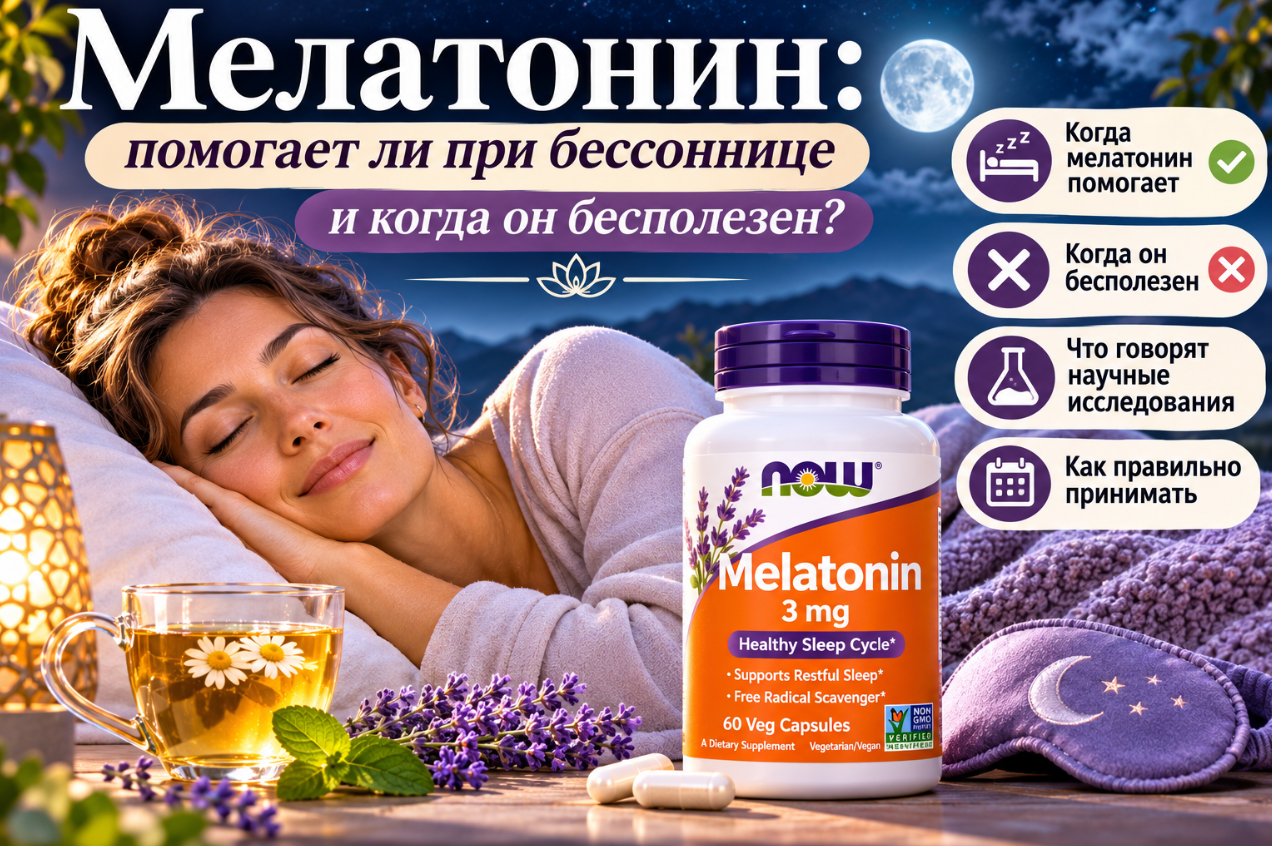
Melatonin is a hormone involved in regulating sleep and circadian biological rhythms. It is often taken as a sleeping aid, although its primary function is somewhat different:it helps the body determine sleep time rather than forcing a person to fall asleep..
In some situations, melatonin is indeed helpful. In others, its effect is so minimal that one should not expect full sleep restoration.
In brief: what have studies shown?
-
Chronic insomnia. Most adults do not show convincing sleep improvement. However, for people over 55, there are special extended-release formulations.
-
Disrupted biological clocks. Melatonin can help shift the time of falling asleep if a person is accustomed to going to bed too late.
-
Night shifts. In some studies, it increased the duration of daytime sleep after work.
-
Long-distance flights. It helps reduce symptoms of jet lag.
-
Sleep disturbances due to pain, anxiety, or illnesses. It does not eliminate the underlying cause of insomnia.
How does melatonin work?
Melatonin is produced mainly by the pineal gland — a small gland in the brain. Its secretion usually increases with the onset of darkness, while light suppresses its production.
Thus, melatonin serves as one of the signals regulating internal biological clocks.
This explains why its effectiveness is especially noticeable in circadian rhythm disorders — the natural alternation of sleep and wakefulness.
More about the mechanism can be read in the YogaJoy article "Circadian Rhythms: How Light Controls Internal Clocks".
Does melatonin help with chronic insomnia?
This is where expectations often differ from scientific results.
In 2022, Korean researchers led by Kyunghee Choi analyzed 24 randomized clinical trials of melatonin for chronic insomnia.
In adults, melatonin did not provide statistically significant improvements in sleep onset time, total sleep duration, or sleep efficiency.
Choi et al., Sleep Medicine Reviews, 2022.
But there is an important exception.
In 2023, a European group of specialists led by a German sleep researcher Dieter Riemann updated the clinical guidelines for the treatment of insomnia.
Experts have allowed the use of prolonged-release melatonin in people aged 55 and older, usually for a course of no more than three months.
At the same time, they did not recommend immediate-release melatonin for the treatment of chronic insomnia.
European guidelines on insomnia, Journal of Sleep Research, 2023.
The difference matters: regular melatonin enters the bloodstream relatively quickly, whereas the prolonged-release form releases the substance gradually.
For example, the European Medicines Agency (EMA) has approved a 2 mg prolonged-release melatonin preparation for short-term treatment of primary insomnia in patients aged 55 and over.
European Medicines Agency — Circadin.
What really helps with chronic insomnia?
European and American experts consider cognitive behavioral therapy for insomnia (CBT-I) as the first-line treatment method..
It aims to change factors that maintain sleep disturbances: unstable routines, habits related to being in bed, and anxious anticipation of another sleepless night.
American Academy of Sleep Medicine — clinical guidelines, 2021.
Therefore, if insomnia lasts for months, endlessly changing melatonin dosages is not the best way to solve the problem.
Does melatonin help you fall asleep after a night shift?
After working at night, a person may feel very tired but still have difficulty falling asleep in the morning. The reason is a mismatch between the needed rest time and the internal biological clock.
In 2014, researchers from the Cochrane Collaboration analyzed clinical trials of medications used for shift work.
In seven studies involving 263 people, melatonin increased daytime sleep duration after a night shift by an average of 24 minutes compared to placebo.
However, no convincing reduction in sleep onset latency was found. The quality of evidence was rated as low.
Melatonin after flights: proven benefits
When flying across several time zones, the body's internal time no longer matches the local time.
A Cochrane systematic review analyzed ten clinical trials.
In eight studies, melatonin reduced symptoms of jet lag, especially after flights crossing five or more time zones.
Melatonin for the prevention and treatment of jet lag — Cochrane.
The most important factor was the timing of melatonin intake relative to the planned sleep time at the destination. Incorrect timing can actually hinder the adjustment of biological clocks.
At the same time, a regular overnight trip without crossing time zones does not cause jet lag. Fatigue after such a trip may result from sleep deprivation rather than circadian rhythm disruption.
When does melatonin help shift sleep onset?
Some people feel sleepy only late at night and practically cannot fall asleep earlier, even if they need to get up early the next day.
In certain circadian rhythm disorders, properly timed melatonin intake can gradually shift sleep onset to an earlier time.
In 2018, Australian researchers conducted a randomized study involving 307 people suffering from delayed sleep phase disorder.
Melatonin combined with a fixed sleep schedule allowed participants to fall asleep on average 34 minutes earlierthan the placebo group.
Sletten et al., PLOS Medicine, 2018.
But this result was achieved with a specific regimen, not with arbitrary melatonin use before bedtime.
In which cases is melatonin practically useless?
Melatonin does not eliminate causes of sleep disturbances that are not directly related to the functioning of biological clocks.
For example, if a person wakes up due to chronic pain, restless legs syndrome, or sleep apnea, restoring sleep with melatonin alone is not possible.
The same applies to insomnia maintained by severe anxiety, depression, excessive caffeine consumption, or the effects of certain medications.
In such situations, it is necessary to work on the root cause.
Practical ways to change your routine are described in the YogaJoy article "How to Restore Your Sleep Routine: Evening Ritual, Breathing, and the Strategy of Small Steps".
Melatonin and Sports: Does It Help Recovery?
In February 2026, Chinese researchers Jintao Guo and colleagues published a meta-analysis of 19 randomized studies involving 266 participants.
In certain groups, melatonin was associated with improved endurance indicators and a reduction in creatine kinase levels — one of the laboratory markers of muscle damage after exertion.
The most favorable results were observed with evening intake and a sufficient interval before physical activity.
Guo and co-authors, Frontiers in Nutrition, 2026.
The results are interesting for sports medicine but are not yet sufficient to recommend melatonin to all physically active people.
Side Effects and Safety
With short-term use, melatonin is generally well tolerated. Possible side effects include headache, dizziness, nausea, and drowsiness the next day.
Use requires medical approval, especially if the person is taking anticoagulants, anticonvulsants, or other medications. There is insufficient safety data during pregnancy and breastfeeding.
Long-term effects of regular use are much less studied than short-term effects.
It is important to consider the drug form: immediate-release and extended-release preparations are intended for different situations. There is no universal dosage suitable for all sleep disorders.
Source: U.S. National Institutes of Health — Melatonin: What You Need To Know.
Conclusion
Melatonin is most beneficial when the problem is not so much the ability to sleep itself but the timing of sleep onset.
Its effectiveness is fairly well studied for jet lag and certain circadian rhythm disorders. Moderate positive effects are possible for night shift work.
Results are significantly more modest for chronic insomnia, although some extended-release preparations may be used in older adults.
Therefore, the main point is not just to take melatonin but to understand why sleep is disrupted. This determines whether the supplement will be helpful.
s.m.
This material is for informational and educational purposes and does not replace medical consultation.