Articles
Surya Namaskar: from Sun worship to modern yoga practice
The history of Surya Namaskar: sun worship, ancient texts, mantras, 12 poses, modern practice, and scientific research on benefits and workload.
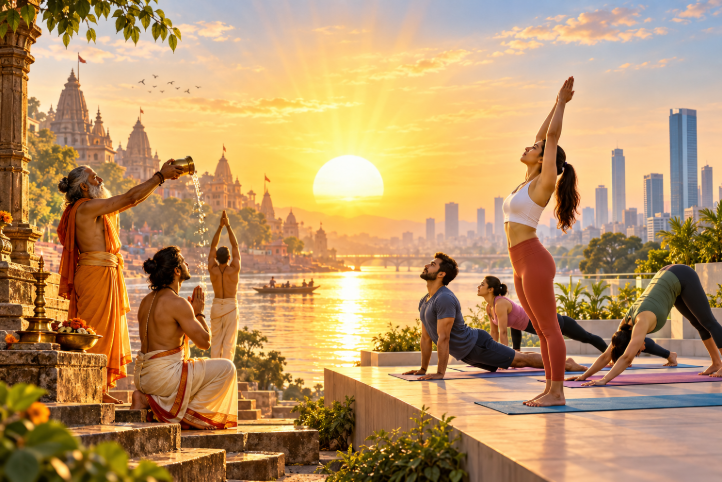
Briefly about the essentials. Surya Namaskar did not emerge at once as a ready sequence of twelve poses. Its history developed gradually: from ancient Sun worship, morning rituals, mantras and bodily bows, traditional Indian physical training, and much later, modern yoga styles. Today Surya Namaskar can be a gentle movement practice with breath or a fairly intense physical workout. Modern research already shows how the pace and method of execution affect heart function, breathing, strength, flexibility, stress, and other indicators.
Official Surya Namaskar sequence — Yoga Certification Board, Ministry of AYUSH
What "Surya Namaskar" means
Sūrya in Sanskrit means Sun and at the same time the name of the solar deity in Indian tradition. Namaskāra — bow, greeting, expression of respect. Therefore, the original meaning of the phrase Sūrya Namaskāra — bow or greeting to the Sun.
Today this name usually refers to a sequence of movements combined with breathing. In some schools, it is twelve positions; in others, the order and individual elements differ. The practice is done slowly or quickly, with mantras or without them.
However, the movement sequence known to us is only the latest part of a much longer history. Yoga historians Stuart Ray Sarbacker and James Dilan Russell show that modern Surya Namaskar formed at the intersection of Hindu solar ritual, bodily bows, traditional physical training, and modern yoga.
Stuart Ray Sarbacker's research on the history of Surya Namaskar
James Dylan Russell's 2025 study on the origin of Surya Namaskar
Who is Surya
Surya (Sūrya) — the solar deity of the Vedic and subsequent Hindu tradition; the same word also denotes the Sun itself.
Already in Rigveda, the oldest collection of Vedic hymns, the Sun holds a prominent place. Vedic texts were formed in an oral tradition in the 2nd millennium BCE; the exact dating of individual hymns remains a subject of scholarly debate.
Surya appears as a celestial light that dispels darkness and watches over the world. Later, the well-known image of Surya moving across the sky in a chariot is established.
Alongside him in the Vedic tradition appears Savitṛ (Savitṛ) — a solar deity associated with the motivating, enlivening power of the Sun. It is to Savitṛ that the famous Gayatri Mantra, one of the most revered Vedic prayers.
Another important name is Aditya (Āditya). Originally, the Adityas were a group of Vedic deities, but later Aditya also became one of the common names for the Sun.
The Sun was associated with light, life, vision, time, the order of the world, health, and well-being. Therefore, addressing it gradually became part of daily rituals.
Dawn, water, and prayer
For the history of Surya Namaskar, it is especially important sandhyā — a traditional practice at transitional times of the day, primarily at dawn and dusk.
From this comes sandhyāvandana — a set of daily prayer and ritual actions. Its specific form varied depending on the Vedic school and region, but the morning invocation of the Sun held a prominent place in it.
One of the central elements is the repetition of the Gayatri Mantra.
The multiple recitation of the mantra is called japa. Traditional guides mention different numbers of repetitions, including 10, 28, and 108. The morning ritual also included arghya — an offering, primarily of water, to the rising Sun — and praṇāma or namaskāra, that is, a bow. Sarbaker shows that in the Vedic ritual tradition, the Sun was greeted with mantras and the offering of water specifically in the context of the morning sandhyā.
In its simplest form, this sequence looks like this:
dawn → addressing the Sun → water → mantra → bow.
What we see here is not yet a sequence of modern asanas, but a solar ritual from which one of the important components of Surya Namaskar later developed.
"Arunaprashna," Upanishads, and the solar tradition
In later Vedic literature, the worship of the Sun receives further development.
Taittiriya Aranyaka — "Taittiriya Aranyaka" belongs to the later layer of Vedic texts. The word āraṇyaka designates works in which the ritual increasingly receives symbolic and contemplative explanation.
Included in it is Arunaprashna — "Arunaprashna", a large cycle of solar formulas. In some later traditions, it is called sūryanamaskāra-mantra — "the mantra of Surya Namaskar." The same historical studies mention Surya Upanishad — "Surya Upanishad", a text of the Atharvaveda tradition dedicated to solar worship.
The solar theme is also developed in the main Upanishads.
Upanishads — philosophical texts of the Vedic tradition. The earliest of them are usually dated approximately to the 7th–5th centuries BCE,and the next major group to the last centuries BCE. In them, ritual themes gradually merge with reflections on consciousness, human beings, the world, and the ultimate reality.
In In the Brihadaranyaka Upanishad there appears worship of the Sun through the Gayatri, in the Chandogya Upanishad, and Mandaka Upanishad, solar light receives contemplative and symbolic meaning, and in the Shvetashvatara Upanishad Savitar is associated with inner discipline and concentration.
Thus, long before the appearance of the familiar physical form, there already existed a developed tradition in which the Sun was connected with daily ritual, mantra, worship, and inner practice.
"Ramayana" and the hymn "Aditya Hridaya"
The next important layer is the great Indian epics.
"Ramayana" — a Sanskrit epic traditionally associated with the sage Valmiki. The text was composed over many centuries; its oldest layers are dated approximately to the middle of the first millennium BCE, with the final formation occurring much later.
In the "Ramayana," the heroes perform morning rites and address solar deities. Especially famous is the hymn Aditya Hridayam — "Aditya Hridaya," "The Heart of Aditya", placed in the war section of the epic.
Before the decisive battle between Rama and Ravana, Agastya — a legendary Vedic sage who cannot be dated as a regular historical figure — comes to him. He imparts to Rama the hymn to Aditya.
The Sun is praised here as the source of light, vital energy, and victory. Sarbaker considers this episode as one of the important stages in the development of the solar religious tradition in epic literature.
"Mahabharata": 108 Names of the Sun and Sūrya Namaskāra
"Mahabharata" — the second great Sanskrit epic of India. Its formation spanned several centuries: the core existed already in the last centuries BCE, and the form known to us took shape approximately by the first centuries CE.
The solar theme occupies a prominent place in the epic. One of the hymns lists 108 names of the Sun, among which are Surya, Aryaman, and other names and images.
Particularly interesting is the reference cited by Sarbaker: in Mahabharata 3.287.16.2 there is a direct mention sūrya-namaskāra — of sun worship.
This is one of the important early attestations of the very expression "Surya Namaskar." In this context, it refers to a respectful salutation to the Sun, not the later system of twelve postures.
Puranas: the great tradition of sun worship
Puranas — an extensive body of religious texts formed and revised over many centuries. They combine mythology, cosmology, stories about deities, pilgrimages, festivals, and rituals.
Surya appears in many Puranas, including Markandeya Purana, Agni Purana, Garuda Purana, Brahmanda Purana, Linga Purana, Brahma Purana and Skanda Purana. The solar cult is given especially large attention in Bhavishya Purana and Samba Purana.
Here emerges a whole world of solar practice:
-
prayers and hymns;
-
offering of water;
-
flowers and other ritual gifts;
-
pūjā — ritual veneration of the deity;
-
vrata — religious vows, often including fasting or special regimen;
-
yātrā — pilgrimage;
-
bows and full-body prostrations.
In puranic traditions, solar vrata practices are often associated with promises of health, longevity, forgiveness of sins, and attainment of well-being.
Thus, the solar cult gradually acquires an increasingly pronounced bodily form.
When worship becomes a movement of the whole body
The word namaskāra it does not necessarily mean just a slight bow of the head.
Praṇāma — respectful bow.
Sāṣṭāṅga namaskāra — full bow "with eight parts of the body." Aṣṭa means "eight," and aṅga "— 'part, member.'
There was also an expression daṇḍavat praṇāma — stretching 'like a stick,' when a person fully stretched out on the ground.
With repeated repetition, such a bow becomes a serious physical action: you need to lower yourself to the ground, stretch out your body, and then rise again.
European travelers visiting India as early as the 16th–17th centuries described sun rituals in which practitioners raised their hands to the Sun, fully stretched out on the ground, and then stood up again. One account mentions several dozen repetitions.
It is here that the ritual movement begins to closely approach physical practice.
Samarth Ramdas: 17th century
An important figure in the history of Surya Namaskar is Samarth Ramdas (1608–1681) — a Marathi religious teacher, poet, and author of a large instructional work Dāsbodh — "Dasbodh".
One of the sections of Dasbodh is dedicated namaskār to it as a form of reverence.
The first object of such a bow is called Surya. Ramdas speaks of sāṣṭāṅga namaskār — a full eight-part bow, which he attributes with humility, blessing, forgiveness of offenses, and spiritual benefit. A modern study by Sarbaker thoroughly analyzes this text and the subsequent tradition linking Ramdas with Surya Namaskar.
Later, a story appeared that Ramdas performed 1,200 such bows a day. However, this figure is known from much later 20th-century literature, not from Ramdas himself. Dasbodh.
For history, something else is more important: in the 17th century, the prescription to perform a full body bow to the Sun.
was already documented.
Traditional Indian physical training
Alongside religious bows, developed systems of physical training existed in India. vyāyāmaThe word used for physical exercise was akhāṛā "vyayam". Such training held a special place in
akhāras — traditional places where wrestling and general physical training were practiced. daṇḍ One common exercise was
"danda" — a dynamic movement supported by hands and feet, with many variations. Training also included squats, exercises with heavy clubs, and work on strength and endurance. Therefore, here we speak of.
traditional Indian physical training — including exercises used by wrestlers. An interesting source isMallapurāṇa, "Malla-purana"
, a treatise on wrestling dated approximately to the 15th–16th centuries. It shows an environment where physical exercises already coexisted with breathing and yogic practices.
The familiar sequence of Surya Namaskar is not present there. However, dynamic exercises and multiple transitions between body positions demonstrate the physical tradition in which related movements could later develop. Vyāyāma Śikṣak By the beginning of the 20th century, this system became even more diverse. The 1904 manual describes many variations of daṇḍ"danda". Some positions in form resemble transitions that later appear in Surya Namaskar. Research by Russell and Jerome Armstrong examines these coincidences and possible mutual influences in detail.
1837: an important testimony by Brahmananda
Between the old sun ritual and the 20th-century system, there is a particularly interesting testimony.
Brahmananda — a 19th-century Sanskrit commentator, about whose life little is known. He authored a commentary Jyotsnā — "Jyotsna", "Moonlight" on the classical text of Hatha Yoga. Haṭhapradīpikā.
In a commentary dated 1837, Brahmananda speaks about excessive physical exertion and among the examples mentions multiple repetitions of sūryanamaskāra. Russell pays special attention to this fragment in his study of the origins of modern practice.
This means that in the first half of the 19th century, under the name sūryanamaskāra there was already a practice known that was intense enough for multiple physical repetitions.
Brahmananda does not describe its movements, so the exact form cannot be reconstructed. But this finding shows that the physical Surya Namaskar existed before its famous systematization in the 20th century.
Maharashtra and Pant Pratinidhi
At the beginning of the 20th century, sources become much more detailed.
Bhavanrao Shrinivasrao Pant Pratinidhi (1868–1951) — ruler of the Aundh principality in the territory of modern Maharashtra — played one of the central roles in turning Surya Namaskar into a widespread system of physical practice.
Pratinidhi said that he knew an older form of the sun salutation from childhood and that his father had practiced it for many years. Around 1908 he began regularly performing Surya Namaskar and gradually restructuring the sequence.
He experimented with foot placement, torso movements, breathing, and the way of transitioning between individual phases, achieving a more continuous and energetic practice.
In the 1920s, Surya Namaskar became part of the physical education system of Aundh.
In In 1928 Pratinidhi's illustrated book on Surya Namaskar was published. Now we have not just isolated mentions but a detailed description of the sequence of movements intended for regular practice.
Therefore, Pant Pratinidhi is more accurately called not the "inventor" of Surya Namaskar, but one of the main systematizers and popularizers of the modern physical form of the practice..
How Surya Namaskar entered modern yoga
Today it seems natural to call Surya Namaskar yoga, but in the first half of the 20th century this was not so obvious.
Swami Kuvalayananda (1883–1966) — an Indian teacher and one of the first researchers who tried to study the physiology of yoga by experimental methods. In 1924 he founded the Kaivalyadhama institute and the journal Yoga Mimamsa.
Kuvalayananda distinguished traditional yogic asanas from Surya Namaskar, which was then often perceived as an independent physical system. Sarbaker's historical research shows this boundary between hatha yoga and physical culture especially well.
The next important figure is Tirumalai Krishnamacharya (1888–1989), a Sanskrit scholar and one of the most influential teachers of modern yoga.
In the 1930s he taught in Mysore. His system placed great emphasis on vinyāsa — constructing sequences in which body postures are connected by movement and breathing.
It was precisely in the first half of the 20th century that Surya Namaskar gradually became part of the emerging modern postural yoga — directions where asanas and sequences of movements occupy a central place.
Russell's modern research shows that this process was more complex than the simple scheme of "one person invented it — another adopted it." Several traditions of physical exercises and yogic sequences developed in parallel and influenced each other.
Shivananda, Satyananda, and the modern system
Another influential line is connected with Swami Sivananda Saraswati (1887–1963) — originally a physician by education, later a monk and yoga teacher who founded the Divine Life Society in Rishikesh.
In Sivananda's publications, Surya Namaskar is gradually included in the overall system of yogic practice.
His student Swami Satyananda Saraswati (1923–2009) In 1964, he founded the Bihar School of Yoga. In the books of this school, Surya Namaskar takes on the structure familiar today: twelve postures, breathing, names of the Sun, mantras, and concentration.
Thus, a practice that was once perceived separately from Hatha Yoga has ultimately become one of the most recognizable elements of modern yoga.
The Twelve Names of the Sun
In many modern schools, the twelve postures are associated with the twelve names of the Sun:
-
Mitra
-
Ravi
-
Sūrya
-
Bhānu
-
Khaga
-
Pūṣan
-
Hiraṇyagarbha
-
Marīci
-
Āditya
-
Savitṛ
-
Arka
-
Bhāskara
The name is followed by namaḥ — "salutation," "reverence." For example, Oṃ Sūryāya namaḥ means "salutation to Surya."
Many of these solar names have a very ancient history: Surya, Savitar, Pushan, and Aditya are already known in the Vedic tradition. However, the connection of the twelve names with the twelve modern postures was formed much later.
Some schools also use bīja-mantra — short "seed" sacred syllables traditionally used in meditative and tantric practice.
Why Surya Namaskar Can Be Different
Now the variety of modern versions becomes clear.
Different schools vary in:
-
the number of postures;
-
the order of transitions;
-
the use of plank posture;
-
the form of the eight-limbed bow;
-
the position of the legs in the lunge;
-
the depth of bends and backbends;
-
the tempo;
-
breathing;
-
the mantras;
-
the number of cycles;
-
the definition of one complete round.
These differences are not accidental mistakes by modern teachers but the result of a long history in which Surya Namaskar existed both as a ritual salutation, a system of physical movement, and as part of various yoga schools.
The Modern Official Version in India
Today, Indian government institutions use a standardized version of Surya Namaskar.
Yoga Certification Board, operating under the Ministry of AYUSH India, presents the sequence as eight main asanas performed in 12 steps:
-
Namaskarasana — the salutation posture.
-
Hastottanasana — raising the arms and backbend.
-
Padahastasana — forward bend.
-
Ashwa Sanchalanasana — lunge, the "rider's position."
-
Santolanasana — plank.
-
Ashtanga Namaskara — eight-limbed bow.
-
Bhujangasana — "cobra."
-
Parvatasana — raised hip posture.
-
Repeat Ashwa Sanchalanasana.
-
Padahastasana.
-
Hastottanasana.
-
Return to Namaskarasana.
Then the sequence is repeated with the other leg. The movement is coordinated with inhalation and exhalation.
Official Surya Namaskar sequence — Yoga Certification Board, Ministry of AYUSH
Thus, an ancient ritual motif, having gone through several stages of development, has received a standardized form in modern India for teaching and mass practice.
When to Practice Surya Namaskar
The historical connection with the Sun naturally makes dawn the prime time for practice.
Morarji Desai National Institute of Yoga, a government institute under the Ministry of AYUSH, calls sunrise the ideal time and recommends, if possible, practicing outdoors facing the rising Sun. However, other times of day are allowed if the stomach is empty.
The Ministry of AYUSH also conducts mass Surya Namaskar programs, including on the day Makar Sankranti, the winter solar festival celebrated in India in January. In the Ministry's official materials, Surya Namaskar is defined as eight asanas performed in twelve steps, mostly in the morning.
More details about choosing the time for regular yoga practice can be read in the YogaJoy article "When is the best time to practice yoga — morning or evening?".
Why 108 Surya Namaskars are performed
The number 108 holds a special place in Indian religious traditions. For example, malas mālā often have 108 beads, and in Mahabharata there is a hymn with 108 names of the Sun.
Later, the number 108 also entered modern Surya Namaskar practice. Today, 108 cycles are sometimes performed during solstices, equinoxes, festivals, or special yoga marathons.
This is a large volume of repetitive movement, so for everyday practice, the number of rounds is better chosen according to physical fitness, pace, and the person's condition.
What happens to the body during Surya Namaskar
From a modern movement perspective, Surya Namaskar is interesting because it combines many types of work in a short time.
A person bends and extends, shifts weight onto the hands, holds the body in support, performs lunges, works the muscles of the legs and torso, changes the position of the spine, and synchronizes all this with breathing.
Therefore, intensity is determined not only by the poses themselves. It is influenced by:
-
speed;
-
the number of cycles;
-
duration;
-
range of motion;
-
pauses;
-
level of physical fitness.
One of the early physiological studies was published in 2004. It involved 21 men from the Indian armywho completed a three-month yoga program. During Surya Namaskar, lung ventilation, oxygen consumption, heart rate, and energy expenditure were measured. The average energy expenditure was about 3.8 kcal per minute, with noticeable variation in load between individual postures.
VO₂, or oxygen consumption,shows how much oxygen the body uses during exertion and helps assess its intensity.
Study of energy expenditure and cardiovascular function during Surya Namaskar — PubMed
Fast and slow Surya Namaskar
Pace can significantly change the nature of the practice.
In a 2011 study, 42 adolescents aged 12–16 were divided into two groups: one practiced the slow version for six months, the other the fast version.
Both groups showed changes in strength, endurance, and respiratory function, but the nature of the changes differed. The fast version created a more pronounced training load, while the slow version allowed longer control of movement and breathing.
A more recent study of acute responses also showed that at a fast pace, oxygen consumption, heart rate, and energy expenditure increase compared to the slow version.
It turns out that the term “Surya Namaskar” itself says little about intensity. Several slow cycles and a long fast series can represent completely different loads.
What happens after one session
A 2025 study involved 21 healthy women aged 18–25.
Oxygen consumption and respiratory parameters were measured before and immediately after a 45-minute Surya Namaskar practice. heart rate variability and performing cognitive tests.
Heart rate variability, or HRV, is the variation in time intervals between consecutive heartbeats. This indicator is used in the study of cardiovascular system regulation.
After the session, researchers observed changes in several cardiorespiratory parameters and improved reaction time in one of the attention tests. This is an interesting line of research: now it is possible to separately study which changes occur immediately after the session and which develop with regular practice.
A 2025 study on the immediate response of the body and attention after Surya Namaskarr
Strength, flexibility, and physical fitness
Physical qualities are among the most frequently studied areas.
Recent studies have examined:
-
muscle strength;
-
muscular endurance;
-
flexibility;
-
balance;
-
aerobic capacity;
-
body composition.
A randomized experiment with 44 female students aged 19–22 with overweight or obesityis especially interesting. For eight weeks, one group practiced Surya Namaskar while the other served as a control.
Randomization means that the allocation between groups is done randomly. This helps make the groups more comparable and more accurately assess the program's results.
After eight weeks, the authors found changes in several physical fitness indicators and perceived stress. Intergroup differences were especially evident in flexibility and perceived stress levels. The study is notable for using a much stricter design than many earlier studies.
For beginners, YogaJoy materials are helpful "Yoga for Beginners — Where to Start Yoga at Home?" andIs it possible to practice yoga if you lack flexibility?
Surya Namaskar and stress
Psychological state is also increasingly becoming a subject of research.
A 2026 systematic review compiled studies assessing stress, anxiety, emotional indicators, and psychological well-being. Several studies showed favorable changes, although methods and programs varied significantly.
In this area, it is especially interesting to separate the effect of movement itself from the roles of breathing, rhythm, attention, and regularity of practice. Surya Namaskar is convenient for such studies because all these elements are combined within one sequence.
Sleep and concentration
Researchers have begun studying more specific indicators.
In one small study, Surya Namaskar was compared with walking in young adults with poor sleep quality. Other studies analyzed attention and reaction speed.
In June 2026, a study was published involving 20 students aged 18–25who had not previously practiced Surya Namaskar. They practiced five times a week for six weeks, and concentration was assessed using a computer test Cognitrone from the Vienna Test System. After the program, test results improved noticeably.
The study is small, and the next interesting step is to verify this effect in larger groups and compare Surya Namaskar with other types of physical and breathing practices.
Surya Namaskar and weight loss
Surya Namaskar is often associated with weight loss.
Physiologically, there is a clear mechanism: the fast sequence requires energy, increases oxygen consumption, and can be a full part of overall physical activity.
Studies have indeed reported changes in body mass index, waist circumference, and some body composition indicators. However, programs vary greatly in duration, pace, and volume of practice.
This makes the topic especially promising for further research: it is important to determine what volume of Surya Namaskar produces noticeable long-term changes and how its effect compares with regular walking, strength, and aerobic training.
We discuss in detail how yoga in general can be related to weight loss in a separate YogaJoy article. "Is it possible to lose weight with yoga?"
Research on specific conditions
Gradually, research is expanding beyond healthy young participants.
In June 2026, in the journal Diabetes of the American Diabetes Association, interim results of a pilot multicenter study of adults with type 2 diabetes and cardiac autonomic neuropathy.
Cardiac autonomic neuropathy is a diabetes complication in which the nerves that automatically regulate heart and blood vessel function are impaired.
Participants performed Surya Namaskar five times a week under supervision in addition to standard treatment. The authors reported changes in some autonomic function tests and psychological indicators. However, HbA1c, blood pressure, and lipids did not change significantly. This six-month study now provides an interesting direction for further clinical work.
Pilot study of 2026 on people with type 2 diabetes — American Diabetes Association
In August 2026, a study was published involving 60 female students with primary dysmenorrhea — menstrual pain without diagnosed pelvic organ disease. Participants performed Surya Namaskar three times a week for eight weeks. The authors recorded a reduction in pain and improvements in performance and quality of life measures.
Such studies show how broad the range of questions around Surya Namaskar is becoming and how many directions remain to be explored.
What the 2026 systematic review showed
The most comprehensive picture to date is provided by a systematic reviewpublished on July 1, 2026, in the journal Healthcare.
A systematic review is a study in which authors predefine the rules for searching and selecting scientific works and then analyze the entire collected data set rather than a single experiment.
The authors searched for publications in PubMed, Scopus, Web of Science, and Google Scholar as of December 31, 2025.
The review included 14 studies:
-
eight examined Surya Namaskar as a standalone practice;
-
six involved broader yoga programs that included it as a separate component.
The training duration ranged from 4 to 24 weeks.
Strength, endurance, flexibility, balance, cardiovascular and respiratory functions, psychological indicators, and body composition were studied. Many studies showed favorable changes.
However, the review authors rated the confidence in the evidence as low for physical and physiological outcomes and very low for psychological indicators and body composition.The main reason is not the lack of interesting results but the great diversity of studies: different versions of Surya Namaskar, varying speeds, durations, participant ages, and assessment methods.
This is precisely where the next important stage in Surya Namaskar science lies: larger studies, unified protocols, and direct comparisons of different practice variants.
Scientific study of Surya Namaskar is actually just gaining depth. Cardiovascular load, oxygen consumption, flexibility, strength, endurance, stress, sleep, and some cognitive indicators have already been measured. Now it is especially interesting to investigate which changes are determined by pace, which by breathing, which by practice regularity, and which arise from the combination of all these factors.
Systematic review of Surya Namaskar studies, 2026
Safety
Surya Namaskar consists of a repeating sequence of bends, backbends, lunges, hand supports, and transitions to and from the floor.
Therefore, the load should correspond to the individual's capabilities.
Special attention is required for:
-
spinal pain and injuries;
-
sensitive knees and shoulders;
-
cardiovascular diseases;
-
severe hypertension;
-
hernias;
-
postoperative period;
-
pregnancy;
-
Conditions in which a doctor has restricted physical activity.
Official Indian guidelines also provide for restrictions and adaptation of the sequence in certain conditions.
A beginner does not necessarily have to perform long fast sequences right away. You can first master individual poses, reduce the range of motion, perform movements more slowly, and gradually link them into a continuous sequence.
Detailed general principles can be found in the YogaJoy article "Safety in Yoga: Basic Practice Rules."
Surya Namaskar today
Surya Namaskar has taken an unusual path. It combines ancient sun worship, a morning ritual, mantras and bows, traditional Indian physical training, and various styles of modern yoga.
Perhaps that is why the practice is so flexible. It can be performed as a calm morning sequence, as work with breathing and attention, or as a fairly intense physical workout. The pace, number of repetitions, and chosen variation significantly change its character.
Modern research already allows us to see this practice from a new perspective. Scientists measure oxygen consumption, cardiovascular and respiratory system function, flexibility, strength, endurance, sleep, stress, and attention. As new studies emerge, it becomes increasingly interesting to observe which features of Surya Namaskar are related to pace, breathing, movement sequence, and regularity of practice.
Over millennia, the form of the ritual, methods of execution, and the very understanding of the practice have changed. But its main idea has remained: a person greets the Sun with movement, breath, and attention.
And perhaps it is this ability to combine ancient symbolic meaning with a living bodily practice that has allowed Surya Namaskar to endure through the centuries and become one of the most recognizable forms of modern yoga.