Articles
Yoga as an internal self-massage: what happens to the organs during asanas and breathing?
How asanas and breathing influence the movement of internal organs, digestion, blood flow, and lymph, and what scientific studies show about this.
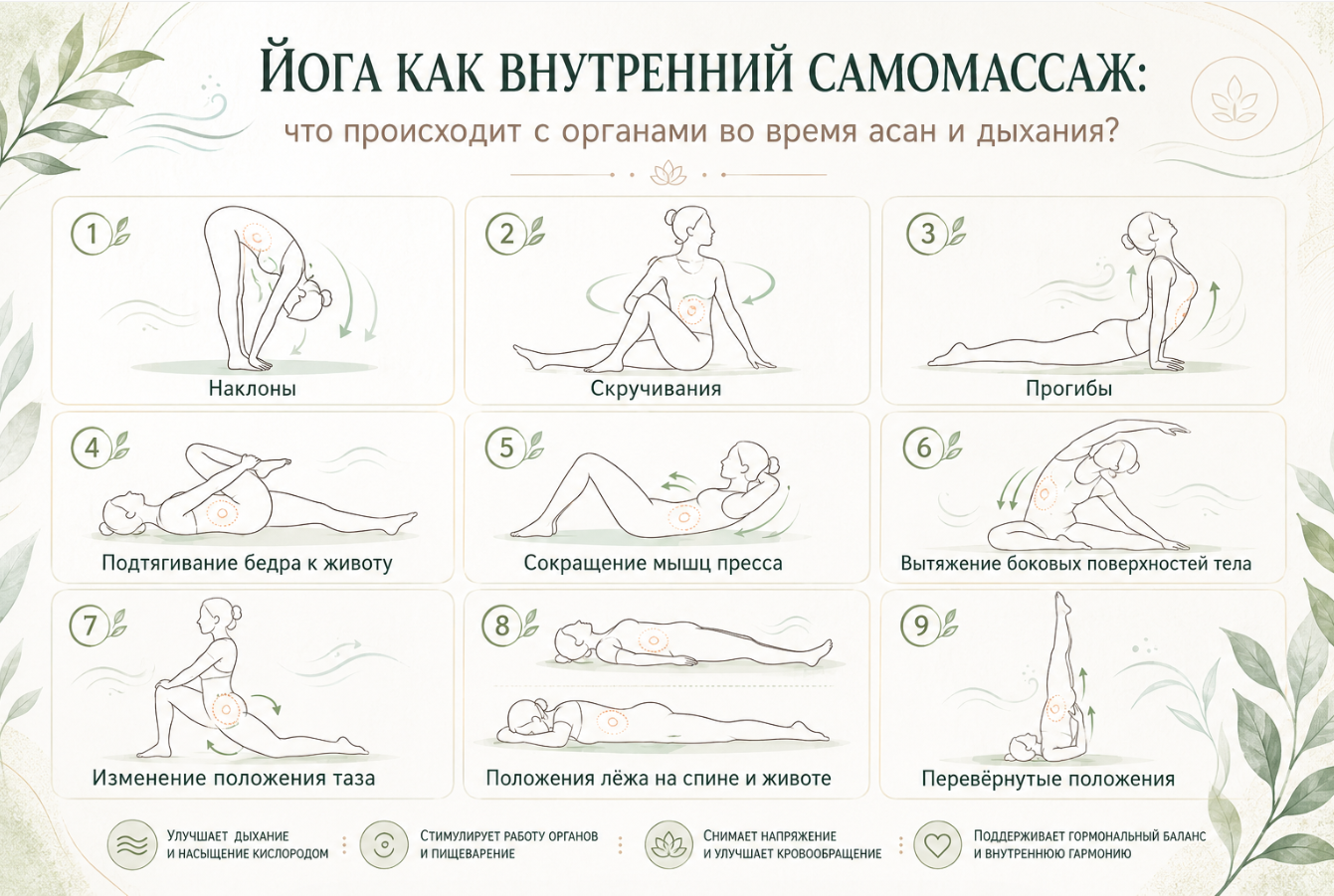
Briefly: what is important to understand
-
Internal organs really do shift slightly with breathing and body movement.
-
The diaphragm creates constant mechanical movement inside the abdomen.
-
Yoga gives the body movements that many people rarely experience in everyday life: deep twists, backbends, compressions, stretches, changes in position relative to gravity.
-
Certain asanas can temporarily change stomach function indicators.
-
Agnisara in a small study increased blood flow in the superior mesenteric artery — one of the main vessels supplying the intestines.
-
Muscle contractions and breathing are connected to lymphatic dynamics.
-
Slow, controlled breathing affects not only mechanically — it is linked to changes in autonomic regulation and stress levels.
-
Therefore, "internal self-massage" is a good metaphor, if not taken literally: yoga makes the body move not only externally but also internally.
Now, in more detail
Internal organs really do move
We are used to noticing what happens outside: the chest turns, the leg lifts, the muscle stretches, the spine changes position.
But movement continues inside as well.
Internal organs constantly shift slightly with breathing and body movement.
This can be measured.
In one ultrasound study of healthy people during calm breathing, the average amplitude of diaphragm movement was about 12 mm, the liver about 10 mm. The kidneys also moved. With deeper breathing, the movement could become significantly more pronounced. [1]
So even when a person is simply sitting calmly and breathing, mechanical movement is constantly happening inside the abdomen.
Now let's add to it:
-
bends;
-
twists;
-
backbends;
-
pulling the thigh towards the abdomen;
-
contracting the abdominal muscles;
-
stretching the lateral surfaces of the body;
-
changing the position of the pelvis;
-
positions lying on the back and stomach;
-
inverted positions.
The mechanical picture becomes significantly more complex.
It is from here that the idea arises "internal self-massage".
Why yoga is especially interesting here
In everyday life, most people use a rather limited set of movements.
We sit.
We stand.
We walk.
We bend down to pick something up.
But how often during an ordinary day do we:
-
deeply rotate the rib cage relative to the pelvis;
-
press the thigh to the abdomen;
-
sequentially arch and stretch different sections of the spine;
-
stretch the lateral surfaces of the body;
-
deeply twist the torso;
-
change the body's position relative to gravity by performing inverted poses;
-
breathe consciously precisely in these positions?
For most people — rarely.
Yoga returns to the body movement variety.
Physical activity is usually measured by the amount of:
calories burned;
kilometers run;
heart rate;
kilograms lifted.
But movement has another dimension:
how diversely the body moves.
Turning to places we almost never turn to.
Stretching what stays practically in one position most of the day.
Contracting one area, then releasing it.
Changing position relative to gravity.
Breathing precisely in this position.
Moving to the opposite.
Tensing up.
Relaxing.
And along with muscles and joints, internal tissues and organs inevitably participate in these changes.
That is why, for regular practice with a variety of movements, you can choose a suitable yoga practice based on your level, time, and goal.
Can this really be called an "internal organ massage"?
As an image — yes. As a literal medical statement — not yet.
To date, there is no quality evidence to say:
"this asana massages the liver";
"this twist massages the kidneys";
"this pose squeezes toxins out of the internal organs."
But behind the image of internal self-massage lie real processes:
-
movement of the diaphragm;
-
displacement of organs;
-
change in body position;
-
muscle contraction;
-
change in pressure inside the abdominal and chest cavities;
-
blood flow;
-
the involvement of muscle movement and breathing in lymphodynamics;
-
changes in nervous regulation.
Therefore, it is more accurate to speak not of "massaging a specific organ," but of a constantly changing mechanical environment inside the body..
Asanas can change stomach function indicators.
In 2025, a randomized study was published involving 68 people with diabetes aged 40–60 years..
One group performed a twenty-minute series of asanas.
The other rested lying down for twenty minutes.
Stomach function was assessed using electrogastrography.
After the series of asanas, researchers recorded changes in the stomach's electrical activity, including an increase in the proportion of normogastric waves compared to the control group. [2]
What does this tell us?
Not:
"any yoga heals the stomach."
More precisely:
a specific sequence of body positions can cause a measurable change in stomach function indicators.
And this is no longer a subjective sensation or traditional explanation.
The change was recorded by an instrument.
Agnisara: a particularly interesting example
Another important finding is related to the technique Agnisara..
This is active work of the anterior abdominal wall performed together with Uddiyana Bandha.
In 12 healthy experienced practitioners, researchers measured blood flow in the superior mesenteric artery — one of the main vessels supplying blood to the intestines — using ultrasound Doppler.
After 100 cycles of Agnisara, the average volumetric blood flow increased approximately:
from 448 ml/min to 590 ml/min.
That is approximately by one third.
The diameter of the vessel also increased. [3]
The study is small — only 12 people.
Therefore, no conclusion can be drawn from it:
"Agnisara improves blood supply to all internal organs."
But another statement can be made:
a specific yogic technique caused an objectively measurable vascular response in the system supplying blood to the intestines.
Why this is especially interesting compared to regular physical exercise
Because intense physical exercise often creates a different response.
When large muscles are actively working, the body needs to direct more blood to them.
As a result, part of the blood flow may be redistributed from the digestive organs to the working muscles.
In a systematic review of 16 studies with 305 participants, in most studies blood flow through the superior mesenteric artery decreased after physical exercise. [4]
In one classic study, after 15 minutes of fairly intense treadmill walking, blood flow through this artery immediately after exercise decreased by about 43%. [5]
And after Agnisara in a small study, the opposite direction of change was observed.
This does not mean:
"Yoga is better than running."
The conclusion is more interesting:
different types of movement create different physiological stimuli.
Yoga is not necessarily just another way to move and burn calories.
One practice can combine:
-
contraction of some muscles;
-
relaxation of others;
-
stretching;
-
compression;
-
change in body position;
-
work of the anterior abdominal wall;
-
breath control;
-
focus of attention.
And the physiological response to such a combination may differ from the body's reaction to running, strength training, or other intense exercise.
And what happens with the lymph?
Here it is important to immediately remove a common simplification.
Sometimes it is said:
"The lymphatic system has no pump of its own, so lymph needs to be propelled."
This is not entirely accurate.
Lymphatic vessels have their own contractile activity.
But the movement of lymph is indeed helped by additional mechanical factors — including contractions of surrounding muscles and pressure changes.
In a study of human skeletal muscles, dynamic and isometric contractions increased the rate of removal of a lymphatic marker from the working muscle by about 3 to 6 times compared to rest. [6]
In 2025, researchers were able to observe the largest lymphatic vessel in the body — the thoracic duct — using high-frequency ultrasound.
After physical exercise, its maximum diameter in participants increased on average by about from 2.69 to 3.41 mm. [7]
This does not mean that "the entire lymph flow of the body increased by so many percent."
But it shows:
movement is accompanied by measurable changes in the lymphatic system.
Therefore, the formulation:
"movement participates in lymphodynamics"
has a sound physiological basis.
As a practical example, YogaJoy offers Yoga 140 for beginners with a focus on lymphatic drainage..
The diaphragm is one of the main internal drivers.
The diaphragm connects several topics of this article at once.
It participates in:
-
breathing;
-
pressure changes;
-
movement of internal organs;
-
interaction between the thoracic and abdominal cavities;
-
partially — lymphodynamics;
-
autonomic regulation.
On inhalation, the diaphragm descends.
On exhalation, it rises.
Along with this, the pressure inside the thoracic and abdominal cavities changes and the internal organs shift slightly.
Therefore, breathing is not only the movement of air through the lungs.
It is also a constant mechanical movement inside the body.
In a 2026 systematic review dedicated to the physiology of the thoracic lymphatic duct, respiratory activity was associated with changes in flow and/or pressure in five out of six human studies. [8]
At the same time, the results of different studies are heterogeneous.
Therefore, it is correct to say:
breathing is one of the factors related to lymphodynamics.
But it is premature to claim:
"deep breathing accelerates lymph flow and cleanses the body."
In yoga, something else is interesting.
It combines at once:
muscle movement + change in body position + diaphragm work + respiratory pressure fluctuations.
This is where the central idea of the article sounds especially accurate:
Yoga makes the body move not only externally but also internally.
Breathing acts not only mechanically.
Breathing has another unique feature.
It happens automatically.
But at the same time, we can consciously change it right now.
We cannot simply command the heart:
"beat slower."
We cannot directly tell the intestines:
"work harder."
But breathing can be made faster or slower, deeper or shallower.
Therefore, it becomes one of the accessible ways to interact with the state of the entire system.
Slow breathing and the autonomic nervous system
The most reliable scientific basis today exists for slow controlled breathing.
Systematic reviews link it to changes in heart rate variability and autonomic regulation, as well as reductions in physiological arousal, anxiety, and subjective stress. [9, 10]
This is also important for digestion.
The functioning of the gastrointestinal tract is closely connected to the autonomic nervous system.
We notice this even without instruments.
Strong excitement — and the appetite disappears.
Stress — and the stomach tightens.
In one person, intestinal activity speeds up, in another — it slows down.
That is, the influence of the practice on our internal state can occur not only through mechanical movement of the abdomen.
There is a second pathway:
nervous regulation.
For such work, you can use breathing practices for relaxation and calming.
And if the main goal is to relieve accumulated tension and switch to a recovery state, you can choose special anti-stress practices.
We analyze the recovery mechanism in more detail in the article "Why Relaxation Is One of the Keys to Youthfulness?".
Not all breathing calms you down
You cannot group all breathing techniques under the principle:
"breathe — calm down."
Different types of breathing create different physiological responses.
Conditionally:
slow breathing is more often used for regulation and calming;
Bhastrika and Kapalabhati belong to more activating techniques;
breath retention is a separate and more intense physiological stimulus.
Studies show that different pranayamas indeed cause different cardiovascular and cerebrovascular reactions. [11, 12]
Therefore, the question is better formulated not as:
"Which breathing is the most beneficial?"
But as:
"What state do we want to achieve and why are we performing this technique?"
Breathing can help to:
-
activate;
-
calm down;
-
focus attention;
-
better feel the body;
-
prepare for meditation.
And what about breath retention?
Here it is especially easy to move from physiology to mythology.
For example:
"the longer the retention, the more beneficial";
"Kumbhaka rejuvenates cells";
"Prolonged breath retention automatically heals the body."
Research does not support this.
But it shows something else:
breath retention is indeed a strong physiological stimulus.
Kumbhaka is breath retention,not a "root lock."
In small studies, Kumbhaka caused significant changes in cerebral hemodynamics and cardiovascular indicators. [11, 12]
And here it is important to distinguish two things:
a strong physiological effect ≠ automatically a beneficial effect.
Therefore, breath retention is a separate technique, not a competition of "who can hold longer."
A simple practice: feeling the movement from within
To feel one of the mechanisms discussed in this article, a complex asana is not needed at all.
Sit or lie down comfortably.
Relax your face and shoulders.
Place your hand on your lower ribs or abdomen.
For a few minutes, simply observe your breath.
Do not try to take in as much air as possible.
Breathe comfortably.
Notice:
-
how the inhale begins;
-
how the lower ribs expand;
-
how the position of the abdomen changes;
-
how the exhale begins;
-
how the movement gradually ends.
If comfortable, you can allow the exhale to become a little softer and longer.
The main task is not to perform the "perfect breath."
But to notice:
breathing happens not only in the lungs. The entire center of the body moves along with it.
For deeper work with relaxation, you can use meditations for relaxation.
What changes when we combine breath and movement?
Movement alone:
-
contracts and stretches muscles;
-
changes joint positions;
-
affects blood circulation;
-
participates in fluid movement.
Breath alone:
-
moves the diaphragm;
-
slightly shifts internal organs;
-
changes pressure in the chest and abdominal cavities;
-
is connected with autonomic regulation.
And during yoga, all of this comes together.
We simultaneously:
move;
breathe;
change the position of the body;
stretch and compress different areas;
tense and relax;
direct attention inward.
It is precisely the combination of movement, breath, and attention that is a distinct and important feature of the practice.
More about this in the article "Yoga, Breath, and Meditation: Why the Combination Is More Effective".
What does this "internal self-massage" ultimately give us?
We won’t say that yoga "heals internal organs" — there is no scientific basis for such a broad claim.
But today we can confidently say something else.
During the practice:
-
the diaphragm moves;
-
internal organs shift slightly;
-
pressure changes inside the chest and abdominal cavities;
-
muscles work and relax;
-
blood flow conditions change;
-
movement and breathing participate in lymphatic dynamics;
-
breathing techniques affect the autonomic nervous system.
Therefore, "internal self-massage" — a good metaphor, if understood not as a massage of a specific liver or kidney, but as a constant alternation of movement, pressure, stretching, contraction, and relaxation inside the body.
And here appears, perhaps, one of the most interesting features of yoga.
We are used to measuring physical activity by quantity: kilometers, calories, pulse, lifted weight.
But movement has another dimension — variety.
Yoga makes us turn, stretch, compress, bend backward, change position relative to gravity, and breathe in these unusual postures.
Perhaps one of the underrated effects of yoga is not that it makes us move more, but that it makes us move more diversely.
And then movement outside truly becomes a way to set in motion what is happening inside.
Sources and research
1. Davies S.C. et al.
Ultrasound quantitation of respiratory organ motion in the upper abdomen.
British Journal of Radiology, 1994.
DOI: 10.1259/0007-1285-67-803-1096.
2. Patil K. et al.
Transient Effect of Specific Yogic Posture on Gastric Motility in Diabetes Mellitus Patients: A Randomized Controlled Trial.
International Journal of Yoga, 2025.
DOI: 10.4103/ijoy.ijoy_256_24.
3. Minvaleev R.S. et al.
Yogic agnisara increases blood flow in the superior mesenteric artery.
Journal of Bodywork and Movement Therapies, 2022.
DOI: 10.1016/j.jbmt.2022.04.004.
4. Knight K.A., Moug S.J., West M.A.
Systematic review: the impact of exercise on mesenteric blood flow and its implication for preoperative rehabilitation.
Techniques in Coloproctology, 2017.
DOI: 10.1007/s10151-017-1589-9.
5. Qamar M.I., Read A.E.
Effects of exercise on mesenteric blood flow in man.
Gut, 1987.
DOI: 10.1136/gut.28.5.583.
6. Havas E. et al.
Lymph flow dynamics in exercising human skeletal muscle as detected by scintography.
Journal of Physiology, 1997.
DOI: 10.1111/j.1469-7793.1997.233bf.x.
7. Shinaoka A., Kimata Y.
Lymphatic flow dynamics under exercise load assessed with thoracic duct ultrasonography.
Scientific Reports, 2025.
DOI: 10.1038/s41598-025-99416-8.
8. Moazzam S. et al.
The physiology of thoracic duct pressure and flow: A review of the literature.
Physiological Reports, 2026.
DOI: 10.14814/phy2.70742.
9. Zaccaro A. et al.
How Breath-Control Can Change Your Life: A Systematic Review on Psycho-Physiological Correlates of Slow Breathing.
Frontiers in Human Neuroscience, 2018.
DOI: 10.3389/fnhum.2018.00353.
10. Fincham G.W. et al.
Effect of breathwork on stress and mental health: A meta-analysis of randomised-controlled trials.
Scientific Reports, 2023.
DOI: 10.1038/s41598-022-27247-y.
11. Nivethitha L. et al.
Cerebrovascular hemodynamics during pranayama techniques.
Journal of Neurosciences in Rural Practice, 2017.
DOI: 10.4103/0976-3147.193532.
12. Nivethitha L., Mooventhan A., Manjunath N.K.
Evaluation of Cardiovascular Functions during the Practice of Different Types of Yogic Breathing Techniques.
International Journal of Yoga, 2021.
DOI: 10.4103/ijoy.IJOY_61_20.