Articles
Shatavari: what it is, properties, and uses
What shatavari is, why it is used in Ayurveda, and what modern research shows: women's health, lactation, menopause, and digestion.
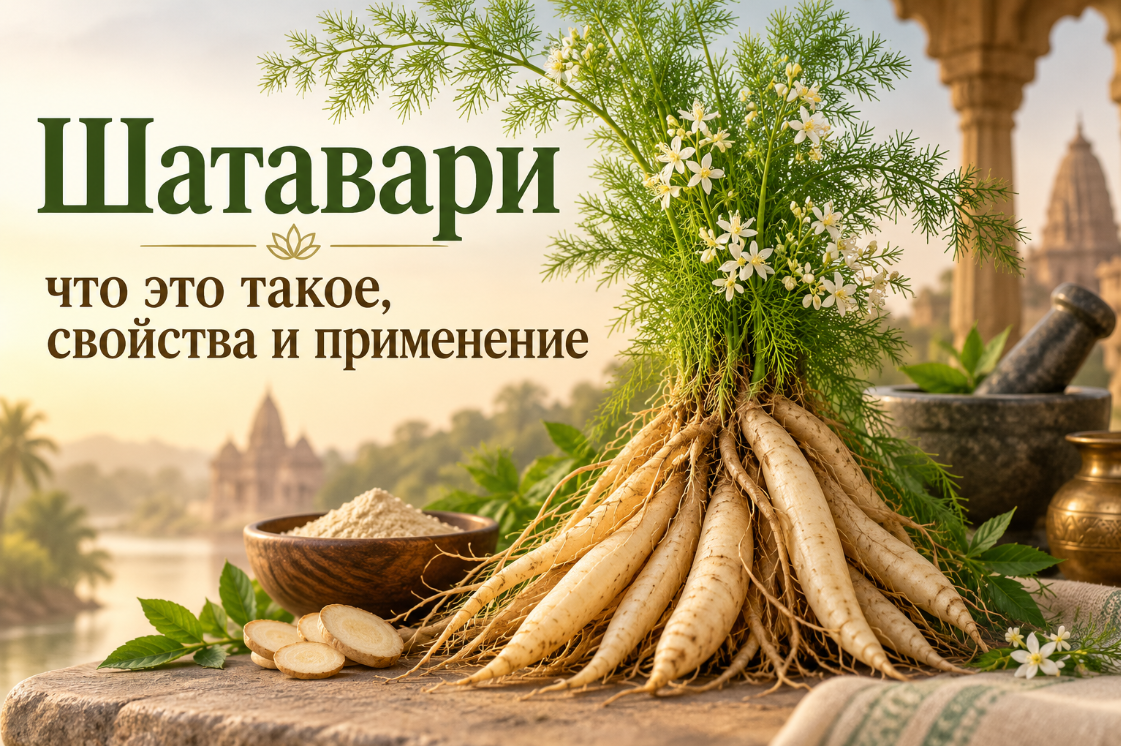
Shatavari is an Indian medicinal plant, botanically named Asparagus racemosus, or Asparagus racemosus. In Ayurveda, mainly its roots are used. For many centuries, Shatavari has been applied as a strengthening and restorative remedy, especially after illness, during exhaustion, and in periods of increased physical stress.
Shatavari gained special fame due to its use for women's health, but its applications go far beyond that. Today, the plant is studied by scientists in India, the USA, the UK, Sri Lanka, and other countries.
If you are interested in specific studies, universities, dosages, and forms of preparations, we have analyzed them in detail in a separate scientific review article "Shatavari in Ayurveda: from ancient texts to modern research."
Why Shatavari is so well-known in Ayurveda
In Ayurveda, Shatavari is classified as a rasayana — a remedy intended for restoring the body, maintaining vitality, preserving youthfulness, and promoting active longevity.
The word “Shatavari” is often translated as "she who has a hundred husbands."This unusual name is associated with the belief in the plant's ability to support female strength, reproductive health, and the body's capacity for restoration.
The Shatavari root is considered cooling, nourishing, and soothing. Therefore, it has traditionally been used for conditions related to exhaustion, dryness, excessive internal heat, and fluid deficiency in the body.
Shatavari and women's health
This is the area for which it is best known today.
In Ayurveda, Shatavari has traditionally been used for:
-
postpartum recovery;
-
supporting breast milk production;
-
certain menstrual cycle disorders;
-
maintaining reproductive function;
-
age-related changes in the female body;
-
supporting sexual health.
Interestingly, some of these ancient uses have today received support from clinical studies..
For example, studies on women show that Shatavari preparations can increase breast milk production.Several studies have noted an increase in milk volume and elevated levels of prolactin — the hormone involved in lactation.
Other modern studies have shown a reduction in hot flashes, sleep disturbances, anxiety, and some other symptoms of menopause..
Shatavari is also being studied for polycystic ovary syndrome — PCOS.Initial clinical studies have reported positive changes in ovarian condition and some other indicators.
Can Shatavari affect sexual function?
This is another interesting area.
In a recent study involving over one hundred women, Shatavari improved certain measures of sexual function and satisfaction with sexual life..
In Ayurvedic tradition, the plant was also used for men. Modern studies on male reproductive function have also yielded interesting results: after using Shatavari root powder, some sperm parameters improved, including sperm concentration and motility.
Research is ongoing, so this topic deserves a separate, detailed discussion.
Shatavari and digestion
Shatavari has traditionally been used for increased acidity, stomach irritation, and ulcer conditions.
Later, this area attracted scientific interest. Studies have shown that preparations from Shatavari root can support the protective layer of the stomach lining and promote its restoration.
This aligns well with the traditional Ayurvedic view of Shatavari as a cooling and soothing agent.
You can read about how movement and breathing are connected to the function of internal organs and digestion in our article "Yoga as an internal self-massage: what happens to the organs during asanas and breathing?".
Not just women's health
Modern research on Shatavari has long gone beyond the reproductive system.
Today, its possible effects on are being studied:
-
the immune system and inflammatory processes;;
-
cell protection from oxidative damage;;
-
memory and the nervous system;;
-
glucose levels and insulin action;;
-
cholesterol and fat metabolism;;
-
the liver and kidneys;;
-
the respiratory tract and cough;;
-
muscle strength and physical performance.;
-
some bacteria and fungi.
Research in some of these areas has already been conducted on humans, while data in other areas have so far been mainly obtained in laboratories and on animals.
Shatavari is even being studied in oncology
There is also a more unusual area of research.
In laboratory experiments, some extracts of shatavari and the substances contained in it inhibited the growth of various tumor cells.
Studies in which shatavari was examined alongside chemotherapy are especially interesting. In animal experiments, preparations from its roots helped partially protect bone marrow and the hematopoietic system from damage caused by certain chemotherapy drugs.
This does not yet mean that shatavari cures cancer or can already be used to ease chemotherapy in humans. But the results are interesting enough to continue research in this area.
What is contained in shatavari
Many biologically active substances have been found in the roots.
Of particular interest are shatavarins — a group of natural compounds classified as steroidal saponins.
The word "steroidal" here does not mean that the plant contains human hormones. It refers to the chemical structure of these substances.
It is shatavarins that are currently being actively studied as one of the possible reasons for the biological activity of shatavari root.
How safe is shatavari
Shatavari has been used in India for a very long time, and modern clinical studies allow for additional assessment of its tolerability.
In human trials, the studied shatavari preparations were generally well tolerated, and serious adverse effects were not noted in most of these studies.
At the same time, different preparations can vary greatly: some use ordinary root powder, others use concentrated and standardized extracts. Therefore, the results of a specific study apply specifically to the form of the preparation used in it.
What we know today
Shatavari is a good example of how an ancient medical tradition gradually meets modern science.
Ayurveda has used this plant for many centuries to restore strength, maintain youthfulness, reproductive health, lactation, and digestion.
Today, some of these properties are already being tested in human studies. Especially interesting results have been obtained regarding lactation, menopause symptoms, female sexual function, PCOS, and male reproductive function.
Other properties of shatavari are still at an earlier stage of study, but laboratory and experimental research is opening up new directions.
Therefore, the story of shatavari today is no longer limited to ancient Ayurvedic texts. This plant is gradually becoming the subject of modern scientific research — and judging by the number of new studies in recent years, interest in it is only growing.
A detailed review of studies, universities, preparations, and scientific results can be read in our comprehensive article "Shatavari in Ayurveda: from ancient texts to modern research."